It’s Been an Odd Day…

 Today – Remembrance Day – has been a day when we paid homage to so many who gave their lives in past wars. A day that must have brought back memories for many. It has for me.

It’s eight years since my mother died. My sister arranged the funeral for eleven o’clock today. Eleven o’clock, on the eleven day of the year – perhaps no one else wanted that time or day – I was never told.

This is a post I wrote shortly afterwards. The relationship between Mum and me, and the one between her and my sister, proved so very different. There’s nothing wrong in that, but at no time was it more obvious than on that day…

I wrote… 

Last week I was at my mother’s funeral. I say at because I felt it was a funeral I was a spectator to, not part of.

During the service I realised something strange. Being the eldest, and living nearer to Mum than me,  my sister had insisted on organising the whole thing. It was a Humanist service which was fine; my mother had no beliefs.

But what was odd, was that what my sister had written about my mother was totally unlike the mum I knew. And I wonder if that is something all siblings share; a different view of the characters of their parents.

The mother my sister saw was a woman who liked poetry. So there were three poems in the service. I’ve never once seen my mother read poetry although she did like to misquote two lines from ‘ What is this life if, full of care…’

The mum I knew read and enjoyed what she herself called ‘trashy books.’ They weren’t, but she did love a romance and the odd ‘Northern-themed’ novels. (I’m always glad she was able to enjoy the first book of my trilogy – dementia had claimed her by the time the next two were published) She still managed a smiling grumble, though, telling me it had  taken me ‘long enough to get a book out there’) And she loved reading anything about the history of Yorkshire and Lancashire. Oh, and recipe books… she had dozens of recipe books and could pour over them for hours. I often challenged her to make something from them. She never did… it was a shared joke.

Mum had a beautiful singing voice in her younger days.  She and my father would sing duets together. Anybody remember Pearl Carr and Teddy Johnson?  My parents knew all their songs. And so did my sister and I… I thought. The songs and singers chosen were not ones I remembered. And Mum loved brass bands! She’d have loved to have gone out to a rousing piece from a brass band, preferably the local band. She loved everything about the area and the house she’d live in for almost sixty years

Which brings me to the main gist of the service. No mention of Mum’s love of nature, of gardening, of walking. Nothing about Mum’s sense of humour; often rude, always hilarious. When telling a tale she had no compunction about swearing if it fitted the story. And her ability to mimic, together with her timing, was impeccable. She was smart, walking as upright in her later years as she had when in the ATS as a young woman, during the Second World War. She worked hard all her life;  as a winder in a cotton mill, later as a carer, sometimes as a cleaner. Throughout the service there was no inkling of the proud Northern woman willing to turn her hand to any job as long as it paid. No mention of her as a loyal wife to a difficult man.

Thinking about it on the way home I realised that my sister had seen none of what I’d known and I knew nothing of what she’d seen in Mum. And then I thought, perhaps as we were such dissimilar daughters to her, Mum became a different mother to each of us? Hence the completely opposite funeral to the one I would have arranged for her.

Is that the answer? A funeral is a public service. Are they all edited, eased into the acceptable, the correct way to be presented for public consumption? Because it reflects on those left behind? I don’t know.

Perhaps, unless we’ve had the foresight to set out the plan for our own funerals, this will  always be the case.

So I’d like it on record that, at my funeral,  I’d like Unforgettable by Nat King Cole (modest as always!), a reading of Jenny Joseph’s When I Am Old (yes, I do know it’s been performed to death but won’t that be appropriate?). I’d like anybody who wants to say anything…yes anything…about me to be able to…as long as it’s true, of course! And then I’d like the curtains closed on me to Swan Lake’Dance of the Little Swans. (Because this was the first record bought for me by my favourite aunt when I was ten. And because, although as a child I dreamt of being a ballet dancer, the actual size and shape of me has since prevented it.)

Thank you for reading this. I do hope I haven’t offended (or, even worse, bored) anyone. I was tempted to put this under the category ‘Fantasy’ but thought better of it!

And, today, I’ve also had thoughts of my grandad. Like do many young men he served in WW1

This is a post from quite a while ago, as well. Today was the day my grandad died. I never really knew him. He was always in bed in the front room of my grandmother’s house and had no patience for a small child. But I do remember that day: my mother crying, the fear of not knowing why, what had happened. Of not knowing what to do.

And I have only one small black and white photograph of him on my study wall. He’s standing in the backyard of the terraced house they lived in in Oldham. Lancashire. This is a poem I wrote about him a long time ago. My mother once told me that he was gassed in WW1 and never recovered.

My Grandad

I look at the photograph.

He smiles,and silently

he tells me

his story…

In my backyard I stand,

Hands wrapped around a mug of tea.

Shirt sleeves, rolled back,

Reveal tattoos – slack muscles.

I grin.

All teeth.

Who cares that they’re more black

Than white.

Underneath

That’s my life.

That’s the grin I learned

When burned

By poison

Spreading

Like wild garlic.

That’s the grin I wear

When I look

But don’t see

The dark oil glistening,

Blistering, inside me.

When I hear, but don’t listen

To my lungs closing.

I posture,

Braces fastened for the photo,

Chest puffed out.

Nothing touches me –

Now.

Later I cough my guts up –

Chuck up.

I trod on corpses: dead horses,

Blown up in a field

Where grass had yielded

To strong yellow nashers.

And in the pastures

I shat myself.

But smelled no worse

Than my mate, Henry, next to me

Whose head grinned down from the parapet –

Ten yards away.

He has perfect, white teeth.

Much good they’ve done him,

Except for that last night at home

When the girl smiled back.

It feels right that I post the images below – if it wasn’t for my mother and grandad, I probably wouldn’t have had the inspiration to write these books.
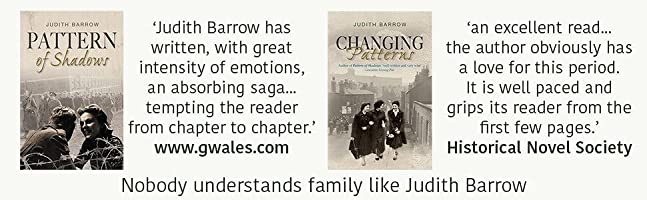
A Wonderful Review from LoveReading for my next book, published by Honno

Grateful for this review from https://www.lovereading.co.uk/

“This gripping story of harrowing behind-closed-doors coercion has tremendous emotional pull.”

LoveReading Says

Domestic thriller fiction at its most heart-wrenching, Judith Barrow’s The Stranger in My House is also utterly un-put-down-able — readers will be desperate for a family broken by cruel coercive control to be reunited.

The novel opens in 1967 when twins Charlie and Chloe are introduced to their “new mummy” Lynne while they’re still bereft at losing their mother to cancer. Early on, Lynne’s behaviour causes alarms bells to ring for the twins — and readers — which only adds to the mounting tension and fear of where things are going, with their father, Graham, vulnerable to emotional manipulation, rendered powerless to do anything to stop his life from careering out of control, which it does at alarming speed.

Before Graham can catch his breath, he’s lost everything, as have his children, who are separated from their father and each other, while Lynne and her bully of a son continue their campaign of cruelty.

Years later, the twins are living separate lives in different parts of the country, both scarred but their hearts lifted by kind souls. And then comes a race-against-time to find each other and save their dad.

Though weighty and harrowing in subject, The Stranger in My House is grippingly easy-to-read in delivery, which makes it a powerful page-turner that will have fans of family drama thrillers reading long after they’d planned to turn out the lights.

Joanne Owen

Books of the Month

Find This Book In

Primary GenreCrime and Mystery
Recommendations:Books of the Month

£9.99 £8.99

This title will be released on 14/11/2024. Pre-order now.

Add To Wishlist

Buy from our bookstore and 25% of the cover price will be given to a school of your choice to buy more books. *15% of eBooks.

Collections Featuring This Book

Best Domestic Noir Novels – 30+ Brilliant Books about Household Horrors and Domestic Just Desserts.

https://www.lovereading.co.uk/book/9781916821224/isbn/The-Stranger-in-My-House-by-Judith-Barrow.html?awc=30897_1730738102_df174f2c9bf111ec6852167c1371767c

Honno’s Story

Honno is an independent co-operative press run by women and committed to bringing you the best in Welsh women’s writing.

It was established in 1986 by a determined group of volunteers who wanted to increase the opportunities for Welsh women in publishing and bring Welsh women’s literature to a wider public. They asked the people of Wales to show their support for the new enterprise by becoming shareholders in the cooperative and in the first six months more than 400 people bought shares. Honno continues to be supported by hundreds of individual shareholders who believe in its work.

​True to its roots the press still only publishes work by women of Wales. Most of Honno’s titles are novels, autobiographies and short story anthologies in English as well as Classics in both Welsh and English. We have in the past also published poetry, children’s and teenage titles and books in both Welsh and English.

Over the years the Press and its titles have been awarded many prizes.

​It is guided by the Honno Committee of volunteers who set the strategic direction of the Press, decide the publishing programme and manage the office and staff. The Honno office is located in the mid-Wales coastal town of Aberystwyth.

​Honno receives financial support from the Books Council for Wales.

Trust and Secrets: The two things in families that make or break the familial bond.

Trust is the one thing that families should be able to take for granted. Trust born from love, from the belief that each member knows the other because they have lived together, seen the weakness and strength of each other. Having faith in each other means there is trust in theirselves, in their judgements, in the confidence that they are implicitly correct in that conclusion. But of course trusting can be the automatic option, the unquestionable. It also avoids any confrontation between siblings, parents, relatives. It means that every one can get on with their lives, not having to think too hard about the actions of everyone else in the family. It’s taken for granted that each believes whatever they are told. Don’t question. In turn it’s accepted that each can also reveal whatever they want to disclose about themselves, their thoughts, their actions. And take for granted that they are believed.

There is only one problem with that premise. Everyone is alone in their heads. No one (whatever anyone believes to the opposite) can read minds. What we present to the world, the façade we choose to show is our decision.

 And that is where the secrecy comes in. Although it’s undeniable that every family has its secrets, it’s the substance of them that count. Of course secrets can also be trivial, small, kept in a loving way (a celebratory surprise, a present) or as a kindness, hiding something that is better kept under wraps if the person keeping it believes that.

On the other hand, harrowing, life-changing secrets can damage an entire family for some time. Even forever. Those kinds of secrets break that instinctive trust, that belief that those closest to us, who we love and respect, are truthful. Are not lying.

Families can be complicated. That’s an obvious statement. And where there are families with secrets, there are stories. And these are the stories that are at the root of all my books.

Links:

The Stranger in my House

The Memory

Sisters:

Social Media links

https://judithbarrowblog.com/


https://twitter.com/judithbarrow77


https://www.facebook.com/judith.barrow.3


https://www.honno.co.uk/authors/judith-barrow

https://www.bookbub.com/profile/judith-barrow

Our Past Shapes Our Present And Our Future. (Whether We Like That Or Not) #BOTY2021 #memories #secrets #TheMemory #ThursdayThrowback @honno

Seeing the results of the Wales Book of the Year Award 2024, and reading one or two of the books of the shortlisted authors over the last month, brought back memories of 2021 when I was nominated for the Literature Wales Book of the Year Award. It still feels strange.

The Memory was published around the first week of the first lockdown and I thought it became lost in all the disruption and anxiety of the pandemic. So, when I first heard that the book was being nominated, it was a complete surprise. Naturally I was also thrilled because, at that time,The Memory was so different from my first four novels, which are historical family sagas. And I wasn’t sure how it would be received by the readers who had enjoyed those books. So, to be recognised by Literature Wales for the Wales Book of the Year Award 2021, The Rhys Davies Trust Fiction Award, was a great accolade for me.

I believe we are all affected by our pasts; experiences that shape our present and future. And, as writers, memories feed our stories. Families fascinate me: the love, the loyalties, the rivalry, the complex relationships. Layers that are in all families. The casual acceptance of one another in a family can bring the best and the worst out in all of us, so there is a wealth of human emotions to work with. This is how The Memory evolved. A little of the background comes from a time when I was a carer for my aunt who lived with us. She developed dementia and I kept a journal so we could talk about what we’d done each day. Many years after she’d died, some of those recollections crept into The Memory. And then there are the memories from my childhood, when I had a friend who was a Downs Syndrome child. The affection she gave, the happiness that seemed to surround her, is something I remembered long after she died of heart failure at the age of eleven. And I wanted that love to be a huge part of the book, a main theme. Fundamentally it’s the story of a secret that is never discussed within a family, but which has had a profound lifelong effect on the relationship between the mother and daughter. The Memory is sometimes poignant, sometimes sad, but is threaded throughout with humour.

Reviews for The Memory:

“… As a reader, when a character becomes as completely real to me as Irene does, I often find myself wondering what happened next for her. But Irene’s story is so perfectly and elegantly resolved that I know without a shade of doubt what her future holds.The Memory is not a comfortable or easy read. But if you’re looking for a beautifully written, character-driven story with a dark base but superb resolution, it just might be the perfect choice.”

” …The writing is what I’ve come to expect from Judith Barrow. The effortless prose brings a fresh quality to the mundane and familiar.
There’s also a building menace to the book and a sense of foreboding that drives you on right to the surprising end.
The Memory is a remarkable book and I wholeheartedly recommend it.”

When The Memory was shortlisted for the Wales Book of the Year Award in 2021 I was also pleased for Honno. I’d been published by them for many years and I believe it also gave them some much deserved recognition.

And I’m thrilled that Honno will be publishing my eighth book with them in November.

The Stranger in My House.

After the death of their mum, twins Chloe and Charlie are shocked when their dad introduces Lynne as their ‘new mummy’. Lynne, a district nurse, is trusted in the community, but the twins can see her kind smile doesn’t meet her eyes. In the months that follow they suffer the torment Lynne brings to their house as she stops at nothing in her need to be in control.

Betrayed, separated and alone, the twins struggle to build new lives as adults, but will they find happiness or repeat past mistakes? Will they discover Lynne’s secret plans for their father? Will they find each other in time?

The Stranger in My House is a gripping ‘cuckoo in the nest’ domestic thriller, exploring how coercive control can tear a family apart. Set in Yorkshire and Cardiff, from the 60s to the winter of discontent, The Stranger in My House dramatises both the cruelty and the love families hide behind closed doors.

“Judith Barrow’s greatest strength is her understanding of her characters and the time.” TerryTyler