
We’ve just returned from a wonderful couple of weeks on Arran. The photographer sourced the walks for us. Today he promises a short outing because it’s rather warm; “maybe a couple of hours allowing for stops… for Dusk, our borrowed border collie, of course”. (Oh, not for photographs then?).
We are going to one of the most famous waterfalls on Arran, Glenashdale Falls, and then on to see the Giants’ Graves.
We follow the directions from a rather old book of walks, which immediately adds a couple of miles on by sending us along a wide rather rough road, instead of going to the end of Whiting Bay and turning onto the forestry track.
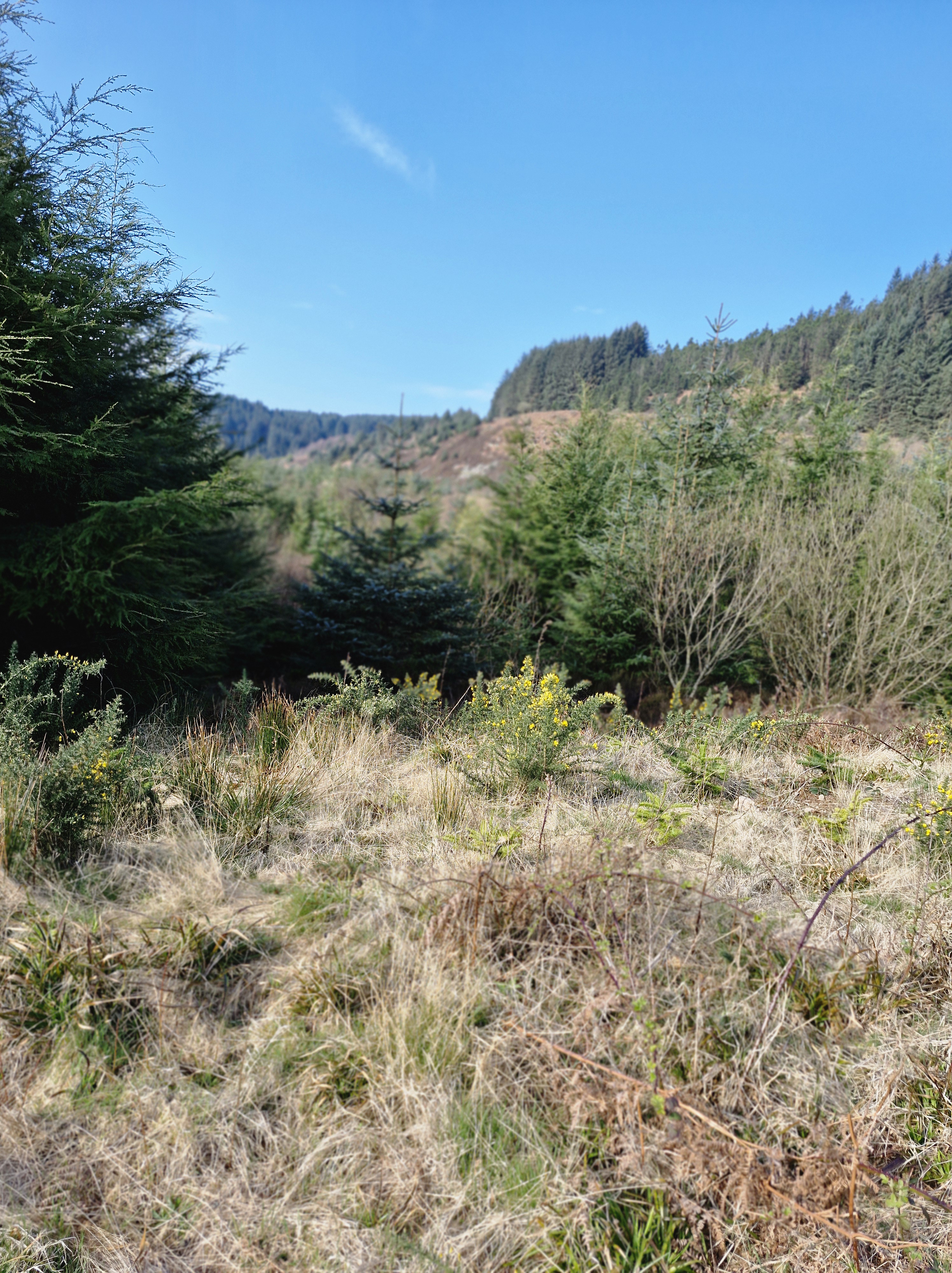

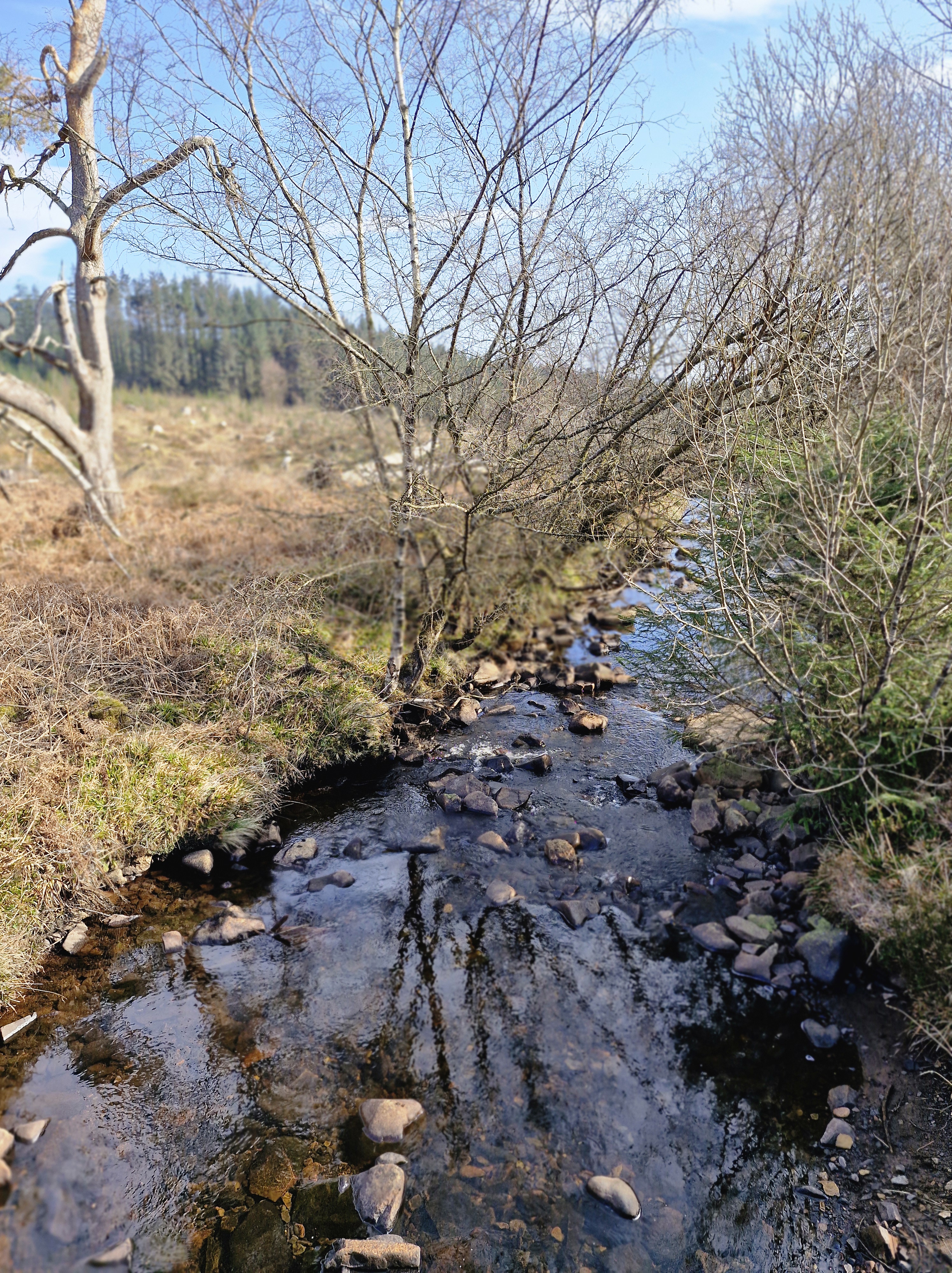
Though I have to admit we passed some peaceful scenic views.
We were unable to follow the path through the forest to the Iron Fort due to the damage and fallen trees, caused by the latest storm on the island. So we continued along the wide track for another mile.
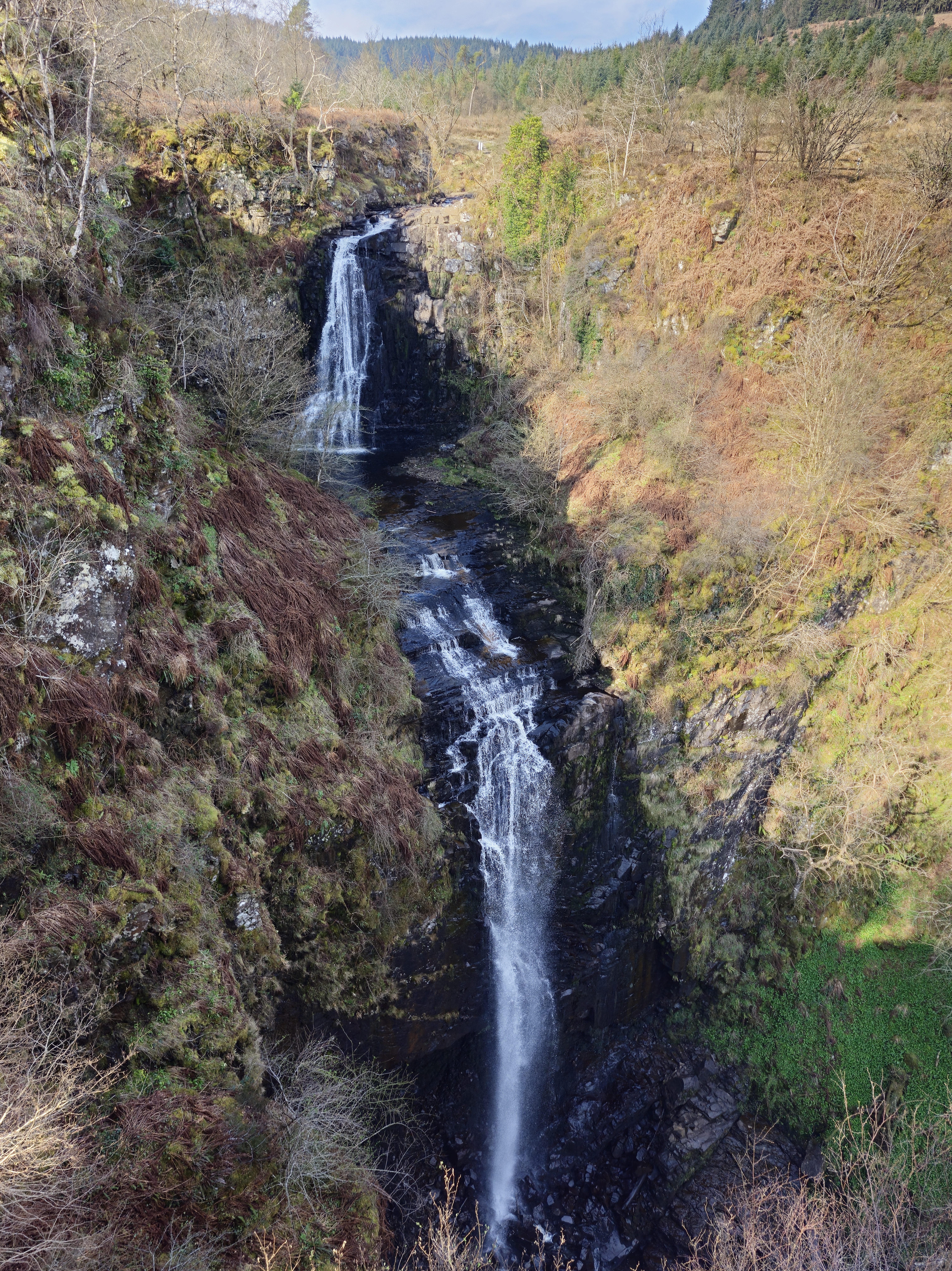
We reached Glenashdale Falls, also known as Eas a’ Chrannaig, one of a series of falls on the Glenashdale Burn, which flows from moorland near the summit of Tighvein eastwards towards Whiting Bay.


The viewing platform – not for anyone scared of heights

Not sure why I was encouraged to go along the viewing platform first. Thinking about it, my walking companions may have thought I was heavier than the two of them put together…
The sound of the rushing water competes with the breeze rustling through the trees around us. It’s a magnificent, awe inspiring place.

We retraced our steps from the waterfall and turned left, following a sign to the Giant’s Graves along the wide track … for another mile.

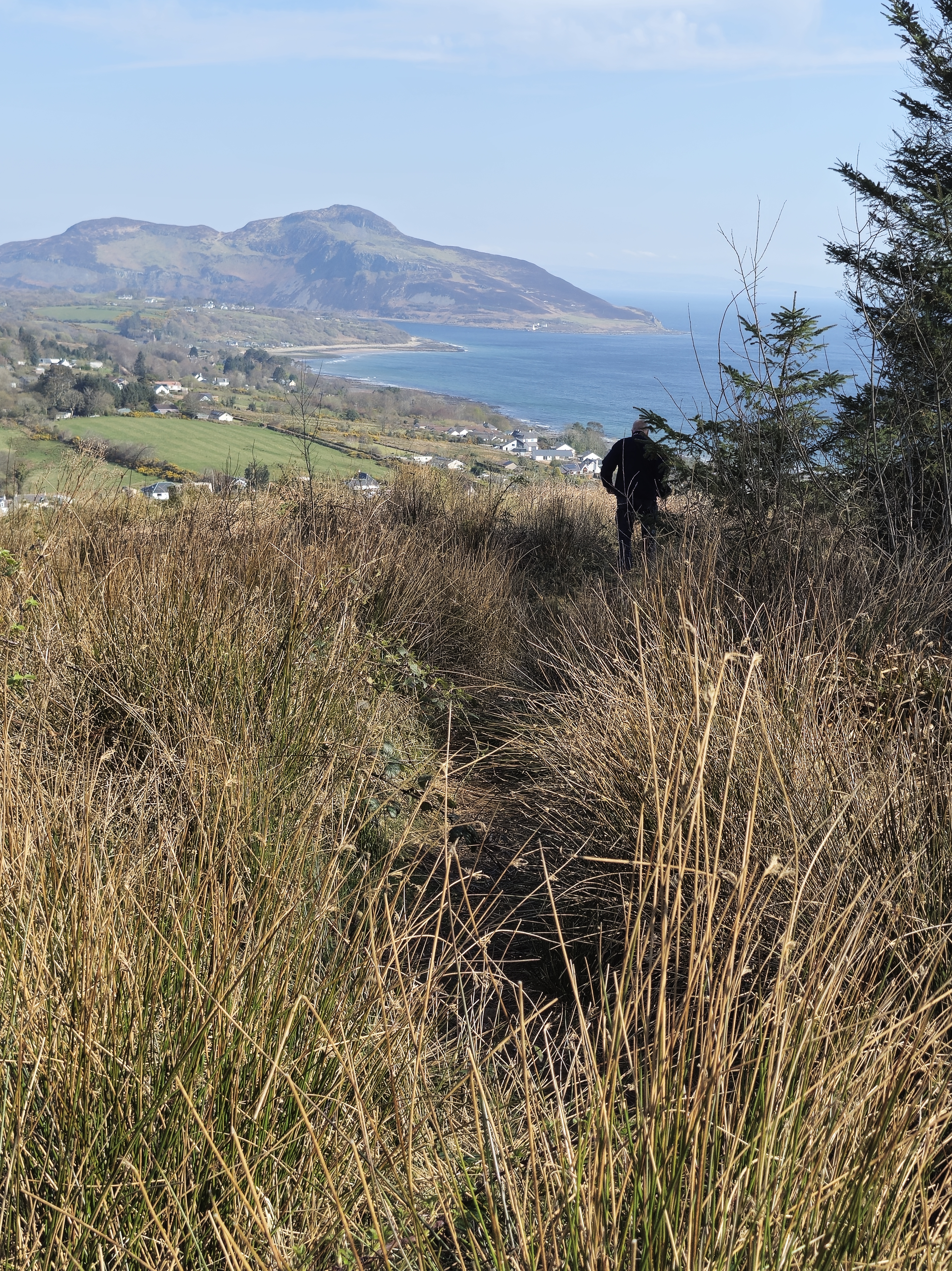
The Photographer trudges through tall grass to the edge of the cliff to take pictures. At one point he disappears completely. Dusk and I wait – patiently – he’s done this disappearing act many times in the past, just to get a good shot of somewhere.
When he returns we walk on, until a sign for a narrow path informs us we’re almost at the site of the Giants’ Graves.


The Giants’ Graves are the remains of two Neolithic chambered tombs on the Isle of Arran in Scotland on a ridge one hundred and twenty metres above the sea and overlooking Whiting Bay to the south. Mostly ruined, with turf covering part of the remains, they still have an air of mystery standing proud in a clearing in the forest.
The North cairn, excavated in 1902, has a chamber that is six metres long, and is around one metre wide. Among the artifacts recovered were pottery shards, flint knives, and leaf-shaped arrowheads.
The South Giant’s Grave has a chamber about four metres long, and over one metre wide. The initial excavations in 1902 only revealed soil and stones, but in 1961/2 more exploration produced nine shards of a round-based vessel, and fragments of burnt bone.
Legend has it that the giant referred to is Fionn mac Cumhaill, an early Irish war-leader, and his followers, known as the Fianna. Between the 10th and 14th centuries, his legend became widely known in Scotland. According to legend, Fionn and the Fianna had superhuman strength and size, being as much as 500 times larger than a man.
It’s getting late; we need to get back to Whiting Bay.


Beyond the graves the narrow path winds its way steeply down. And one of the rare times the Photographer catches me unawares for a photograph … from behind!
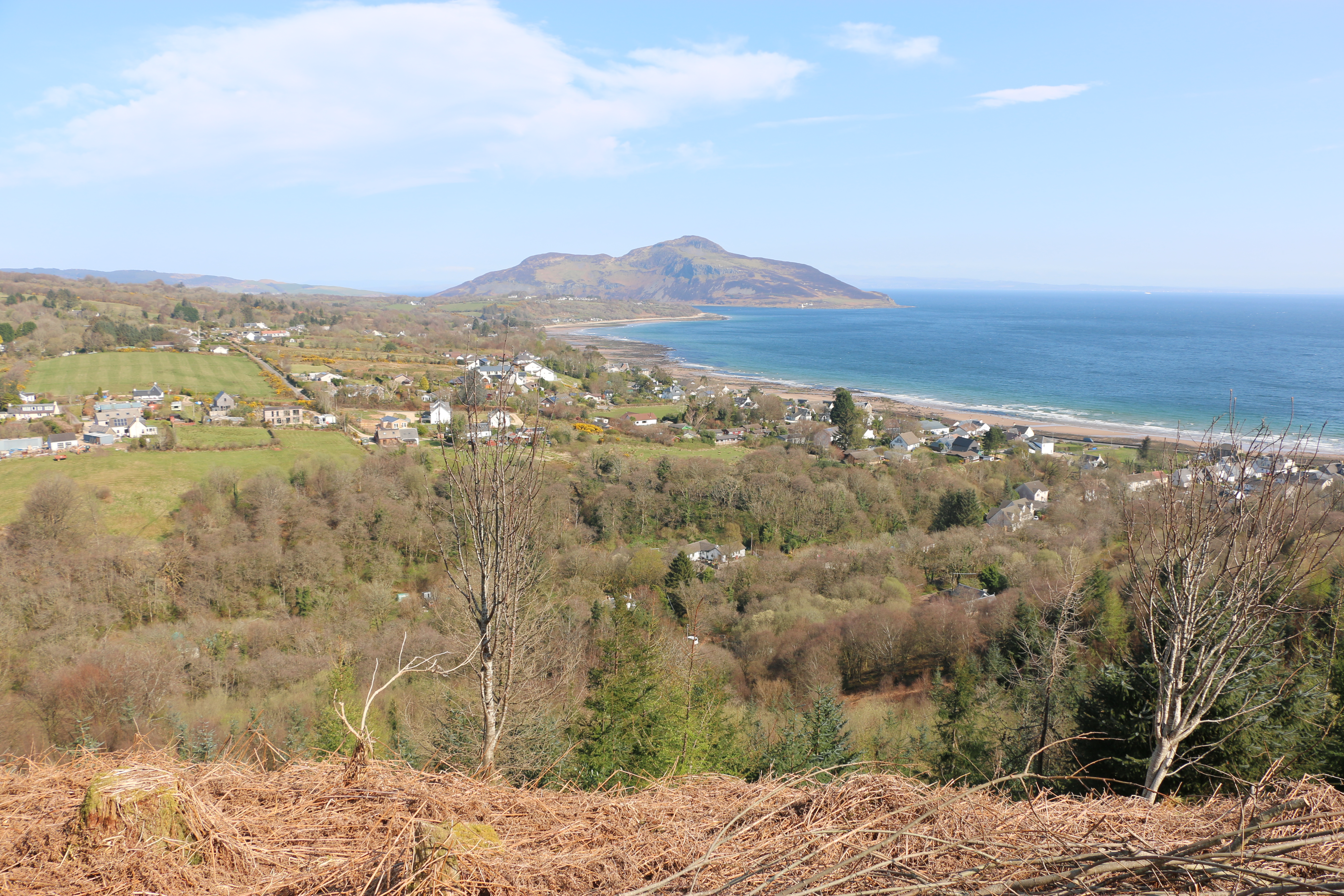
One last photo – Whiting Bay, with Holy Island in the distance.
The walk took us just a little more than the two hours that the more up-to-date directions we later discovered, so the following day we had a rest (using Dusk as our excuse again!) before our next adventure – a coastal trek as far as Kingscross Point, stopping to photograph the ruins of a viking fort and the views of Holy Island, before continuing back to Whiting Bay.
The Holy Island or Holy Isle is an island in the Firth of Clyde, off the west coast of central Scotland, inside Lamlash Bay on the larger Isle of Arran. The island is around three kilometres long and around one kilometre wide. Its highest point is the hill Mullach Mòr. There will be more about the Holy Island in our next post of walking on Arran.
And now a little self indulgent promotion…

A gripping ‘cuckoo in the nest’ domestic thriller
After the death of their mum, twins Chloe and Charlie are shocked when their dad introduces Lynne as their ‘new mummy’. Lynne, a district nurse, is trusted in the community, but the twins can see her kind smile doesn’t meet her eyes. In the months that follow they suffer the torment Lynne brings to their house as she stops at nothing in her need to be in control.
Betrayed, separated and alone, the twins struggle to build new lives as adults, but will they find happiness or repeat past mistakes? Will they discover Lynne’s secret plans for their father? Will they find each other in time?
The Stranger in My House is a gripping ‘cuckoo in the nest’ domestic thriller, exploring how coercive control can tear a family apart. Set in Yorkshire and Cardiff, from the 60s to the winter of discontent, The Stranger in My House dramatises both the cruelty and the love families hide behind closed doors.
“Judith Barrow’s greatest strength is her understanding of her characters and the times in which they live.” Terry Tyler
Grateful for this reader’s review. One of the first for The Stranger in my House, when it was published in November 2024.
“The Stranger in my House is an urgently compelling story of abusive power, detailing the damage that happens when those with the power to protect vulnerable children choose to turn their eyes away. Judith Barrow takes us into the dark & haunted world of coercive control, masterfully turning her own power as a storyteller on to this troubling theme, exploring it with insight & sensitivity.
In Lynne, the author has created a monster. Her victims, twin children Chloe & Charlie & their hapless father, are each portrayed with Judith Barrow’s usual precision & humanity; the writing as always, is impeccable.
It is a troubling book, but ultimately, on some level, redemptive. And although I found the ending satisfying & honest, I was nevertheless left with a sense of sadness, not only for Chloe & Charlie, but because decades on from the events in this book we still exist in a world where the emotional needs of children are too often subsumed by those of selfish, self-serving, abusive adults.
The Stranger in my House is a hugely important book & I highly recommend it.“
 Judith Barrow