Where We Walked #Llyn Crafnant and LlynGeirionydd #Wales #walks #climbs #photographs #stiles #humour #holidays #Sisters #books #readers @honno

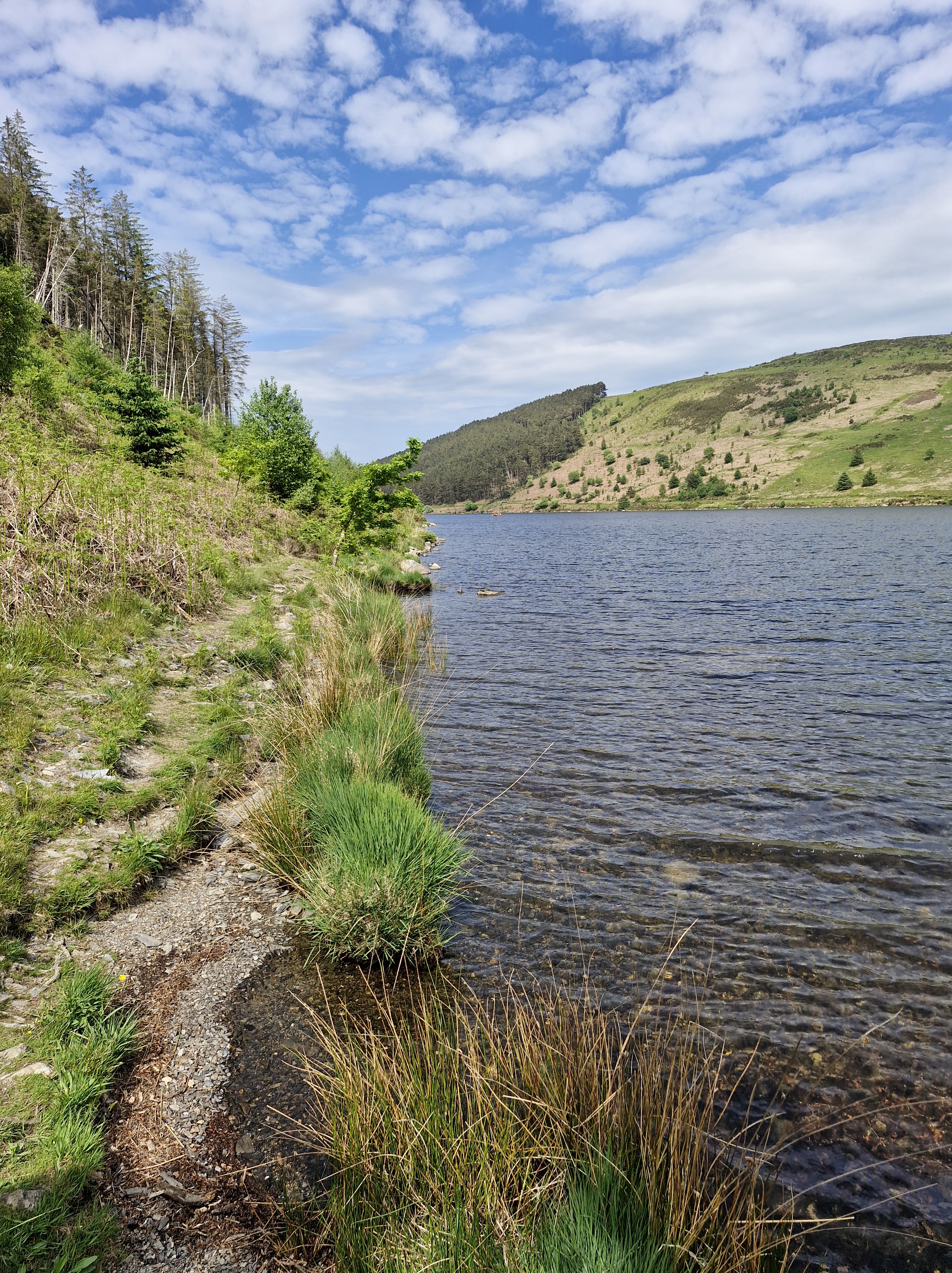
Llyn Crafnant and LlynGeirionydd are separated by the forested slopes of Mynydd Deulyn (Mountain of the Two Lakes) and lie within wonderfully scenic valleys where the Gwydyr forest meets the lower slopes of the Carneddau mountains in Conwy.”The lakes are about a mile apart,” said the photographer casually. “The walk’s about five miles.” What actually happened was that we took the circular route which covers a distance of eight miles and involved some steep climbing.

But, at this point I have to say that wasn’t his fault. We ended up – or should I say – started off walking in the opposite way to the route in the book, having parked in the car park near LlynGeirionydd, instead of the one near Llyn Crafnant.

This was due to the fact that, at one point, the SatNav took us in the wrong direction. It’s always the SatNavs fault, you know; we once got stuck on a very narrow dirt farm track faced with a sign that joyfully said in large red writing, ” Use your eyes, the SatNav lies”. I think I might have said that before, it’s something I bear in mind when sitting by a certain irate driver having to turn back on a journey.

Anyway, I thought, it’ll be alright; we’ll just read the directions backwards.

I waited on the edge of the grass while the photographer took his first photo of Llyn Geirionydd.

Gwydir Forest is named after the Gwydir River, which takes its name from the ancient Gwydir Estate, established by the John Wynn family of Gwydir Castle, who owned this area (Gwydir is translated as River with Red Banks) The land here was once dominated by lead and zinc mines. Some of the mines have been partially restored and made safe for visitors, but we didn’t visit; our sights were set on getting to Llyn Crafnant Though we did pass an old restored engine-house, and also the waste tips, now left to be naturally covered over.

The First World War had highlighted a shortage in wood production and the forest was stripped bare at the time because many of the early forestry workers, former employees in the forest’s mines, had no experience of forestry. This caused the 1919 Forestry Act to be passed and Gwydir Forest was acquired from Lord Ancaster by the Forestry Commission in 1921.

Most of the original plantations have now been felled and replanted as part of the forestry cycle. We passed quite a few places where this was happening.

The majority of the forest is conifer such as Japanese larch, Norway spruce and Scots pine but apparently, over the last two decades there has been more Welsh Oak, ash and beech planted to give a more varied and softer outline to the forest

“When we get to the top of this track, there’s a little bit of a short climb and the track narrows a bit,” said the Photographer over his shoulder as I puffed and panted behind him. ” Don’t worry, it’ll be so worth it for the view.’

The track did narrow a bit indeed. As the directions said, ‘…into a steep narrow footpath, less than forty centimetres wide (that’s about sixteen inches in old money) in some places, on an unmade and uneven surface, where you can expect mud, rocks and tree roots.‘. The embarrassing thing is, just as I was wobbling leaping gazelle-like from rock to another a young couple (stressing young here!) ran past… with a dog … very quickly. And they even had the breath to wish us a cheerful “good morning.”

Every now and then we caught glimpses of the view. Went past a stile. Down a wider path. Through a gate. Saw the obligatory cow. And then…

The Photographer got his first proper shot of Llyn Crafnant on the northern edge of the Gwydir Forest.

And then lots more. It really is a glorious place

One last look and we walked away from Llyn Crafnant …

Following the arrows we crossed over the road into a small wooded area. And there the arrows stopped. We looked around: there was a stile in the far corner, but it was broken, covered in brambles and branches and looked unused. On the other side of the clearing there was a broad track. After some discussion we chose the track. (later realising we should have tackled the stile).

After an hour of walking up the never-ending road we stopped for breath, and for the Photographer to revell in the scenery and take many photos of the craggy slopes of Mynydd Deulyn.

And for me to have a rest. It wasn’t until we got back to the car that I realised I had somehow managed to take the attractive shot below whilst I was rummaging in my rucksack for the fourth, and last, bottle of water. Naming no names, but someone dared me to include this in the post – and I’m never one to pass on a dare. Which is probably the reason I find myself on these hikes walks.

Another hour of uphill, round a bend, and the road began to descend, until we were …

Back to the start…

I’m often asked what do I think about when I’m walking and with not enough breath to talk. I must say not having enough breath to talk isn’t something that often happens to me. But usually I’m taking in what’s all around us. We walk in so many diifferent kinds of places, so I just soak up the sights and the sounds whether in the country or in more urban areas.

But there are times when I’m thinking how to describe what I’m seeing, wondering if it will fit into a scene in the book I’m currently working on – or intend to work on. Sometimes it will, sometimes it won’t. It’s usually the latter, but that’s okay. And if I can keep it in mind for when we next stop for the Photographer to capture the scenary, I’ll make notes.

And there have been occasions when I can use those notes. One day we were nearing the end of our walk at Llyn y Fan Fach and Llyn y Fan Fawr near Llanddeusant in Carmarthenshire, Wales. It had been long, so the sun was low in the sky and it felt quite erie as we took a last look out over the water.

And I remembered that moment, that feeling of almost sinister atmosphere when I wrote one of the scenes in Sisters.

“‘Whoops! Watch your step, Miss Clumsy.’ Said in a jokey manner, it still manages to imply the familiar censure. ‘If it wasn’t for me always looking out for you, I don’t know what you’d do.’ He laughs. ‘Probably kill yourself, one of these days.’ He pulls her close, turns her so they are facing the lake, standing on the edge of the steep banking.
The sun is sinking lower in the sky, the black shadows of the trees lengthen, their reflection stretch and waver over the lake, the water rendered blood-red.

Book Description:

An accident and a terrible lie by sixteen-year-old Angie tears her family apart and her younger sister, Lisa, being sent away. They don’t speak for thirteen years, until their mother’s death brings them together. Lisa quickly realises her sister is trapped in a dangerous marriage.

What does Lisa owe to the family that betrayed her? And if she tries to help, will she make things more dangerous for them all?

A powerful story of domestic violence, courage and forgiveness.

Published by Honno Press (26 Jan. 2023)

A Home is a Safe Haven … or Should Be #Promotion #Families #Sisters

A home is a safe haven, a place we live with our families. A place to build memories as well as a basis to build a future. A place where we can just be ourselves.

But what if it’s not?

What happens when there is a family disaster and one member of that family is seen to be at fault? Tension inevitably builds, judgements are made. Whether it’s a total catastrophe or an avoidable misfortune, ifthe finger is pointed, estrangement can follow.

Some of these rifts develop over long periods of time, following a series of mistakes and carelessness, whilst others are brought about by a sudden, unexpected tragedy. Often, when it’s the latter, when it’s something so dreadful, so unforgivable, that the hurt within the family is too great, there seems to be no choice but to expel that member off, to disown them. They are denied a voice, become vilified.The estrangement widens and over the years layers of resentful memories build up.

The misery is more palpable when the alienation is between children. Sibling relationships can be one of the most enduring connections we have in our lives. Usually they are the first people we bond with, after our parents. When that bond is forcibly broken it can lead to unimagineable heartbreak.

Families can be complicated. That’s an obvious statement. And where there are families, there are quarrels, and there are often estrangements. And there are stories. And these are the stories that are threaded through all my books.

None more so than in Sisters, a story built around one of the most devastating tragedies a family can endure.

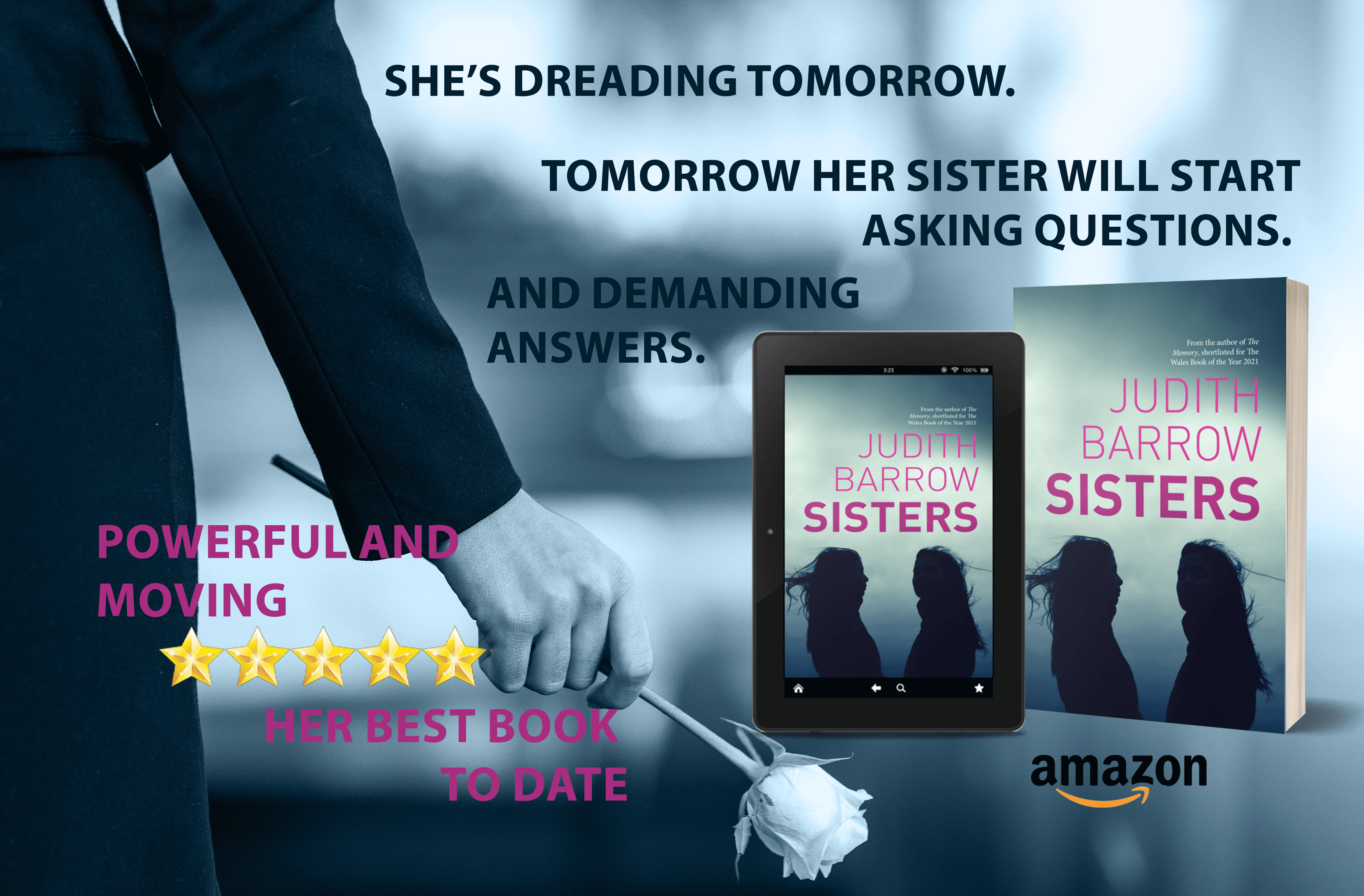
Sisters is on promotion at 99p ” A moving study of the deep feelings – jealousy, love, anger, and revenge – that can break a family apart”

Readers have asked what was the inspiration for Sisters. I can only answer that it was an incident that I witnessed as a child. An event that tore in two a family that lived nearby. It’s something I’ve never forgotten.

I’ve had some wonderful reviews for Sisters. This is one of my favourite

Review: http://tinyurl.com/3yjkz7ku

I’m going to borrow some words I used when I reviewed The Memory – “absolutely compelling, a story superbly told, and an entirely unforgettable emotional experience”. I used the word “stunning” a few times too – and although this is a very different book, the words seem equally appropriate. With this book, the author has produced another that packs a considerable emotional punch, coupled with an original story that had me pinned to the seat as I read it from cover to cover in one sitting.

A short prologue hints at what is to come, but the book opens in 1970 – with a family who will be torn apart by a tragic accident, where the blame settles with young Mandy, and its consequences are devastating. Sent to live with her uncle and aunt in Wales, they uncover the truth about what happened – that she was unable to share with her parents – and show her the love she needs to move on, to build a new life as Lisa, and to rebuild her relationship with her mother. Meanwhile her older sister Angie, wracked with guilt after setting up an alibi to escape any consequences for her own actions, flees her home and her life follows a difficult path that will prove hard to escape. The narrative resumes in 1983 – when Lisa returns for her mother’s funeral, she finds that her estranged sister’s earlier actions and later life choices have trapped her in a marriage fraught with abuse, both physical and emotional, with no means of escape. Angie’s husband has an agenda all of his own – and, along with a friend from their shared past, the sisters need to work together to bring down a man capable of appalling acts and cruelty who has become a most unlikely pillar of the community.

My goodness, the author’s telling is so much better than that – but this book is far more than its story. Mandy’s voice – that of a confused child, torn between her own grief, her sense of right and wrong, and her love for her family – tears at your heart. We hear Angie’s voice too – the way she deals with her own guilt and justifies her actions – and any sympathy is, at first, difficult to find. The father who rejects his own child, and the mother who condones it – that’s even more complex. But when Mandy – now Lisa – achieves some redemption, we see Angie’s life heading in a different direction. And while there might be some possibility that she reaps what she deserves, the reader’s compassion builds when we see what a mess she’s made of her life. Her husband is the truly evil one, who will stop at nothing to get what he wants – but the strength of character that Lisa has developed, and that really emerges through the writing, means that there might just be some possibility of him being stopped in his tracks.

And I’m back telling the story again – and I really don’t mean to. The character development is tremendously strong – but so is the story’s backdrop, the community that closed ranks against a small child bullied mercilessly and driven from her home, and the differences once thirteen years have passed. And there are the small background details that capture the context and era for both the past and present story – so subtle you barely notice, and really cleverly done. But the most unforgettable thing about this book is the way it makes you feel, by skilfully telling a story that can’t fail to engage the full range of your emotions. And it never feels like manipulation – these are real people who you grow to care deeply for through the course of their experiences. The book’s conclusion is satisfying in every possible way – and this is the point when I really won’t tell you the story, because that would be entirely unforgivable.

A family drama, perhaps a thriller in parts – perfectly structured and beautifully written, tender and gritty, this is a book that defies placing within one genre, and is all the better for it. All I can say is that I entirely loved it – one of my books of the year, and I couldn’t recommend it more highly.

Sample:

Part Four June 1981

Chapter Forty-Three

I’m holding the rail at the top of the steps of the bus and peering through the window. It doesn’t help that it’s dirty and smeared with rain. But I can see Micklethwaite is run-down. Shabby.

Though the doors squeal open I can’t make my legs move. I don’t look at him, but I can sense the driver’s impatience and curiosity, and worry for a moment that he’s recognised me. He’s older, but I know he’s the man who used to be the school caretaker. Can’t remember his name but I wait for him to speak. The old familiar fear prickles my skin, I gulp against the sudden tears thick in my throat.

But all he says is, ’On or off, miss?’

I don’t look round at him when I go down the steps clutching my only luggage, my small, blue suitcase. I’m not intending to stay in Micklethwaite long. Standing on the edge of the flagged square, I look around at what used to be the new shops and flats. It’s depressing, exactly as Mum described it last time she was in Ponthallen. She’d said it had deteriorated beyond recognition and she was right. Most of the shop fronts are boarded up, the windows of the flats above covered in yellowed net curtains or wrecked blinds hanging lopsided. Empty crisp packets and torn greasy chip cartons wrap themselves around the iron railings once fixed to protect the young saplings, now fragmented twigs.

Except for a group of hooded youths slouched in front of an off-licence, the windows plastered in red and orange posters to entice customers in with offers of knocked down beer and wine prices, there’s no one around. What had been there before?

I can’t remember. Then it comes to me; it was the hairdressers, Mavis’s Waves and Curls. Mum used to come out of there once a month with the same tight perm that all the other women had. And each time, red-faced with an embedded line from a hairnet across her forehead, Mum swore she’d find a different hairdresser. Each time it had taken until the evening for that line to fade.

 Angie and I used to tease Mum about it.

The thought makes me feel wretched, broken. Broken was how I felt the last time I was in Micklethwaite, carrying a burden that would be with me all my life. I didn’t think of it in that way then; after all I was just a kid. But I do know no one wanted me here at the time. The sideways glances of hatred and recrimination drove away that feeling of belonging. It’s odd; I haven’t thought of it as home for a long time. I belong in Ponthallen now.

And as for Angie ‒ Angela, I’m not sure how I’ll feel when I see her. It’ll be the first time in over eleven years. The first time I’ll speak to her after my life altered completely because of her.

Links:

Amazon UK: http://tinyurl.com/2r2bu3z4

Amazon.com: http://tinyurl.com/7cw4ss8b

Amazon.com aus: http://tinyurl.com/4rh35v6d

Social Media links:

https://judithbarrowblog.com/


https://twitter.com/judithbarrow77


https://www.facebook.com/judith.barrow.3


https://www.honno.co.uk/authors/judith-barrow

https://www.bookbub.com/profile/judith-barrow