A Hundred Tiny Threads #Prequel #familysaga #histfiction #WW1 #reviews #family #relationships #Poetry

It’s eight years this month since the prequel, A Hundred Tiny Threads, to the Haworth Trilogy was published – so a little celebratory post – with an extra personal memory at the end – for one of my oldest books.

It’s 1911 and Winifred Duffy is a determined young woman eager for new experiences, for a life beyond the grocer’s shop counter ruled over by her domineering mother.

The scars of Bill Howarth’s troubled childhood linger. The only light in his life comes from a chance encounter with Winifred, the girl he determines to make his wife.

Meeting her friend Honora’s silver-tongued brother turns Winifred’s heart upside down. But Honora and Conal disappear, after a suffrage rally turns into a riot, and abandoned Winifred has nowhere to turn but home.

The Great War intervenes, sending Bill abroad to be hardened in a furnace of carnage and loss. When he returns his dream is still of Winifred and the life they might have had… Back in Lancashire, worn down by work and the barbed comments of narrow-minded townsfolk, Winifred faces difficult choices in love and life

A couple of reviews:

“When I emerged at the end of this book – during the reading, my immersion was total – it was with a sense of having experienced it all first hand, and of having deeply felt every moment. This was story-telling at its very best… and a book that will long linger in my memory.”

“I loved it… A page-turner that keeps you hooked. The story line has lots of twists and turns and you feel yourself moved on so many different levels. As the book unfolds it gives you moments of tenderness and love, hatred and spite all blended together with conflict, prejudice, guilt, grief and a desperate longing for change. Judith describes the period so well, with some very graphic, cruel and harrowing episodes, enabling you to empathise with each character in turn. I particularly like the fact that the story held together to the last page.”

Three year earlier, on the exact date – the 17th August – the book was published, I’d written the following…

My Grandad

grandad for sally's blog

My grandfather died seventy years ago this week. Obviously i never knew him and have only one small black and white photograph of him on my study wall. He’s standing in the backyard of the terraced house they lived in in Oldham. Lancashire. This is a poem I wrote about him a long time ago. My mother said he was gassed in WW1 and never recovered. 

My Grandad

I look at the photograph.

He smiles,and silently

he tells me

his story…

In my backyard I stand,

Hands wrapped around a mug of tea.

Shirt sleeves, rolled back,

Reveal tattoos – slack muscles.

I grin.

All teeth.

Who cares that they’re more black

Than white.

Underneath

That’s my life;

That’s the grin I learned

When burned

By poison

Spreading

Like wild garlic.

That’s the grin I wear

When I look

But don’t see

The dark oil glistening,

Blistering, inside me.

When I hear, but don’t listen

To my lungs closing.

I posture,

Braces fastened for the photo,

Chest puffed out.

Nothing touches me –

Now.

Later I cough my guts up –

Chuck up.

I trod on corpses: dead horses,

Blown up in a field

Where grass had yielded

To strong yellow nashers.

And in the pastures

I shat myself.

But smelled no worse

Than my mate, Henry, next to me

Whose head grinned down from the parapet –

 Ten yards away.

He has perfect, white teeth.

Much good they’ve done him,

Except for that last night at home

When the girl smiled back.
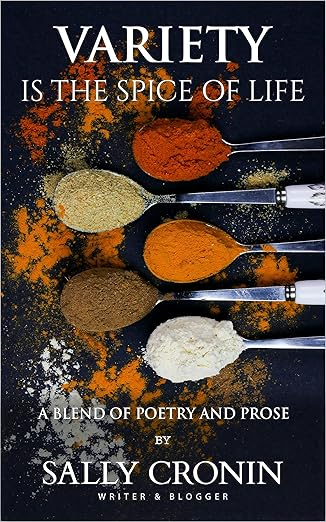
My Review of Variety is the Spice of Life: A blend of poetry and prose by Sally Cronin

Book Description:

Variety is the Spice of Life is a collection of poetry and short stories about relationships with others, including pets and animals inhabiting the world around us. The connection with others brings love and friendship, excitement and sometimes surprises, danger, mystery and sometimes the unexpected.

The poetry explores human nature, the fears, desires, expectations and achievements. Nature offers a wonderful opportunity to observe animals both domesticated and wild. Even in a back garden you can observe a wide variety of creatures and the daily challenges to survive a harsh environment.

The short stories introduces you to a healer whose gift comes with danger, a neighbour determined to protect a friend, a woman on the run, an old couple whose love has endured, an elderly retired teacher who faces a life changing accident, a secret that has been carried for over 70 years and a village who must unite as they face devastating news.

My Review:

I read Sally Cronin’s Variety is the Spice of Life quite a while ago, and recently when ‘tidying up’ my kindle I was surprised and somewhat dismayed to see I’d made notes on this lovely collection of poetry and prose that encompasses such a variety of themes – and not reviewed it.


So here I’m rectifying that.


The poetry at the start of the book is almost a study of the world around us. It’s an invitation to look once more at nature, however small and seemingly insignificant, and is portrayed through wonderfully insightful and sensitive words, so evocative that each piece evokes an image. I remember how, the first time I saw the poems, I read each of them out loud, relishing the sounds, the rhymes, the rhythms. And I would invite any reader to do the same – they come alive in that way, as does all good poetry. Sally has a way of capturing emotions and sensitively showing the uniqueness of the world around us – and the many layers in human nature.


The theme of the individuality, the variety of actions and reactions we are all capable of, is repeated over and over again in many subtle, and sometimes overt ways, throughout her prose. I was tempted to quote, to unpick each of the eight short stories, to describe the core, the main premise that runs through them. But, sticking to my decision not to reveal any spoilers in my reviews, I would just urge any potential reader to discover them for themselves. All reveal the writer’s natural gift for storytelling, of capturing the essence of characters and the world they inhabit. Some stories brought chuckles and a wry smile, others the feelings of sadness, of sharing fears and loss. And tears. Writing a short piece of prose is not an easy task; wrapping up a scene or a journey into a package that reveals a whole plot to the reader in so few words requires a special intuition on the part of the author. Sally Cronin shows she has a talent for such an understanding.


I can do no more, having given Variety is the Spice of Life a second reading, than to stress how much I recommend this offering from Sally. You won’t be disappointed.


A last word on the cover – a brilliant spicy image of the promising within!!

About the author

Sally Cronin is the author of eighteen books including her memoir Size Matters: Especially when you weigh 330lb first published in 2001 which followed her weight loss of 150lbs and the programme she designed to achieve a healthy weight and regain her health. A programme she shared with her clients over her 26 year career as a nutritional therapist and on her blog. This has been followed by another seventeen books both fiction and non-fiction including multi-genre collections of short stories and poetry.

Her latest book Size Always Matters is an extended and updated version of her original book Size Matters and now includes the nutritional element to losing weight and some recipes with ingredients that provide the nutrients necessary for healthy weight loss and continued good health.

As an author she understands how important it is to have support in marketing books and offers a number of FREE promotional opportunities in the Café and Bookstore on her blog and across her social media.

After leading a nomadic existence exploring the world, she now lives with her husband on the coast of Southern Ireland enjoying the seasonal fluctuations in the temperature of the rain.

Find Sally through the following links:

Smorgasbord Blog Magazine: https://tinyurl.com/5xskmavn

LinkedIn: https://tinyurl.com/3tn378xb

Facebook: https://www.facebook.com/sally.cronin

X: https://x.com/sgc58

My Review of A Stolen Future ( A Shade Darker Book 4 by Georgia Rose

Book Description

A rival to overcome… A truth to reveal…

A family firm. A long-held promise. What will it take to protect all she loves?

Alice Fraser has everything she needs. A comfortable home. A few good friends. A satisfying career. But when the promise made doesn’t materialise and everything changes at work she finds herself losing control of all she once held dear.

She could have left. She should have left. Instead she decides to dig in, and make life uncomfortable for her tormentor.

Petty revenge, she calls it. And that’s how it starts. But one day she is pushed too far, and once she takes the next step there is no going back.

A Stolen Future is a gripping domestic suspense novel. If you like character-driven action, suspenseful storytelling and unexpected twists then you’ll love this psychological thriller.

My Review:

From the word go I’ve loved this series from Georgia Rose. In fact I’ve loved all her books, whatever genre. But A Stolen Future is the fourth story that is special, because it’s set in the same village, Melton, and besides being centred on the protagonists and her antagonist, it also touches on and includes characters, now minor ones, whose lives we have seen in depth before.

To that end, I woud encourage any reader to begin – as they say – at the beginning: so it’s

https://tinyurl.com/5n8v36v2

https://tinyurl.com/mw7y2f7b

https://tinyurl.com/55d8brph

I always try not to give spoilers in my reviews, and feel that I’m in danger of doing just that, so I’ll stop there. But what I do need to say is that all these characters are multi layered and immediately identifiable through their dialogue, both spoken and internal. And, together with a cast of wonderful minor characters,, they are embedded in a community that is indicative of so many villages and small towns. And as with all of Georgia Roses’ books the descriptions of the settings give a good sense of place, so I almost felt like on onlooker to life in Melton.

I thoroughly agree with the books description: A Stolen Future is a gripping domestic suspense novel. If you like character-driven action, suspenseful storytelling and unexpected twists then you’ll love this psychological thriller. It’s a book I thoroughly recommend.

About the Author:

Georgia Rose is a writer and the author of the romantic and suspenseful Grayson Trilogy books: A Single Step, Before the Dawn and Thicker than Water. Following completion of the trilogy she was asked for more and so wrote a short story, The Joker, which is based on a favourite character from the series and the eBook is available to download for free at the retailer of your choice.

Her fourth novel, Parallel Lies, encompasses crime along with Georgia’s usual blending of genre and its sequel, Loving Vengeance, has now completed The Ross Duology.

Georgia’s background in countryside living, riding, instructing and working with horses has provided the knowledge needed for some of her storylines; the others are a product of her passion for people watching and her overactive imagination.

She has also recently started running workshops and providing one-to-one support for those wishing to learn how to independently publish and you can find her, under her real name, at http://www.threeshirespublishing.com.

Following a long stint working in the law Georgia set up her own business providing administration services for other companies which she does to this day managing to entwine that work along with her writing.

Her busy life is set in a tranquil part of rural Cambridgeshire in the UK where she lives with her much neglected husband.

The Hidden Danger in Families #coercivecontrol

I love writing about people – especially people in families. There is such a richness of emotion, of action, within families. Nowhere else will love and loyalty vie with dislike and disloyalty, (even hatred in some case), pride with resentment, happiness with complete sadness. Nowhere else are human beings so close.


With The Stranger in my House, I wanted to explore a situation that would completely turn around the characteristic of a family. And I knew that needed to be something drastic. And that the family had to have a weakness within it it. And that weakness in the Collins family was grief, the sadness of losing the mother, the centre of their world. The father Graham is still grieving, bewildered, struggling to cope with running a business and trying to look after his children, eight-year-old twins, Chloe and Charlie.That “something drastic”; the situation that would completely change the characteristic of this family arrives in the form of Lynne, the district nurse who cared for Anna, the wife and mother of the family, who died when the twins were six. Lynne continued to call on Graham after Anna died and slowly but surely becomes part of his life… and consequently of the twins lives, when she and Graham marry.

I’ve always known about coercive control, although that’s not what it’s been called until these last few years. But it’s always been the patriarchal control, the accepted head of the family situation of past times, I was initially aware of. The earliest of my books, A Hundred Tiny Threads the prequel to the Haworth trilogy, is set after WW1 and the protagonist’s father, Bill, is a man of that era; he totally controls the family: by his moods, his temper, his fists.


But these days control of any sort is identified as coercive control, and it’s recognised that this can result in psychological damage that can last for life. It’s difficult, sometimes, for the victim to make sense of what’s happening, to see it as abuse. It’s like imprisoning someone, restricting everything they are. They are robbed of their independence, and their confidence is slowly undermined. It destroys who they are.

Anyone can be guilty of being a coercive controller. And guilt is the right word, because, today, it’s viewed as a crime. To totally have control over another adult human being is a crime. It’s shown in so many ways: physical assault, threats, humiliation, intimidation or other abuse intended to harm, punish or frighten. The perpetrator gaslights the victim by denying things have happened, using the confusion to control, criticising everything they do and say. Victims suffer in silence.

Which is what Graham in The Stranger in my House does, he tells no one, feels completely useless. Isolated, he has no control over what happens to his children or his life.
And neither do his children.

But children grow up. Chloe and Charlie become young adults with minds of their own…

The Stranger in my House: https://bit.ly/3DGwMCU

Find me here:

Amazon: https://bit.ly/3UIid6I

Honno: https://www.honno.co.uk/authors/judith-barrow

Instagram: https://www.instagram.com/judithbarrowauthor/

Threads: judithbarrowauthor

Facebook: https://www.facebook.com/judith.barrow.3/

With Many thanks to @DGKaye for this Review of The Stranger in my House

With many, many thanks to @AnneWilliams for this wonderful review for my latest book, The Stranger in my House. And for all the kind words and reviews (also included) for my earlier books.

A Wonderful Review by Thorne Moore for my Book The Stranger in my House

A much appreciated review from @sallycronin for my small anthology Live and Let.

Author Judith Barrow gives a lively account of her experiences moving to Pembrokshire in the 1970s and managing a holiday let with some interesting visitors, sometimes amusing and sometimes rather challenging.

And so, with Changing Patterns the Story of the Haworth Trilogy continues: Sequel to Pattern of Shadows and the book before Living in the Shadows. #Excerpt #weekendRead #Promotion #Novelines #Honno

Although all three of the books in the Haworth trilogy are based on the same family, they are also stand alone. And yet, to be completely honest, I do need to add this from one of the reviewers…

“This is the part where I’m supposed to tell you that each of these wonderful books can be read alone. But no, don’t do that. In fact, if you haven’t read any of them, you’re luckier than I am, because you can start with the prequel and read in chronological order. I chose to review these books as a set, and I believe that’s how they should be read.
Every now and then, I come across books so beautifully written that their characters follow me around, demanding I understand their lives, their mistakes, their loves, and in this case, their families. Taken together, the Howarth Family stories are an achievement worth every one of the five stars I’d give them.

Changing Patterns – a bargain!

Book Description:

May 1950, Britain is struggling with the hardships of rationing and the aftermath of the Second World War. Peter Schormann, a German ex-prisoner of war, has left his home country to be with Mary Howarth, matron of a small hospital in Wales. The two met when Mary was a nurse at the POW camp hospital. They intend to marry, but the memory of Frank Shuttleworth, an ex-boyfriend of Mary’s, continues to haunt them and there are many obstacles in the way of their happiness, not the least of which is Mary’s troubled family.
When tragedy strikes, Mary hopes it will unite her siblings, but it is only when a child disappears that the whole family pulls together to save one of their own from a common enemy
.

Excerpt:

16th June 1950

Sometimes Mary couldn’t believe he was there. Sleepless, she would reach out and touch Peter just to reassure herself that after five years apart they were together again. He’d given up a lot to be with her.

‘You are happy?’ He slung his arm around her shoulder and pulled her closer.

The breeze ruffled their hair. The tide was on the turn and Mary watched the waves collide and dissolve. High above, gulls hung motionless their cries lost in the air currents

‘Mm.’ Mary rested against him. The smell of the mown lawn on his skin mingled with the salty tang of spray blown off the sea and the faint smell of pipe tobacco. ‘You?’

‘Of course.’

She turned her head to look at him, brushed a few blades of grass from his cheek. In the four months since he’d found her he’d lost the gaunt pallor, the weariness, and gained a quiet contentment.

‘It is good, the two of us sitting here, alone,’ he said.

‘Tom won’t be long though, he’ll be back from Gwyneth’s soon; he said he was only just digging her vegetable plot over for planting tomorrow.’

‘I do not mean Tom. He is family.’

Mary allowed a beat to pass. ‘I know you didn’t, love. And I know what you really mean. But it’s not our problem. If people don’t like our being together that’s their lookout.’ She kissed him. His mouth was warm.

Smiling she drew back. ‘Tom?’ she murmured, her voice rueful.

They sat peacefully on the doorstep of the cottage, each savouring the other’s closeness.

Gradually the sun disappeared behind the cliffs. The trees became shifting silhouettes and the wind slapped the surface of the sea into rolling metallic arcs and carried the spray towards the cottage. Mary licked her lips, tasted the salt

‘It’s getting chilly.’ She shivered.

Peter stood, reached down and lifted her to her feet, holding her to him. ‘Ich liebe dich, my Mary.’

‘And I love you.’

A few moments passed before she forced herself to stand back and, giving him a quick kiss, take in a long breath. ‘Now,’ she said, ‘I’m late sorting tea out. If you put those things away, I’ll go and give that batter a whisk. I’m making Spam fritters to go with that mash from last night.’

She stood on the top step watching him walk down the gravel path to where he’d left the lawnmower and then glanced towards the cottage next door. Although it was only just dusk the window in Gwyneth Griffith’s parlour suddenly lit up and the oblong pattern spilled across the garden. Tom emerged out of the shadows swinging a spade in his hand and turned onto the lane. Mary waved to him and he waggled the spade in acknowledgement. ‘Tom’s coming now,’ she called out to Peter. ‘I’ll stick the kettle on. He’ll want a brew before he eats.

The van came from nowhere, a flash of white. Mary saw it veer to the right towards Tom. Hurtling close to the side of the lane it drove along the grass verge, smashing against the overhanging branches of the blackthorn. Caught in the beam of the headlights her brother had no time and nowhere to go. Frozen, Mary watched as he was flung into the air, heard the squeal of the engine and the heavy thud of his body on the bonnet of the van. The spade clattered along the tarmac. Peter threw open the gate and was running before she could move.

‘Tom,’ she heard him yell. Somewhere, someone was screaming. She was screaming.

Links to buy:

Amazon.co.uk: https://tinyurl.com/4wj2jedc

Amazon.com: https://tinyurl.com/nj87jz6k

My Review of Long Shadows: Tales of Llys y Garn by Thorne Moore #TuesdayBookBlog #Histfiction

long shadows


I gave Long Shadows: Tales of Llys y Garn 5*

Book Description:

Llys y Garn is a rambling Victorian-Gothic mansion with vestiges of older glories.

It lies in the isolated parish of Rhyd y Groes in North Pembrokeshire. It is the house of the parish, even in its decline, deeply conscious of its importance, its pedigree and its permanence. It stubbornly remains though the lives of former inhabitants have long since passed away. Only the rooks are left to bear witness to the often desperate march of history.

Throne Moore’s Long Shadows: Tales of Llys y Garn comprises a trio of historical novellas that let us into secrets known only to these melancholy birds.

The Good Servant is the story of Nelly Skeel, loveless housekeeper at Llys y Garn at the end of the 19th century, whose only focus of affection is her master’s despised nephew. But for Cyril Lawson she will do anything, whatever the cost.

The Witch tells of Elizabeth Powell, born as Charles II is restored to the English throne, in a world of changing political allegiances, where religious bigotry and superstition linger on. Her love is not for her family, her duty, her God or her future husband, but for the house where she was born. For that she would sell her soul.

The Dragon Slayer tells of Angharad ferch Owain in the early decades of the 14th century. Angharad is an expendable asset in her father’s machinations to recover old rights and narrow claims, but she dreams of bigger things and a world without the roaring of men. A world that might spare her from the seemingly inevitable fate of all women.

In these three tales the rooks of Llys y Garn have watched centuries of human tribulation – but just how much has really changed? If you enjoyed the kaleidoscopic sweep of David Mitchell’s Cloud Atlas you will appreciate Long Shadows.

My Review:

I have long been an admirer of Thorne Moore’s work and have not been disappointed with these three novellas in  Long Shadows: Tales of Llys y Garn

The first, The Good Servant is told from the point of view of the housekeeper, Nelly Skeel; the protagonist, living at the end of the nineteenth century.  Well rounded and well portrayed in her actions, there is a vulnerability about this character; as the reader I found myself both can empathising and sympathising  with her and yet being exasperated. Yet should I? She is of her time and  of a certain status in her world.

And, so, on to The Witch. This story, set in the seventeenth century,  takes the reader through the early years of Elizabeth Powell to her adult life. Told mainly from the protagonist’s point of view with the occasional insight to one or two of the  other characters from a third person narrator, the emphasis is on the restrictions of the religion at that time. and the class struggles; land versus money. I liked Elizabeth, which is something I cannot say about Anthony, her brother. Always there is hope that all will be well but there is an all encompassing darkness to her story…

The Dragon Slayer is the story of Angharad ferch Owain, living during the fourteenth  century. Also told from the protagonist’s point of view we read of her fear of her father, of her future. This protagonist I liked the most. The ending is satisfying. I don’t know why I was surprised, but I was. As with the first two novellas, this tale is dark with themes of the women being mere chattels to be bargained with, used for the progression in society of their families.

I enjoyed the way the women were portrayed as having a strength and internal rebellion. But yet there was always the conflicts of status and money, of land and possessions, of greed and thwarted love. Of patriarchy.

In all three novellas, both the internal and spoken dialogue the author has the tone and subtle dialect that I imagine Rhyd y Groes in North Pembrokeshire to have been in those eras.

And, in all, the descriptions of the buildings, of Llys y Garn and of the ever-changing Welsh countryside are evocative and easily imagined.

Just a comment about the style of the book:  

The intriguing Prelude, giving the history of the “rambling Victorian-Gothic mansion” that is Llys y Garn,  is fascinating.  And I loved the short explanations of the after-years of novella. And  then we have the Interludes; told in a conversational tone these are filled both with historical details and those pertinent to the story,. Finally, the Epilogue, giving the continuing, ever-evolving history of Llys y Garn through the following centuries. 

It is apparent that the author has researched thoroughly for each of these stories; the themes of Welsh legends, myths, superstitions  and tales are woven throughout the history of the decades.  

Watch out for the ravens

This is a collection of novellas I can thoroughly recommend to any reader, especially those who enjoys historical literature.

Links to buy:

Amazon.co.uk: https://amzn.to/2rDFQj7

Amazon.com: https://amzn.to/2Iap5Hr

About the author:

Thorne Moore

Thorne was born in Luton and graduated from Aberystwyth University (history) and from the Open University (Law). She set up a restaurant with her sister but now spends her time writing and making miniature furniture for collectors. She lives in Pembrokeshire, which forms a background for much of her writing, as does Luton. She writes psychological mysteries, or “domestic noir,” and her first novel, A Time For Silence, was published by Honno in 2012. Motherlove and The Unravelling followed, also published by Honno. She has also brought out a book of short stories, Moments of Consequence. Her last novel, Shadows, was published by Endeavour in 2017. She’s a member of the Crime Writers Association.

Praise for Thorne Moore and her novels:

“Thorne Moore is a huge talent. Her writing is intensely unsettling and memorable” – SALLY SPEDDING, AUTHOR

“Totally had me hooked from page one… Highly recommended if you love a good psychological thriller” – BROOK COTTAGE BOOKS

“I devoured this book. Beautifully written, frighteningly real” – CHILL WITH A BOOK

“A compelling blend of mystery and family drama with a gothic twist… The author’s ability to create an atmosphere is exceptional” – JUDITH BARROW, AUTHOR

“Beautifully told, this really did have me captivated” – CLEOPATRA LOVES BOOKS

“Moore has created a figure who reaches out across the decades and grabs our sympathy… Her character transforms the novel” – BOOKERTALK