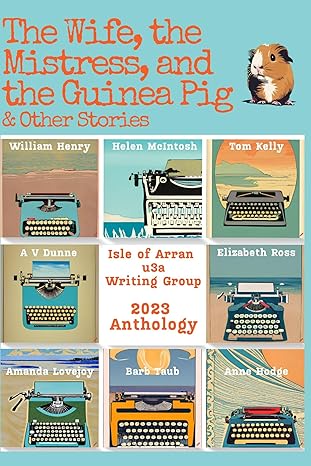
And a mention of their first Anthology:The Wife, the Mistress, and the Guinea Pig & Other Stories
Having been a member of the U3a for some time, I have discovered the value of being able to join in with the many groups and events. I also run a monthly creative writing group.
So, some time ago, I was thrilled to learn that there is a U3a on Arran; an island I’ve been lucky enough to stay on and which is close to my heart because of the wonderful memories and friends I’ve made there. When I discovered in 2023 that the writers’ group had produced an anthology: The Wife, the Mistress, and the Guinea Pig & Other Stories, I read and wrote a brief review:
“This is the first anthology written by the u3a writers on the Isle of Arran, and is a wonderfully engaging read encompassing short stories and poetry, with the underlying theme of ‘lives lived’, in brilliant descriptive detail. Nostalgic, reminiscent, sometimes humorous – but always enjoyable – this is an easy read, a ‘pick up and dive in!’ collection, with the occasional photograph and charming image. Highly recommended … to any reader who wants to be entertained.”
And now the group has written and published their second anthology, and it is equally enjoyable.
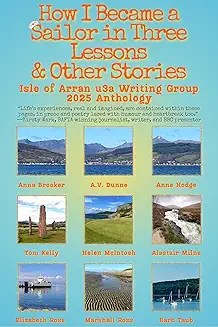
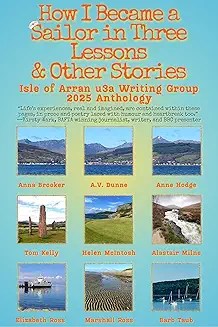
How I Became a Sailor in Three Lessons & Other Stories: 2025 Anthology: by Isle of Arran u3a Writing Group (Isle of Arran u3a Anthology Book 2
I’ll mention a few of my favourite reads in the book.
One piece of writing made me quietly envious – that of Alaster Milne’s view of life on Arran – which is that time on the isle is “ish;” there is a relaxed attitude to time. As he says: “Time on Arran is relative … it’s the Arran way of life that defines where we live.”
And there is both humour and an astute observance on human nature from A.V Dunne, both in poetry and prose. I laughed out loud reading one piece on not being “cut out for the twenty-first century” and could empathise with her Rage Against Age.
I loved revisiting Barb’s Do Not Wash Hands in Plates and her dealings with Delhi Belly and toothache. And then there is Lockdown, a bad knee, and a walking cane – even as I sympathised I’m afraid I chuckled. I hasten to add here that it is always the way she writes, Barb has a tremendous capacity of seeing the funny side of life, whatever happens.
I also enjoyed Helen McIntosh’s and Tom Kelly’s memoir contributions (memoirs are a favourite genre of mine), and the gentle writing of Marshal Ross.
There is an Arran in one hundred words section. Flash fiction is a brilliant writing discipline and all these pieces are fun and interesting to read.
And the black and white illustrations from photographs and drawings, throughout the anthology, from another U3a group, the photographers, add a lovely flavour to the writing.
Finally, there is an explanation of the University of the Third Age (U3a), and a description of the Arran U3a was formed in 2019. I was fascinated to learn that there are over a thousand chapters of people who, having retired, are still sharing experiences and expertise.



 Judith Barrow