Like most writers I’m a people watcher. Not in a creepy way… well, I don’t think so! But in that way of, “hmm, they could make a wonderful character!” and, “I wonder why they did that? Said that? What’s going on?” kind of way. People are fascinating. As human beings we do and say the most extraordinary things – however mundane we think we are, however boring we believe our lives to be. But it’s the layers of the experiences we’ve all built up from childhood to adulthood that makes each of us interesting. And the way we react to others is fascinating. Not least in the relationships within families. Because where else, in what circumstances, is there such a capacity for secrecy, for deception, for lies, for love, for empathy, for forgiveness? For misunderstandings and misreading of siblings, of parents. It’s intriguing. And no two families are alike – so the scope for creativity is endless. And I love exploring all these aspects. This is why, in all my books, the family is always at the centre of the story. Judith Barrow is a writer of domestic thrillers, domestic noir, and historical family sagas. My books include SISTERS, published in 2023, and THE MEMORY, which was shortlisted in 2021 for the Wales Book of the Year (the Rhys Davies Trust Fiction Award), and my last book The Stranger in my House, was published in 2024. I'm currently woring on another domestic thriller, Every Single Moment. Find me on-line at Amazon: https://tinyurl.com/4atrpjmt
Judith Barrow Author MA BA (Hons) Dip Drama
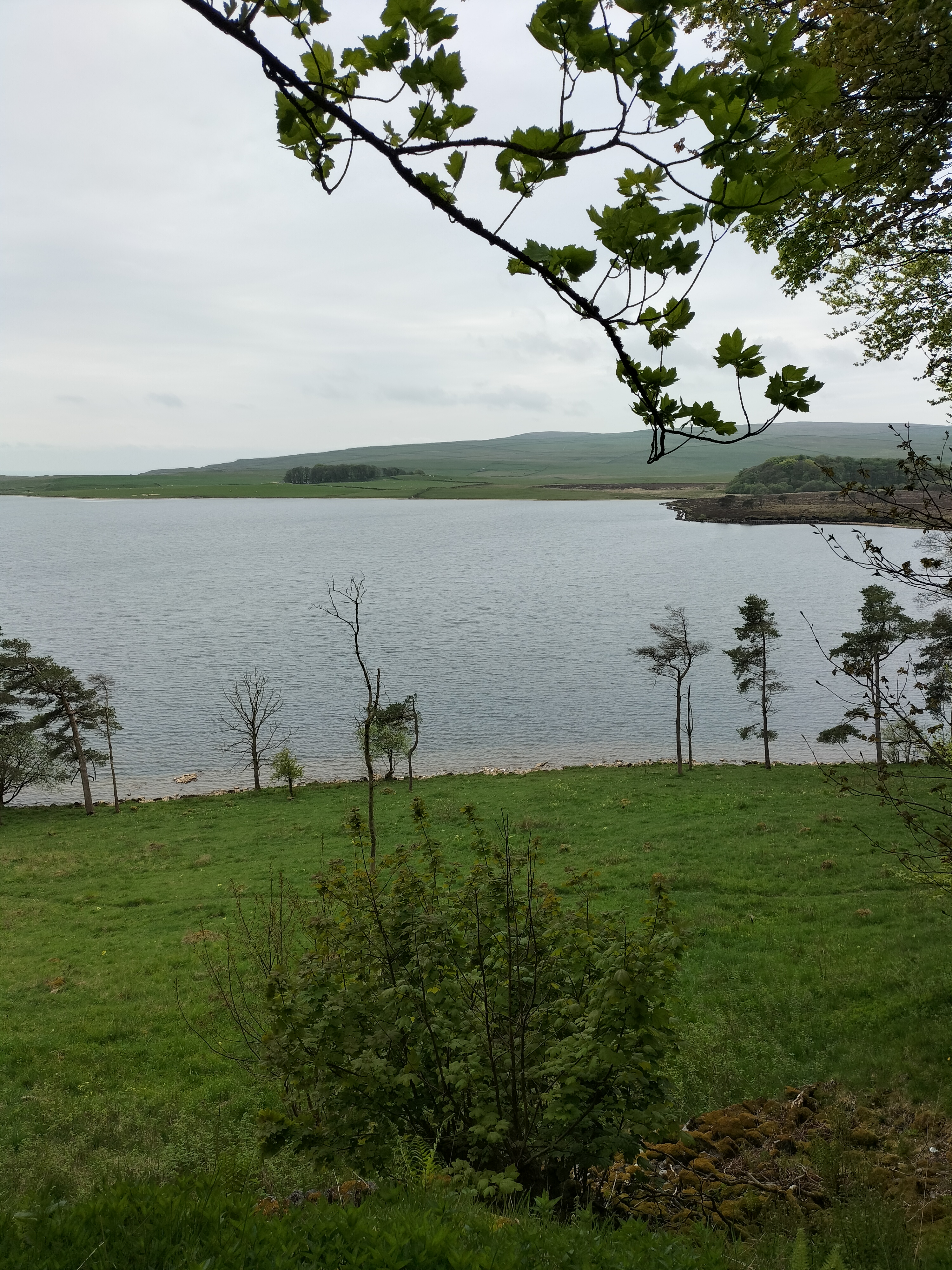
Malham Tarn is a shallow glacial lake three hundred and seventy seven metres above sea level, making it the highest lake in England. Situated above the village of Malham in the Yorkshire Dales National Park, it’s owned by the National Trust. It’s also the source of the River Aire; water flows out of the southern end of the lake and disappears underground to reappear as the River Aire at the foot of Malham Cove about one and a half miles away. Later, we were told by someone local that Malham Tarn is unusual because the water doesn’t sink into the ground. Apparently, during the Ice Age glaciers scraped away the the limestone down to the ancient slate layer underneath, and because slate is impermeable, it doesn’t let the water through. Then, when the glacier melted, the mouth of the Tarn was sealed by banks of clay and gravel.
I studied the map. ‘You said we were having an easy day today.’
‘I told you; eleven miles,’ said the photographer.
‘No, you said a mile.’
It’ s all flat, so it is easy… most of the way.’ And off he strides…
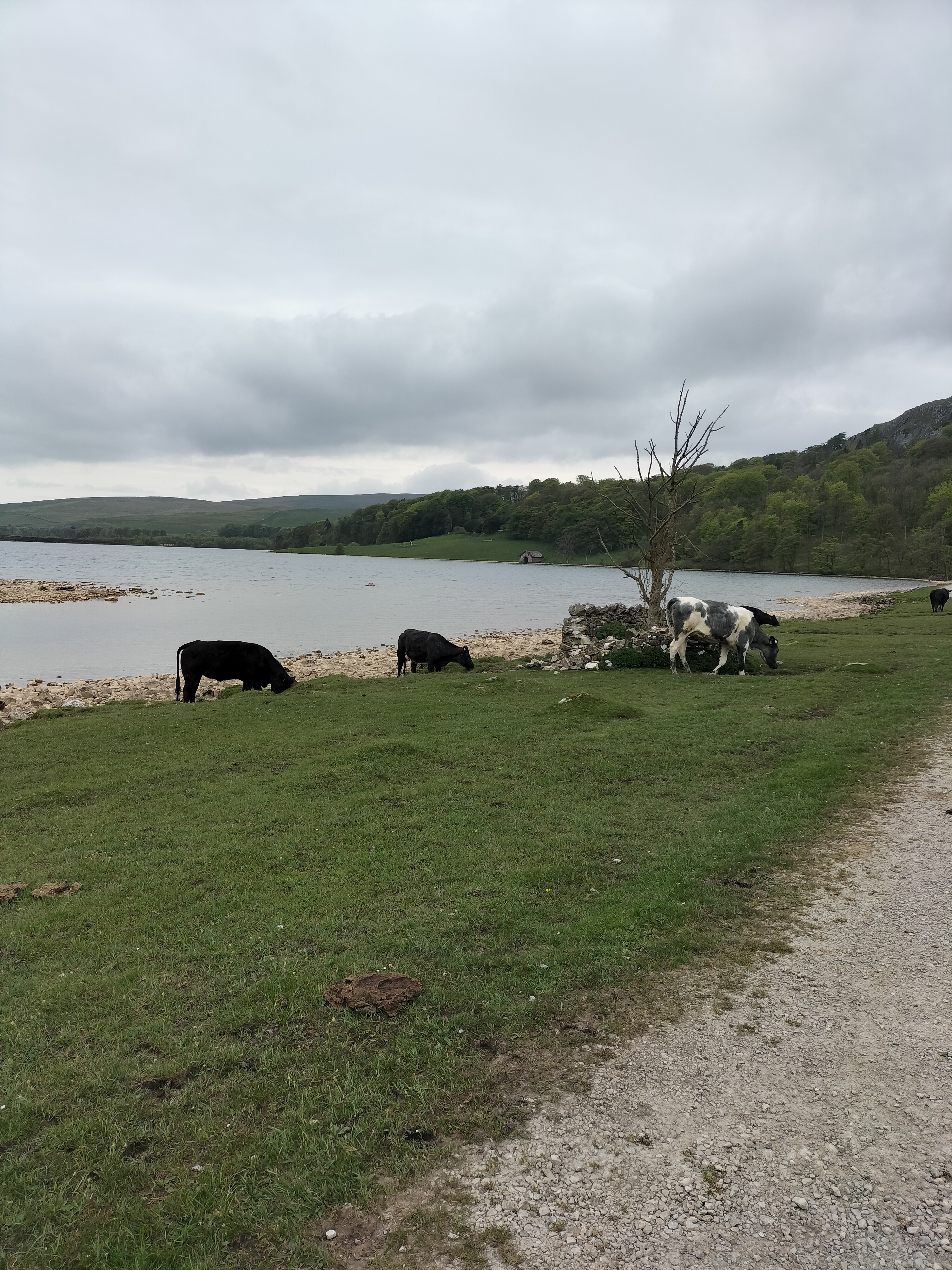
Towards some cows. Who look at us with interest and then decide to follow.
All the way as we walked along the shore of the tarn, through a gate and along a path into the woods.
We passed Tarn House, which was built as a hunting box in the late-18th century, and is now now owned by the National Trust. Used as a Field Studies Centre, there is an Orchid House, which usually has an exhibition area. Seeing the exhibition subject on our day, I passed by.
The house itself must once have been quite grand. It still is impressive, though obviously needs money spending on it.
There isn’t a lot of open water in the area, and, in the Stone Age, the lake was inundated with herds of wild animals, and consequently brought hunters from far and wide. Archaeologists have found the remains of their campsites and stone tools along the shoreline.We walked down to the bird hide.
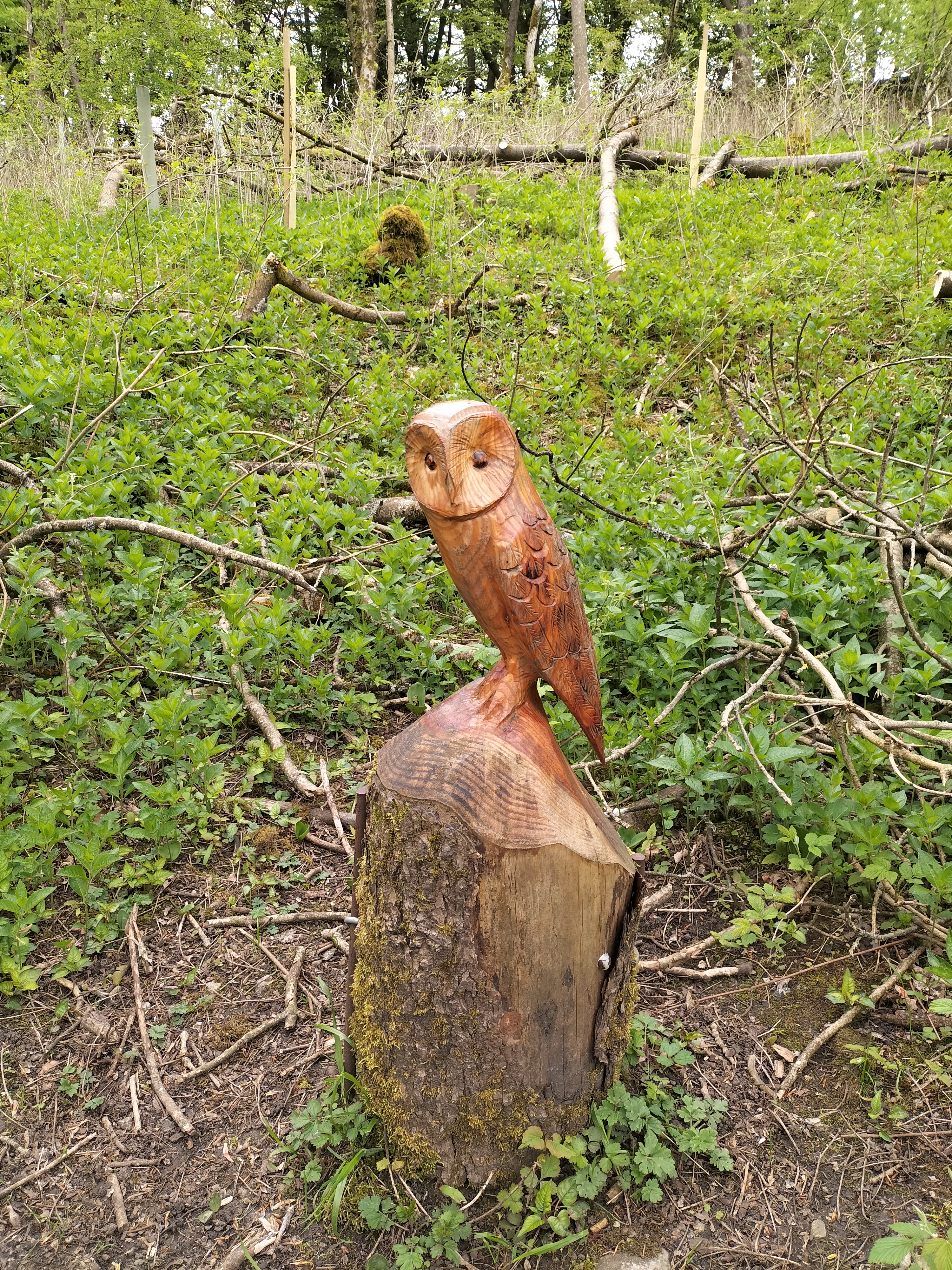
Although we saw Canada geese, a pair of mallard ducks, a greater-spotted woodpecker – and many sparrows, this was the only other wildlife we found…
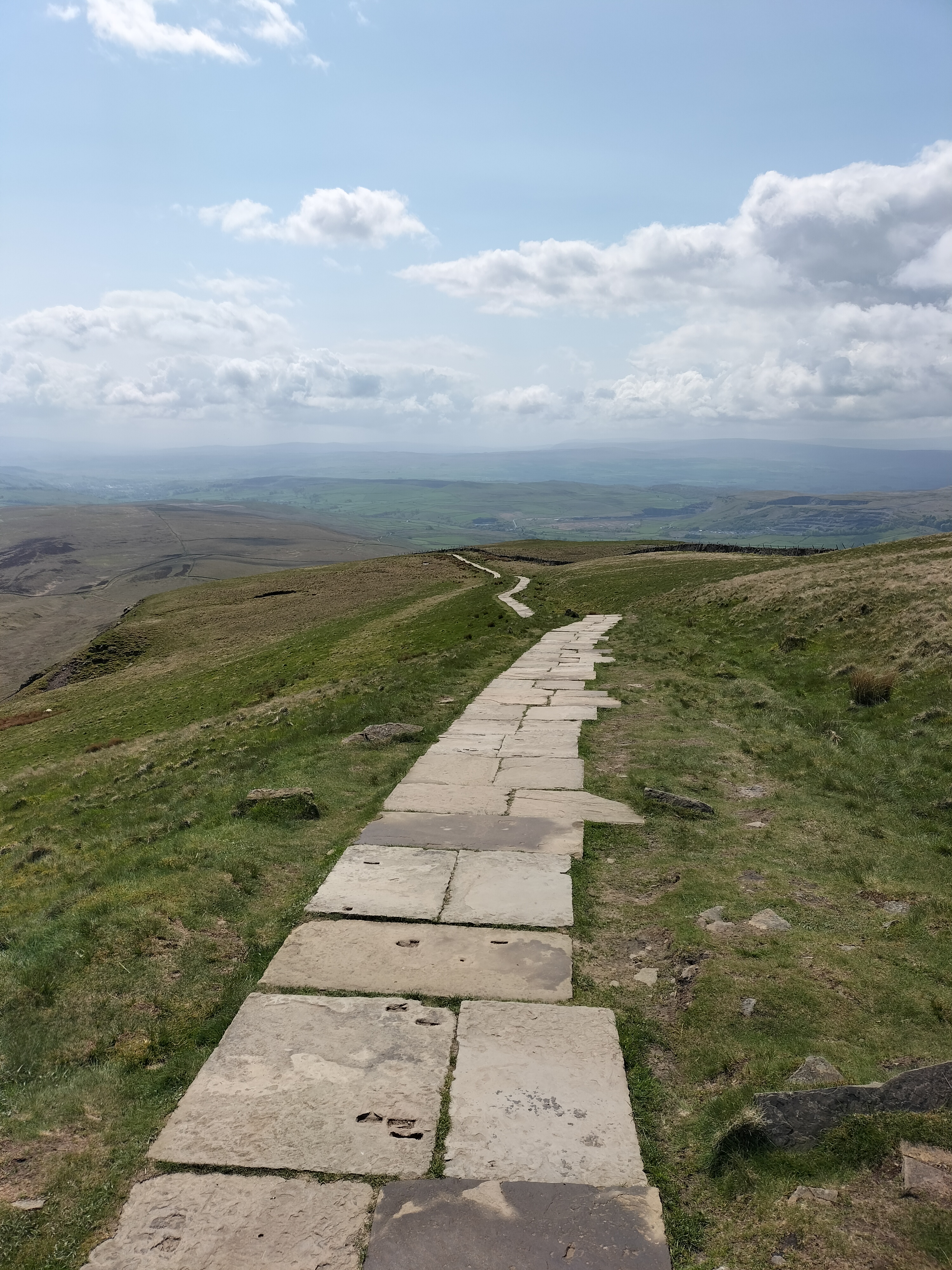
But what was really impressive was the man-made track that leads to the National Nature Reserve. We leisurely followed the boardwalk through the reserve for the next half an hour.
We came out of the reserve onto an unmade track . I expected to turn right to retrace our steps.
‘No left, we’re only halfway around the walk,’ the photographer said. Earlier on I’d seen this in the distance.
Reassured that he’d said the walk was a flat walk, I’d just admired the shape of Great Close Scar.I said nothing. I was saving my breath … and waiting…
An evening stroll to see the vertical face of Malham Cove. It’s magnificent; standing at around seventy-nine metres of sheer rock, the top of the cove is a strange pattern of blocks of limestone. We could hear jackdaws, but knew it was too soon to see the pair of peregrine falcons or house martins that nest during the summer months. We did, however, see two mallard ducks strutting around the nearby stream, who eyed us for a minute or so before realising we had nothing for them, and strutted off.
Only one stile to clamber over … which made such a change (this is a hint of foreshadowing for the next walk… and the perils of a cavalier attitude towards stiles and the advancement of age!)
Formed along the line of the Middle Craven Fault, Malham Cove has been eroded back by the action of water and ice over millions of years. As glaciers moved forward they gauged rocks from the face of the Cove and carried them away. Then, each time the glaciers melted, the torrents of water also eroded the face of the Cove in the form of a massive waterfall.
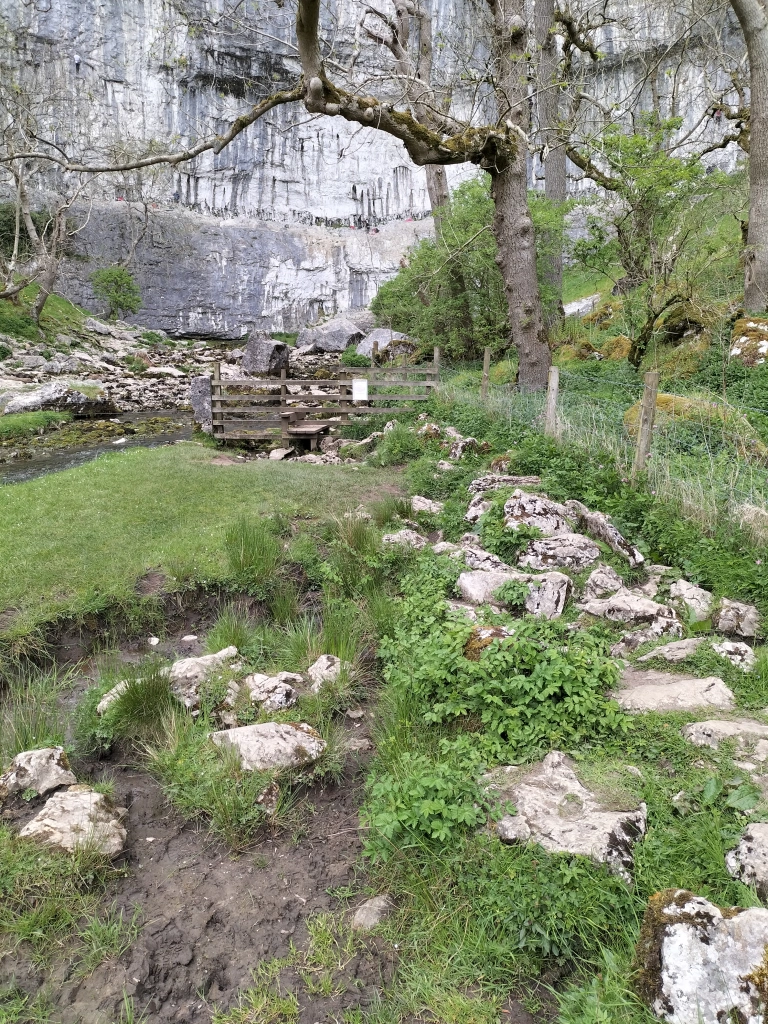
The water flows underground now, then emerges as a shallow rocky stream.
There was no one else around… we thought … until we heard voices echoing eerily around the amphitheatre. Two men abseiling down the rock face (see them? Tiny figures perilously hanging from ropes?). I’m sure they knew what they were doing.. probably!
‘I’d like to do that,’ said the photographer.
‘No, you wouldn’t,’ I said. (Mind you, I have seen him hanging (also perilously) over the cliffs at home in Pembrokeshire just to get, “that brilliant shot” – so I know he’d be daft enough to have a go)
‘So … what’s tomorrow?’ I asked, as we plodded back over the stile and scrambled up a short rocky path to a field where a herd of cows watched with interest. And then followed us … closely (What is it with us and cows?)
‘I’ve found a good walk where there’s a gorgeous waterfall on the way.’
In both the Cumbric language and modern Welsh ‘pen’ means ‘head’, ‘ghent’ is either ‘edge’ or ‘border’. So … Pen-y-ghent or Penyghent … ‘Hill on the Border’
We arrived in Horton-In-Ribblesdale quite early in the day and parked in the village car park. Armed with warm clothes, waterproofs, water and snacks.
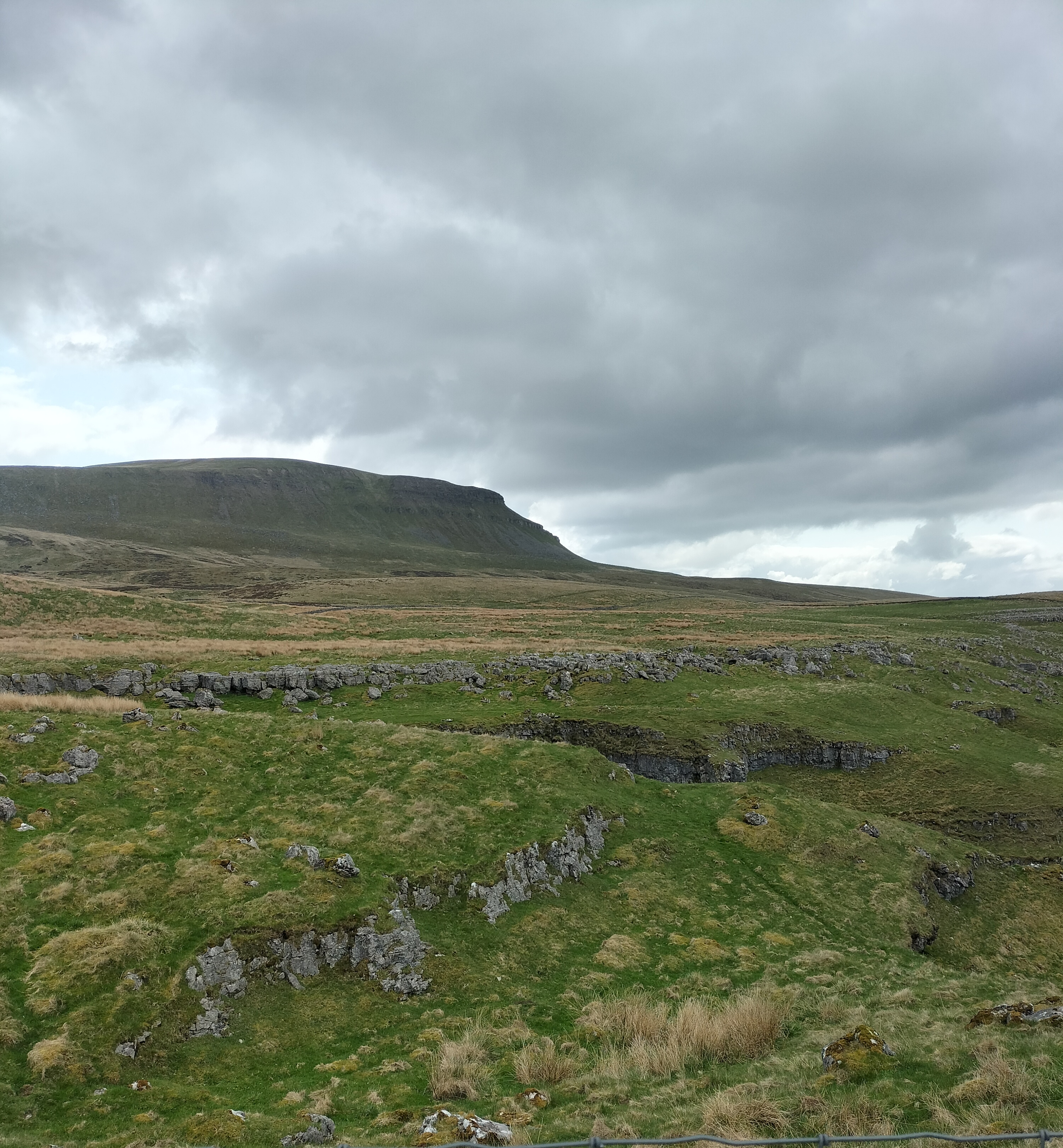
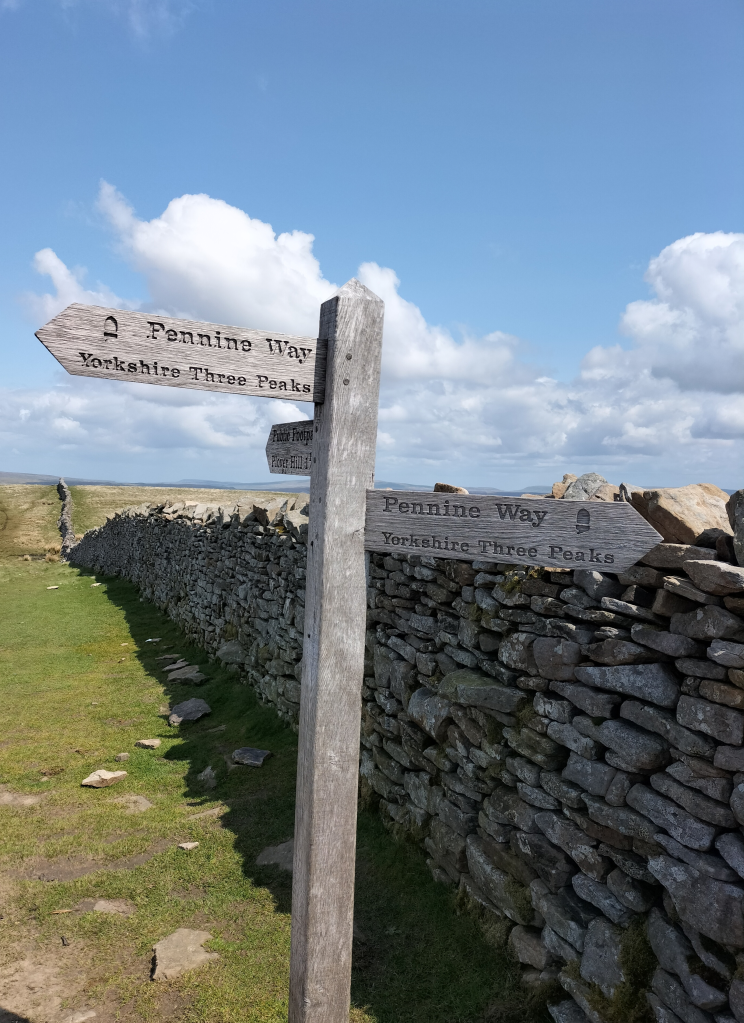
I was told Pen-y-ghent is the smallest of the Yorkshire Three Peaks in the Yorkshire Dales, England. Although I’d read that it was an eleven kilometre circular walk I was told by the photographer that we would only be walking around the base of it. The photographer told fibs.He always tells fibs, to ” get the best photographs”. You’d think I’d know this after all these years.
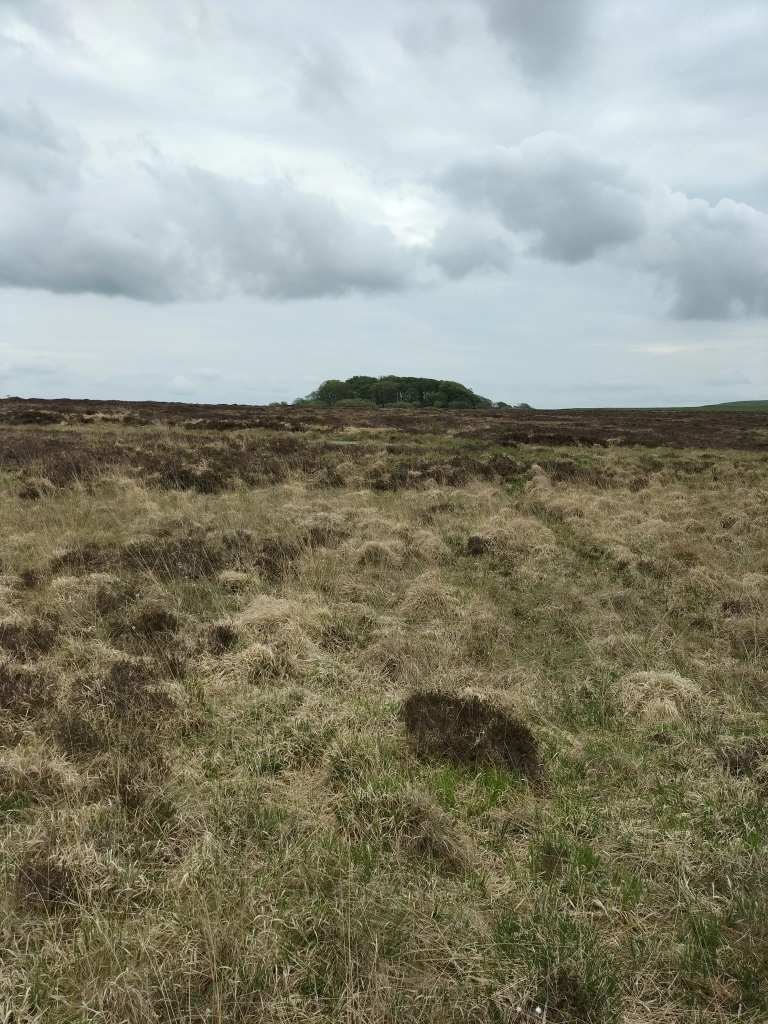
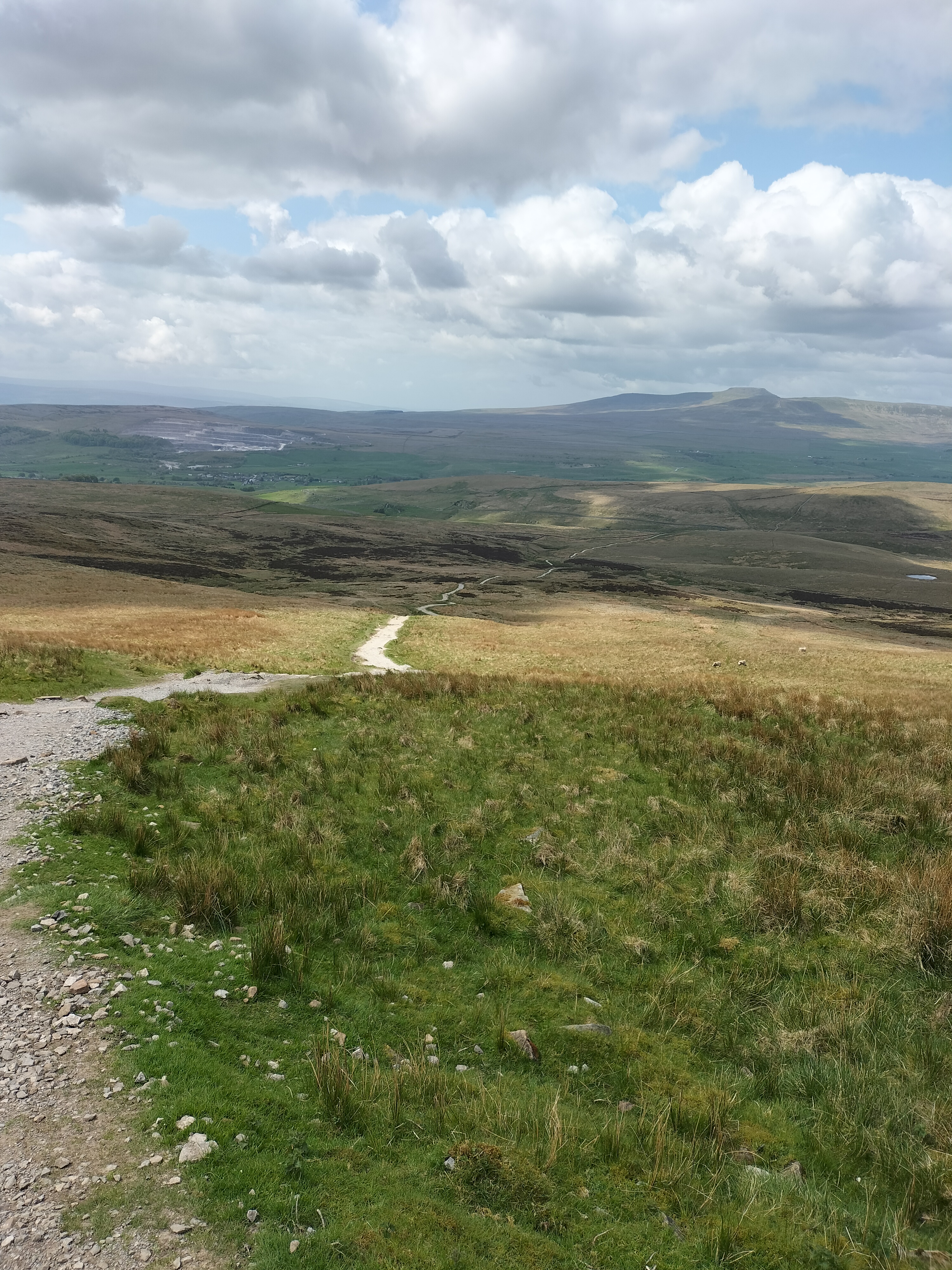
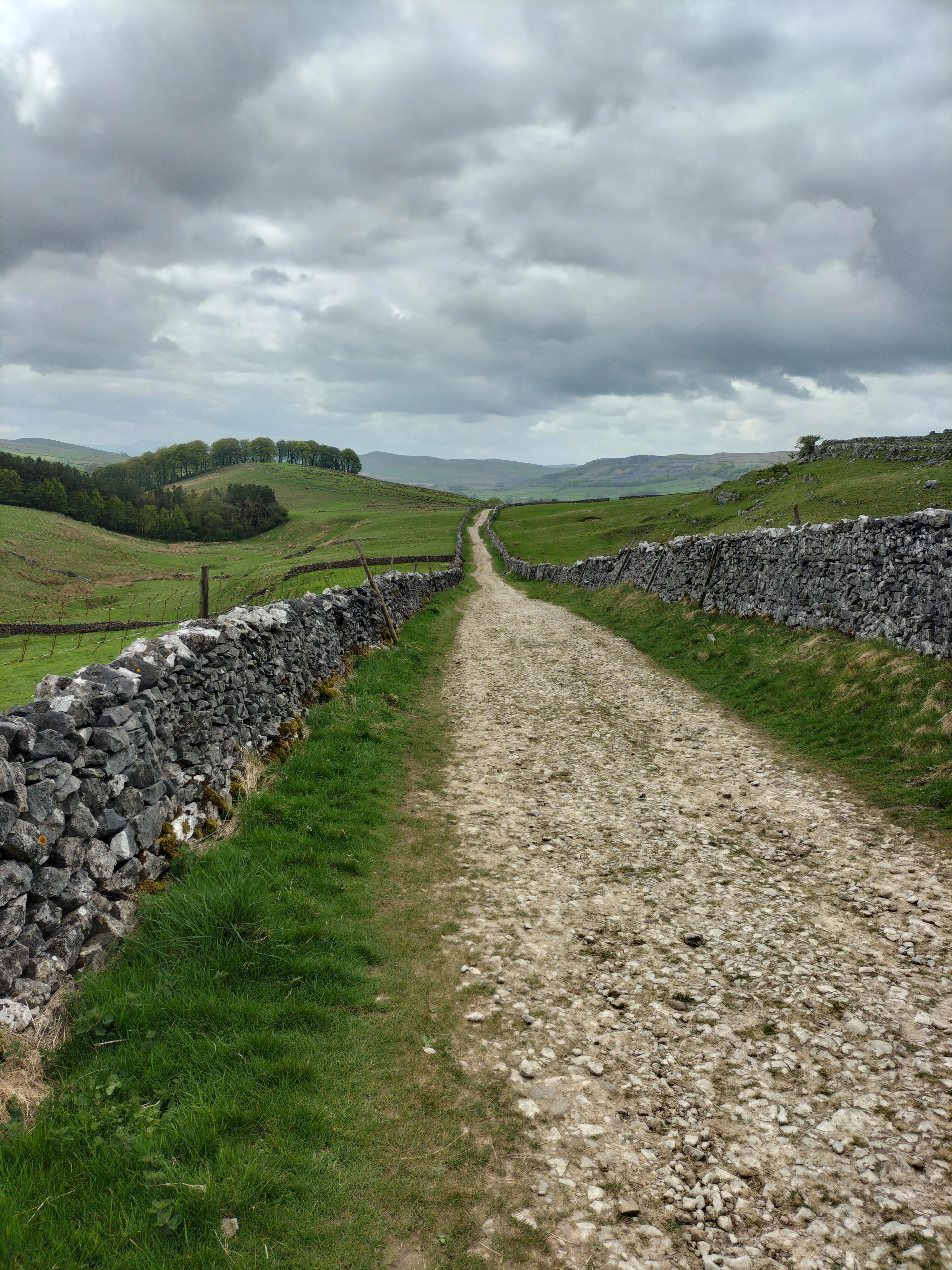
It’s just possible in this photograph to see the track way in the distance. Unfortunately, keeping my head down to make sure I navigated the rocks and ruts in the track, I didn’t notice at the time.
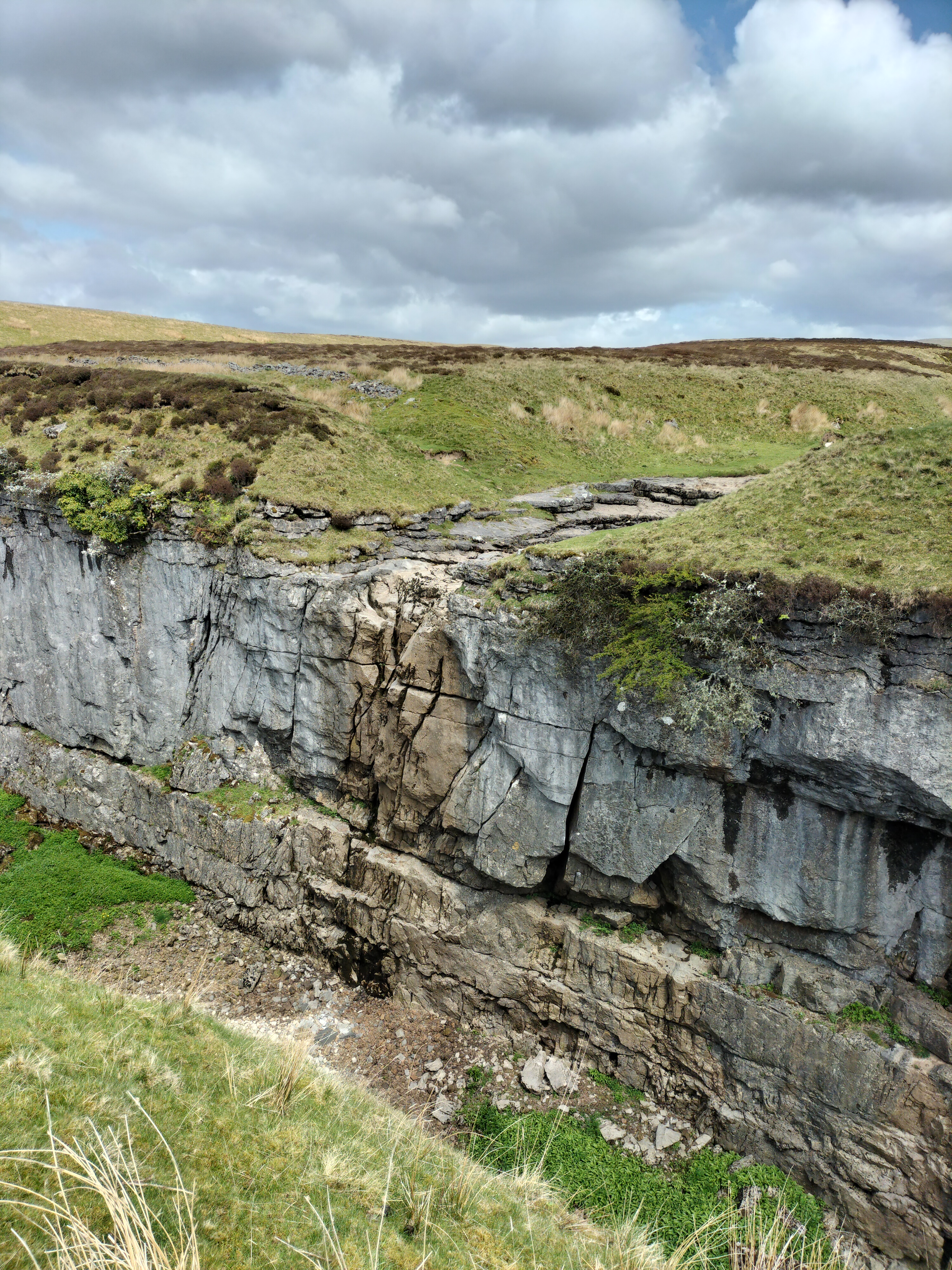
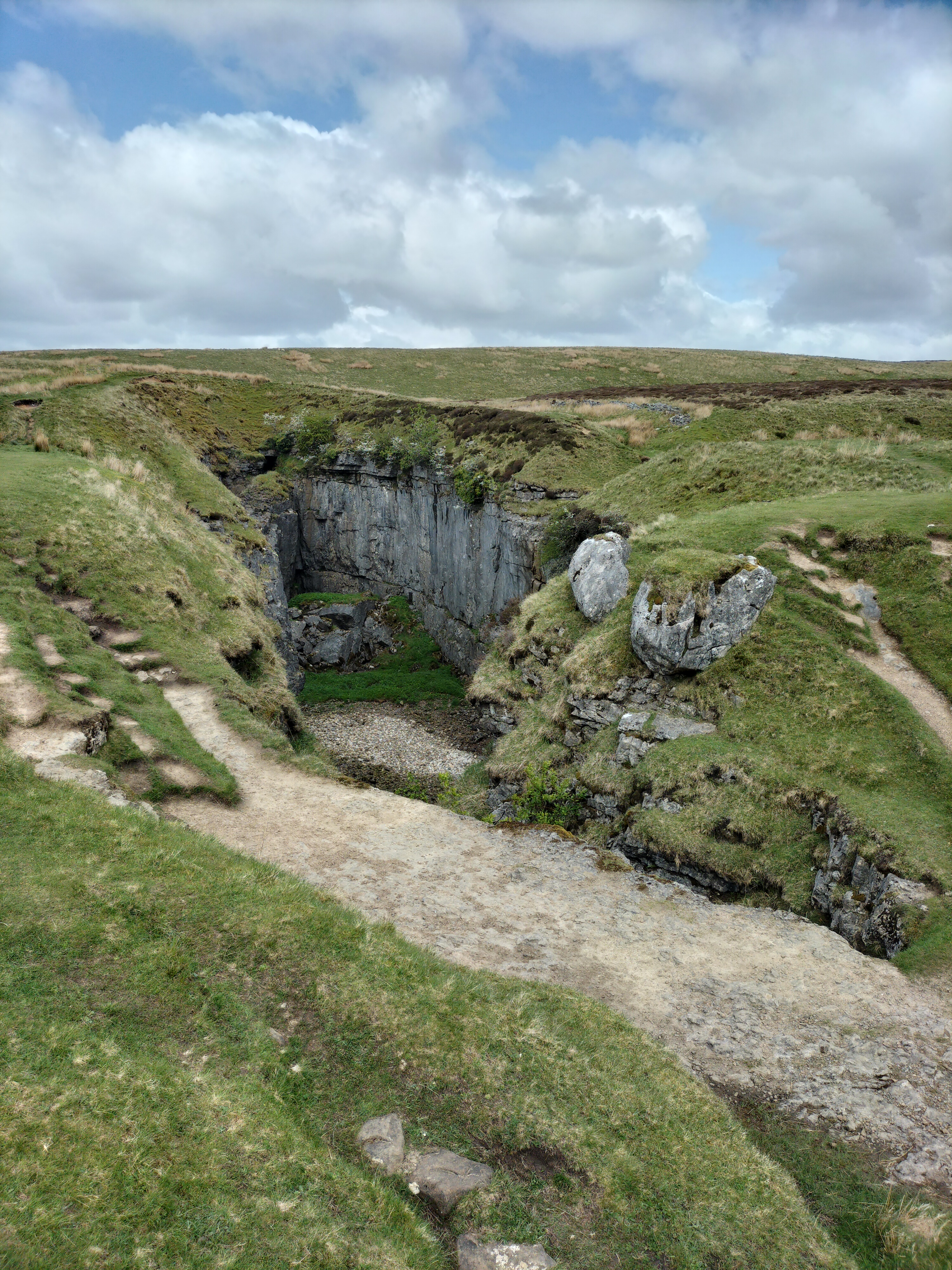
Before we began the ascent we did a detour for about five hundred metres to Hull Pot, a collapsed cavern. I’d read that after rainfall there is an impressive waterfall there, and even, after prolonged rainfall, it turns into a temporary lake. However we arrived after a time of little rain. Still the rock formation of grit stone and sandstone was fascinating.
Pen-y-ghent stands at six hundred and ninety four metres. The higher we went, the colder and windier it became. And the higher we went the steeper some of the sections became, and the more breathless I was. A good excuse to have to take more photographs.
Approaching the summit are a series of man- made steps leading to the summit – all two hundred and ten of them.
Unfortunately we discovered we’d walked up the alternative route, which meant that the scramble up to the top from the other side looked like a sheer drop downwards to me. We decided to retrace our steps. We returned to Horton via an enclosed walled lane called Horton Scar, with aching legs and feet. (The photographer wants me to stress that I’m speaking for myself here).
‘That is the longest, highest walk we’ll be doing this week, isn’t it?’ I asked
The start to our week of walking in the Yorkshire Dales and we began with an easy stroll along the banks of the river Ribble. The name ‘Ribble’ is thought to derive from the Breton word ‘Ribl’ meaning ‘riverbank’. The river begins in the Yorkshire Dales in Ribblesdale, at at a spot called Gavel Gap high on the moor above Newby Head. It’s a famous salmon river and in the Autumn it’s possible to watch salmon leaping up the various waterfalls along its course.
But we’re here in May, and it’s the time of bluebells and wild garlic.
Ribblesdale is the best known walking area in the National Park and features Yorkshire’s famous Three Peaks – Whernside, Ingleborough and Pen-y-Ghent (more about the last on my next post) – offering challenging walks and amazing views. This short walk is the easiest section of the Ribble Way.
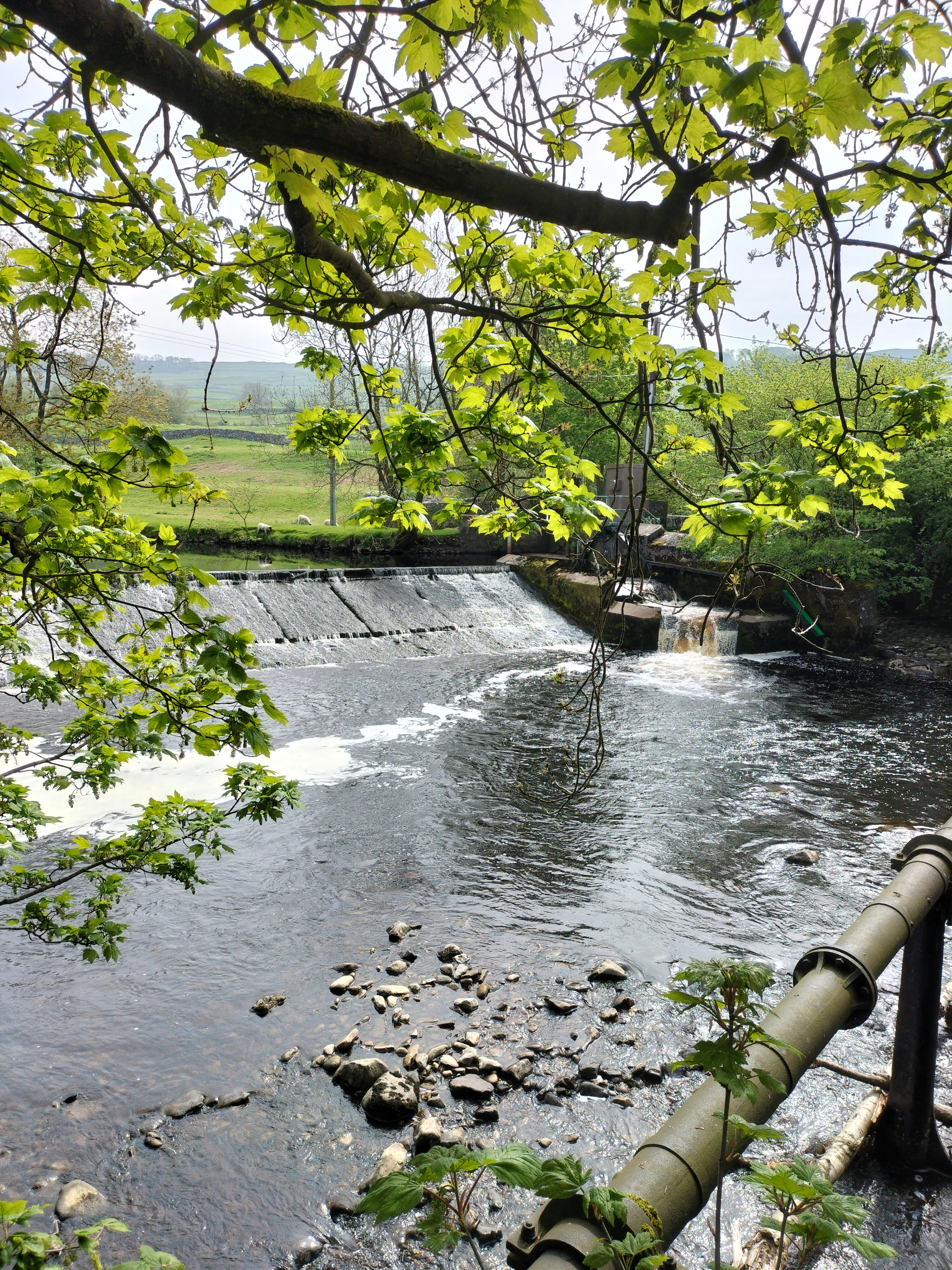
The weir at Longcliffe.
We passed the remains of old cotton and snuff mills, industries long gone now but the houses that were the homes for many of the labourers still stand, strong buildings many built of the local grit stone.
Nearby is the town of Settle where the hydro harnesses the river to create clean, green electricity.
Photograph courtesy of settlehydro.org.uk/
The Hydro is powered by water from the Ribble immediatelyabove the weir, through a sluice gate, down what is called the Archimedes Screw (the turbine) and back into the Ribble just after the base of the weir. Electricity is generated by the falling water rotating the turbine which, in turn, drives a generator. The electricity is fed by a direct line to the old mill building which is now apartments. Any electricity not needed by the apartments is fed into the National Grid.
It was a lovely easy trail, the weather was good, a perfect stroll through the fields and on the Settle bridleway.
And perfect for the photographer to capture two of his favourite subjects… Water and reflections.
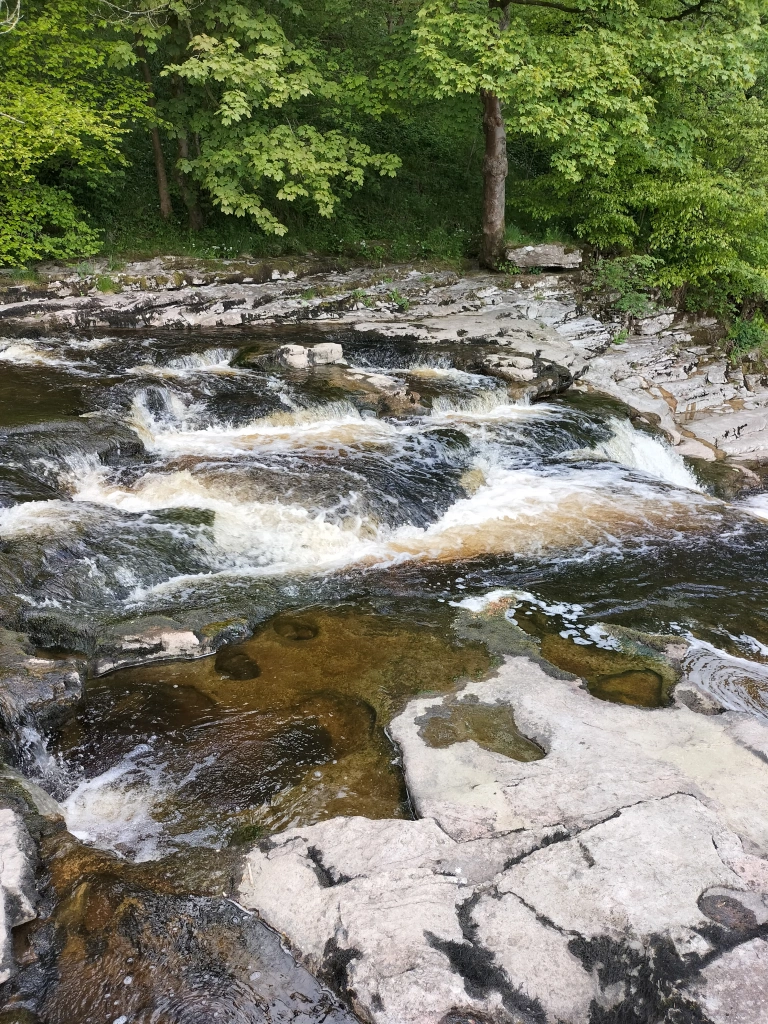
Our main aim for this walk was to see Stainforth Force,the two metre high cascade waterfallwhere the salmon leap in the Autumn.
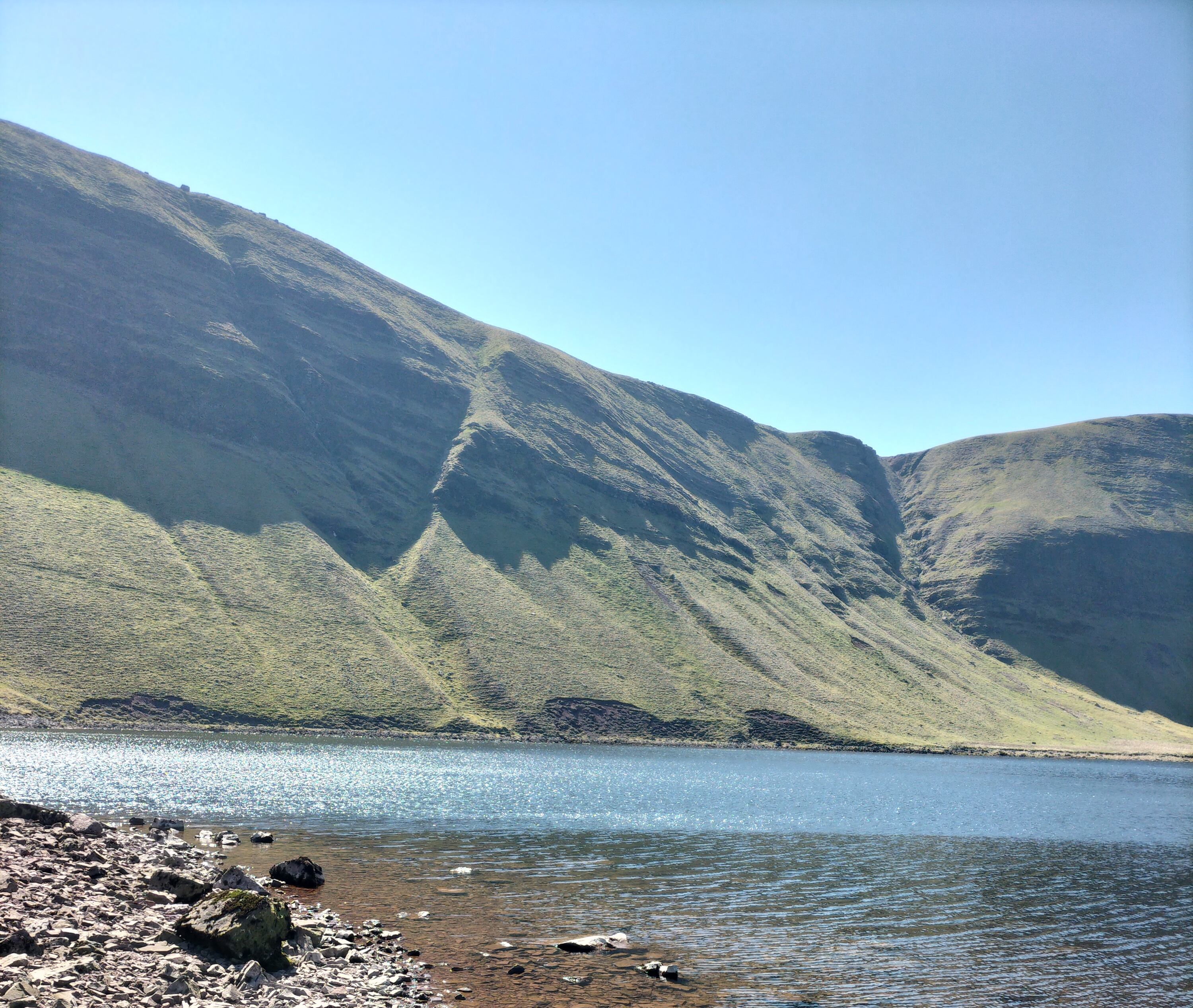
Llyn y Fan Fach is a glacial lake in the Brecon Beacons situated beneath Picws Du mountain, the second highest peak of the Carmarthen Fans in the Carmarthenshire section of the Black Mountain in the west of the Brecon Beacons. (The name Brecon Beacons has recently reverted to its old Welsh name, Bannau Brycheiniog, which means “the peaks of Brychan’s kingdom”)
For anyone interested Brychan Brycheiniog was a legendary 5th-century king of Brycheiniog (Brecknockshire, alternatively Breconshire in Mid Wales.
Brychan depicted in a window of the church in Brecon, Wales.
There is one thing I want to say before we go any further with this post.
Never believe the stats!
Distance: 9.2 miles (14.8km) circuit (Let’s just say Circuitous! Or, if you’re really wanting to be pedantic – like a dog’s hind leg… or two!) Elevation gain: 720m (Gain is the right word. The exhilaration of getting anywhere near that height makes one feel as if one has reached the top of the world. If you can get enough breath to get that far!) Difficulty:Moderate (if you can call the initial mile of a one in ten ratio upwards on a stony, gravelly track, followed by steeper narrow paths – Moderate.
The Llyn y Fan Fach car park near is reached by a winding single track road (with the added bonus of few signposts in an area that the SAT NAV doesn’t recognise – we went in a complete circle at one point) and is remote with no facilities. At all (Am I selling it to you yet? Hmm? Well… I will… later. Honest.).
All the previous being said, we had a wonderful day’s walk. Hike… I should have said hike, here(Or even … climb!)
Actually, when we arrived there was a group of young people from London who were walking the area as part as their Duke of Edinburgh Award. Very chatty – when they stopped to get their breath – which was as often as us. So I didn’t feel that decrepit!
And, of course, we had a picnic sitting by Lyn y Fan Fach, a beautiful lake surrounded by magnificent craggy mountain peaks. Sheltered by a wall, with the sun warm on our backs, we watched the grass swaying under the clear water, the surface a glistening reflection of the sky. The only sounds were the rustling of the wind, the cries of the skylarks, and, in the distance, the faint voices of people walking along the ridges of the Picws Du mountain
Which gave the photographer a chance to peruse the area.
Llyn y Fan Fach is renowned for Welsh Folklore. One folklore legendis the myth of ‘The lady of the lake’. In the folktale, a young farmer of the 13th century spotted the most beautiful girl he’d ever seen emerge from the lake, she was a princess from the kingdom of fairies. He courted the fairy princess by baking her bread and after three attempts he succeeded in winning her hand in marriage on the condition that if he hit her three times she would leave him. He complied easily because she was so beautiful and they were happy for years bringing up a family at his farm near Myddfai, with her magic dowry of farm animals. In time the inevitable happened he hit his wife (reported as apparently playfully!?) and she disappeared back into the lake taking her prized animals with her, leaving the farmer with her sons. The sons once grown became known as the “Physicians of Myddfai” who became physicians to the English royal court..
Further to the east, beneath the peak of Fan Brycheiniog, there is another larger lake called Llyn y Fan Fawr. These lakes and peaks can be visited through a combination of mountain walks. We studied the climb to the right. A very steep climb. And decided to take the easier routeto the left.Easier for some – see below – the photographer in the distance, eager to get more photo opportunities.
It was so clear we could the rise and fall of the land for miles, it was stunning.
The path often disappeared under the mounds of long tough tussock grass and patches of boggy water. Though awe inspiring it felt very isolated: a few people far above us on the ridges of Fan Brycheiniog, a man striding, then sitting down, in the distance, a group of young men studying compasses and maps.We stopped – often – when skylarks rose and fluttered in front of us, desperate to take us away from their nests in the undergrowth. The wind came in strong cold bursts, and after we’d walked another mile, we knew, however disappointing it was, that we should turn back; not try to reach the other lake, Llyn y Fan Fawr, beneath the peak of Fan Brycheiniog, The speed we were going, we would chance being there after dark. Perhaps we shouldn’t have lingered so long at the first lake.Or set out earlier in the day. Or not got lost.
So, after a couple of photo shots, we made our way back across the land and down the track to the car. The Duke of Edinburgh students were still somewhere on the ridge. Knowing how they had dreaded the climb I didn’t envy them. And yet, not having achieved what we set out to do…
Still, a wonderful day in all.
Until the next time we attempt this walk …. or not.
When I was a child my mother took me every Saturday to the small library in our village. I was allowed six books – usually all read by the Wednesday (I was one of those kids who read by torchlight under the bedclothes – and got away with it for years!) I would then wait, not always patiently, until the weekend, when we would go again. I think it was a great relief to both my mother and myself when I was at last allowed to walk to the library by myself.
By the way…In the very olden days libraries were named from the Latin “liber”, meaning “book.” In Greek and the Romance languages, the corresponding term is “bibliotheca”. Or, if you want to go with the medieval version “Calque of Old English bōchord (‘library, collection of books’), equivalent to book + hoard.”
Just thought you might want to know that.
Anyway, when I was a child – libraries were just… libraries. The place one went to to borrow books. For free!!
Image courtesy of Pixabay
Today, libraries are still one of the few free services left. Libraries are used for many different reasons; they contain not only books. magazines, newspapers, manuscripts, but also CDs, DVDs, e-books, audiobooks etc. They connect us to information.And, important in these days, they are also community hubs where authors (if they’re lucky) can go to give talks, hold workshops. It’s where people can connect with other people. They are safe havens.
Reading for pleasure, is one of the most important things one can do, so what we need to make sure of is that future generations have the opportunity to do just that. Books represent the chance for us not only to enjoy the work of so many brilliant writers, but to also to grow, to change, to see life from other points of view. We will only ever see life through our own perspective … unless we read.
In our area, the Pembrokeshire County Council has approved its budget for 2023-24. We will have a Council Tax rise of 7.5%. It would be wonderful if the value of libraries and librarians were understood; if those in authority – those with access to their council budgets – acknowledged this importance for every generation. If enough funding were to ploughed into libraries to preserve them.
Image courtesy of Pixabay
Each month on the Libraries Wales website, they focus on introducing an author based in or writing about Wales. I am thrilled to be the author for April 2023.And I am more than happy, alongside other friends who are also writers, to talk about the value of books and the enjoyment of reading.Just give us the chance!!
We found Pembrokeshire by lucky accident. With three children under three years of age, we didn’t want to go far on our annual holiday. Wales didn’t seem that far away from Yorkshire, well, not as far as Cornwall… we thought. We found the house we’ve lived in for over forty years by accident. Being auctioned we thought it fun to dream, to put in a bid. We’ll never get it… we thought. We did. With the optimism of youth and dreams of living near the sea we sold our house in Yorkshire. It’ll be an adventure… we thought. And we could always move back if we don’t settle. We’ll give it five years.We didn’t need five years. Although we moved to Pembrokeshire in the depths of November to a house with no electricity, heating, and not nearly enough furniture to fill a large five bedroomed house, we knew we’d done the right thing. Despite all of us muffled in so many layers of clotihng we looked like a set of Michelin Men ( remember those advert?), we were happy – we were bringing up our children in a wonderful place.
Over the years we’ve walked many times around the Llys – y- Fran reservoir, now called the Llys-y-Fran Country Park.
Back in the day (as my grandad used to say), the walk around the reservoir (about seven miles) was more of a hike and a scrabble around rocks, trees, and, sometimes, through streams.There’s still a little negotiating of streams, as I mention later.
But first the technical and public information bits…
Llys-y-Fran Country Park is three hundred and fifty acres in all, which includes the two hundred and twelve acresof the reservoir. In the parish of the village Llys y Fran, the community of New Moat, it’s on the southern slopes of the Preseli Mountains.
Llys-y-Frân dam was constructed between September 1968 and 1972.The final concrete was laid on the nineteenth May 1971, completing a total of over 500,000 tons of the stuff since the project began. By May, the depth of water had risen to forty feet but it was only on the fifth of December 1971, exactly nine months after impounding had started, that the reservoir overflowed for the first time.
The reservoir was officially opened by HRH Princess Margaret, Countess of Snowdon, on Tuesday, the ninth of May, 1972.
The dam is a hundred feet (thirty metres) high and the lake is fed by the River Syfynwy.The water is used by homes and industry in south Pembrokeshireand is managed by Welsh Water. It’s one of eight-one reservoirs in Wales.
The forecast for the day was good, so we donned walking boots and rucksacks and set off. I’m cheating a little here – the photograph below was taken on the last stretch of the homeward-bound section, as we looked back with smugness on how far we’d walked.
Back to the beginning… These days the walk is a wider, if still steep and winding in places, gravelly track around the circuit of the lake, and is interspersed with cycling routes of varying degrees of difficulty. I promise you, (and am most disappointed that I forgot to ask husband to photograph it), there was one route highlighted by a sign of a skull and crossbones… with a note that the route was only for those of the highest skill and fitness … (and, I added to myself, the most crazy!).
“There’s a lot of water to cross, isn’t there?” I remarked, after wobbling on strategically-placed rocks and tree trunks in one particularly wide stream.
“Well, it is a reservoir,” he replied, striding manfully through the water.
“Sarcasm is the lowest form of wit!” Was the only remark I could summon up, as I stopped trying to balance and sloshed after him.
The whole time we walked we met only two cyclists and three couples with dogs. The sun shone (most of the time) and there was just a slight breeze that moved the grasses, the patches of daffodils, the leaves and petals of the primroses, the early gorse. Except for the calls of the Canada Geese and, at one point, the noisy squabble of seagulls, it was peaceful. Through the woodland there were stunning views all along the way.
We stopped for a picnic. I won’t admit we stopped to catch our breath – although we did do a bit of puffing up those steeper parts. I’ll even go as far as to say it stopped me talking … sometimes!Anyway, we were ready for a bite to eat, a coffee, and another photograph opportunity .
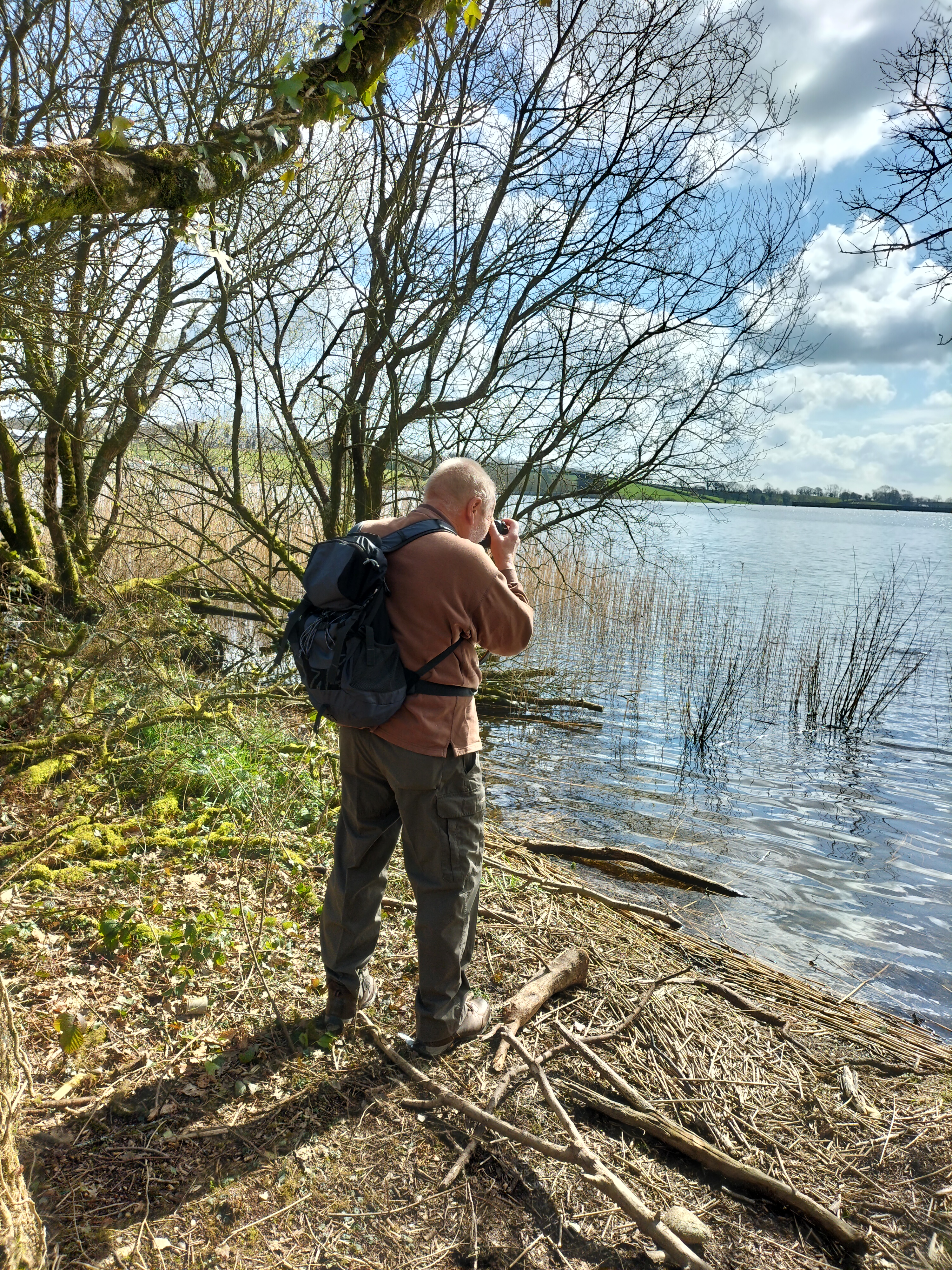
The photographer! What isn’t seen here is the robin who followed us around for a least a mile after we’d fed him some crumbs, and is a few inches behind David, patiently waiting for him to move (he had his foot on a crust of bread).
What used to take us two and a half hours to walk this trail, this time took us over three and a half. I claim mitigating circumstances – we stopped often ( very often) for husband to take photos. Oh … and to eat the picnic.
And I refuse to talk about the fact that we both walked like ducks the day after!
N.B. The word llys translates into English as “court” and y frân translates as“[of] the crow“. Just thought you might like to know that.
Interviewing Debby, who is one of the easiest people to talk to, despite her and her father’s fame. She is so open, so honest, so interesting. And it was fascinating to delve into the reasons she wrote her book.
Over the last few years, I have interviewed many authors and writers of various genres. It’s fun, something I enjoy. Pre-pandemic it was in the studios, but since it’s been through zoom which means it’s easier to chat with anyone from all over the world.
The great thing about www.showboat.tv is that, unlike many other online interviews, these chats are edited. So any waffling (usually on my part), any stumbling or stuttering, or, as they say “Up North” any faffing about, is never seen by the audience.
And the other, brilliant part of the whole process, is that it brings the authors and their books, to the attention of readers and viewers all across the world.
What more could a writer ask? My future posts will be about some of the authors I’ve interviewed so far. I’ll be asking them a little more about them selves and how they enjoyed ( or dreaded!) the experience. How it was for them… kind of thing!!
About Debby Campbell
Country music singer and activist for Alzheimer’s, Debby Campbell was born in Albuquerque, New Mexico in 1956 to Diane Kirk and Glen Travis Campbell. She is the eldest of 8 children and the daughter of the most famous “Rhinestone Cowboy” Glen Campbell. Debby loved singing from an early age and spent many summers with her dad on tour, and in the television studios with his Glen Campbell Goodtime Hour television show.
Debby graduated high school in England living with her mom and step-dad Jack, while her step-dad was in the Air Force. Her dad, Glen became a world sensation, and would perform in England and send for Debby so she could spend time with him.
In her early 20’s, Debby married and became a mother of 3, two boys and a girl. She lived in Italy, and the US during this time and currently loves being a grandmother to 6 grandchildren and 1 great-grand child.
In the mid 80’s Debby became a flight attendant and today, remains flying international as well as domestic.
In 1987 Debby became part of her dad’s show on tour as a featured singer, along with her full time job as a flight attendant. She toured and traveled with the Glen Campbell show for 24 years, which included travels to Europe, Australia, New Zealand, Tasmania and Bermuda and so many more. Many of the Glen Campbell fans became loyal fans & friends of Debby’s and she has remained friends with them today.
Her appreciation for Country music landed her with her own show in Branson, Missouri at the Roy Clark Theatre in the early 90’s. She continued her career as a featured singer at the Grand Palace with her dad and then on to her Dad’s Theatre –The Glen Campbell Goodtime Theatre and ending with a residency at the Andy Williams Moon River Theatre.
Debby’s bragging rights include hosting the Jerry Lewis MDA Telethon, performances at the Grand Ole Opry, opened for greats and Grammy Award artist such as Charlie Daniels, Jerry Reed, Eddie Rabbit, Colin Raye, and performing the National Anthem for the National Finals Rodeo in Las Vegas. She is an author of her recently released book titled “Life with My Father Glen Campbell”. She has also been credited with recording duets with her dad on “United We Stand”, “Let It Be Me”, and “Little Green Apples” and on multiple recording of Glen’s “Live with South Dakota Symphony” on CD and DVD. As Glen recorded some of his final music, Debby was instrumental on background vocals.
Debby is active with the Alzheimer’s cause and finds time for her first priority, family and friends. She golfs, enjoys bowling, travel and of course singing.
The Glen Campbellstory is one of exceptional musical talent, a glittering career and a frequently disturbed personal life. In August, 2017, after battling Alzheimer’s disease, his death was announced to the world.
This celebratory Omnibus enhanced edition of Burning Bridges: Life With My Father Glen Campbell includes both an interactive digital timeline of his life, filled with videos and images of live performances and interviews, as well as a Spotify collection of the greatest recordings that Glen Campbell ever made.
As a studio musician Campbell contributed to countless Sixties and Seventies records; as a solo artist he produced the classic hits Galveston, By The Time I Get To Phoenix, Wichita Lineman and Rhinestone Cowboy; he had a successful US TV show, co-starred with John Wayne in the film True Grit, and was lauded for his talents. However, a series of failed marriages saw this shining star fall heavily into serious substance abuse, and the fabric of his life unravelled.
Persistent short-term memory loss resulted from this turbulence and Glen Campbell would have few constants in his life as the years waned on. One of them, however, was the co-author of this book, his daughter Debby. She witnessed his struggles and suffering, both musically and personally, as well as the beginning of his decline into Alzheimer’s disease.
Burning Bridges: Life With My Father Glen Campbell is a loving but unflinching reminiscence of a multi-talented musician, a troubled man and a father. Debby Campbell provides a poignant, eye-witness account of a musical legend like no other.
Actually, two zoom interviews have been uploaded with the incredible Debby Campbell, daughter of the legendary country singer, Glen Campbell. In Booksmart, she talks to Judith Barrow about her book documenting her life of the road with her father, while on Inside Notes, she discusses her latest album plus her new single “Sunflower”.Watch them for a limited time free of charge on the homepage www.showboat.tv
And here Showboat TV tells us how to watch anytime
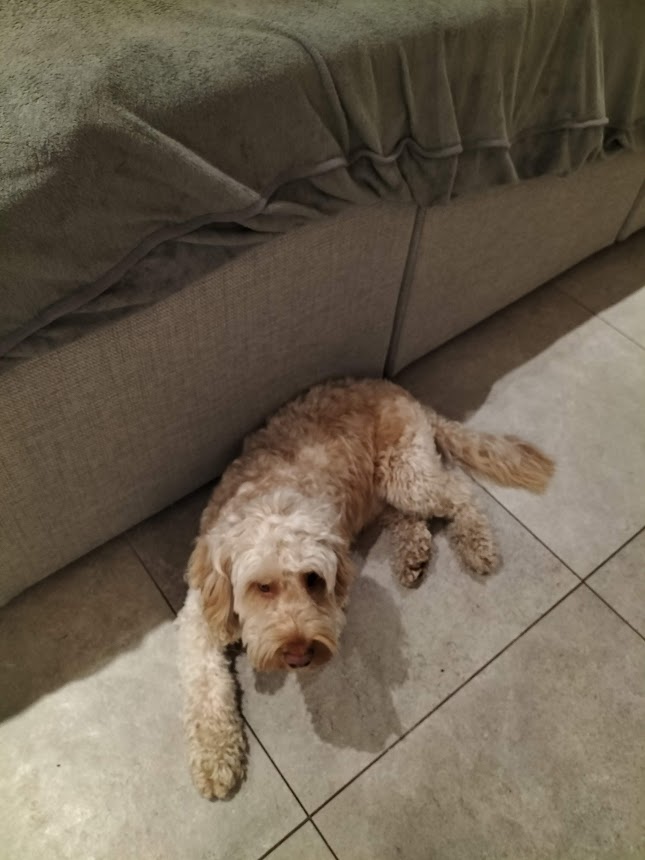
I’d no intention of getting lost – but there again, I never do. It just happens. Usually I have a husband (not a random husband, the one I’ve had for some years) to point me in the right direction. He’s used to me saying ” how far away are we from where we were?”, but this time I was on my own. Well, me and daughter’s dog, Benji.
Looking non too happy. (the reason will become apparent later)
Radyr Woods is around fourteen acres of woodland, with a network of footpaths, boardwalks, and steps throughout the wood.
There is easy access to a mixed woodland and include a local nature reserve (Hermit Wood), with a canal, streams, ponds, springs, grass and heath land.
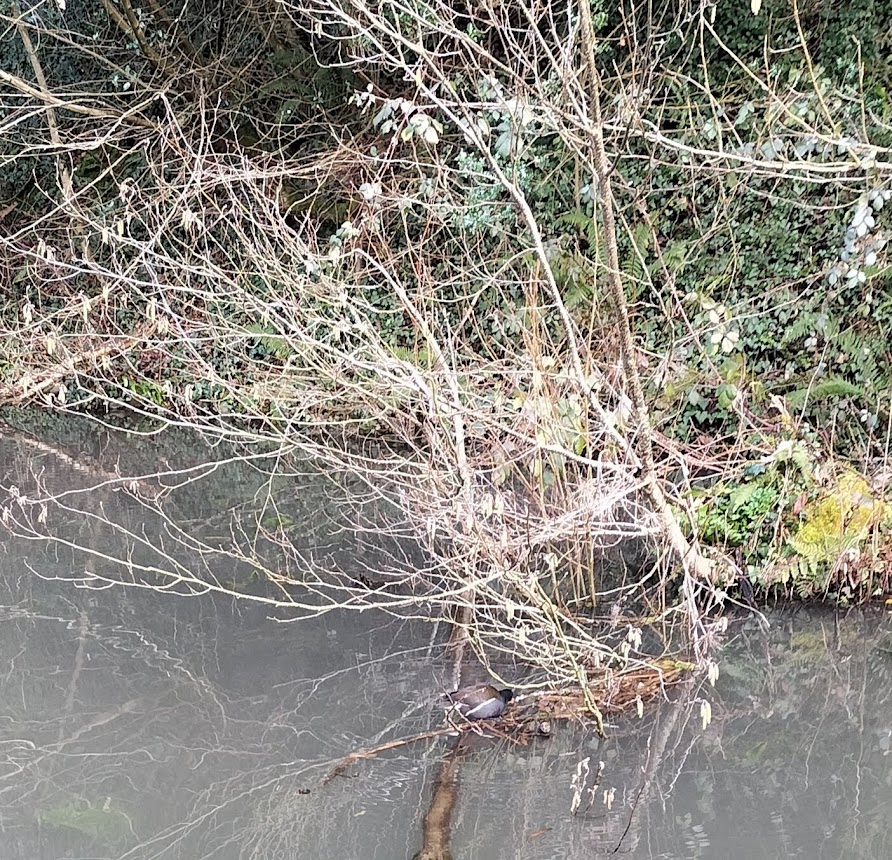
And ducks.
Look carefully… there is a duck, hiding on a mix of branches… honest!
And another… swimming this time.
And there are interesting panels explaining the intriguing history of the area...
Apparently there are the remains of a late-Prehistoric burnt mound where hot stones would have been immersed in water until it boiled and the burnt and broken stones or pot boilers formed the mound. Although it’s not known what the mound was used for (one could guess rituals – but I’ll go no further with that idea) The mound wasn’t discovered until 1911, but it is evidence that the site was inhabited centuries ago. There are also rumours that a 10th century holy well existed on the site In medieval times Radyr Woods formed a part of the walled deer park of Radyr Court, the historic home of the Mathew family.
The area was farmed and quarried up to the mid 20th century. Conglomerate stone from the Radyr Quarry was used in the construction of both Llandaff Cathedral and Cardiff Castle.
There were quite a few other dog walkers to pass pleasantries with and allowing the dogs to sniff one another’s bottoms socialise. Then I met a man walking his dog, and his ferret
He offered to show me how the ferret walked on the lead. But I had seen him walking towards us for some time. And Benji was showing rather too much interest in the proceedings. I thought it safer for the man to hold said ferret up high-ish. Still a bit too close to Benji, I thought. His dog just looked bored.
I walked on, not noticing which paths I took. Until I realised I didn’t know where I was, and how to find my way back.
When one path seemed to run out and I sank into the mud I thought I’d better turn back. After wandering aimlessly for ten minutesI met a young woman I’d spoken to earlier and when she realised how clueless I was, she took pity on me and, with the aid of Google maps (“you haven’t got Google maps?!”, looking askance at me), walked back with me (quite a long way) to where I eventually recognised a path.
Quite fortuitous meeting her, actually. She belongs to a reading group and I’ll be going to talk with them sometime soon.
As for the sulky looking Benji at the start of this adventure – covered in mud when we eventually arrived back at the house, he needed a bath. And wasn’t impressed.
Thank you so much to Random Things Tours for allowing me to be part of the book tour!
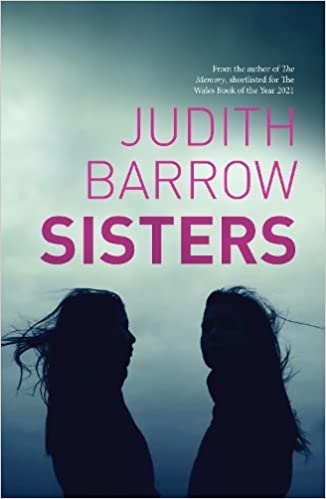
Synopsis: A terrible accident followed by a terrible lie tears two sisters apart. Many taking the blame for it all, because Angie believes she is too young to get into trouble. But she is very wrong and as a result, Mandy feels she is no longer wanted and goes to build a new life and identity at her aunt’s. Mandy starts new as Lisa, slowly she begins to get her life back on track, refusing to have anything to do with her sister again. But 13 years later, they meet again at their mother’s funeral and Lisa sees something is very wrong with her sister. Angie is terrified of her husband and her…
Seeing the results of the Wales Book of the Year Award 2024, and reading one or two of the books of the shortlisted authors over the last month, brought back memories of 2021 when I was nominated for the Literature Wales Book of the Year Award. It still feels strange.
The Memory was published around the first week of the first lockdown and I thought it became lost in all the disruption and anxiety of the pandemic. So, when I first heard that the book was being nominated, it was a complete surprise. Naturally I was also thrilled because, at that time,The Memory was so different from my first four novels, which are historical family sagas. And I wasn’t sure how it would be received by the readers who had enjoyed those books. So, to be recognised by Literature Wales for the Wales Book of the Year Award 2021, The Rhys Davies Trust Fiction Award, was a great accolade for me.
I believe we are all affected by our pasts; experiences that shape our present and future. And, as writers, memories feed our stories. Families fascinate me: the love, the loyalties, the rivalry, the complex relationships. Layers that are in all families. The casual acceptance of one another in a family can bring the best and the worst out in all of us, so there is a wealth of human emotions to work with. This is how The Memory evolved. A little of the background comes from a time when I was a carer for my aunt who lived with us. She developed dementia and I kept a journal so we could talk about what we’d done each day. Many years after she’d died, some of those recollections crept into The Memory. And then there are the memories from my childhood, when I had a friend who was a Downs Syndrome child. The affection she gave, the happiness that seemed to surround her, is something I remembered long after she died of heart failure at the age of eleven. And I wanted that love to be a huge part of the book, a main theme. Fundamentally it’s the story of a secret that is never discussed within a family, but which has had a profound lifelong effect on the relationship between the mother and daughter. The Memory is sometimes poignant, sometimes sad, but is threaded throughout with humour.
Reviewsfor The Memory:
“… As a reader, when a character becomes as completely real to me as Irene does, I often find myself wondering what happened next for her. But Irene’s story is so perfectly and elegantly resolved that I know without a shade of doubt what her future holds.The Memory is not a comfortable or easy read. But if you’re looking for a beautifully written, character-driven story with a dark base but superb resolution, it just might be the perfect choice.”
” …The writing is what I’ve come to expect from Judith Barrow. The effortless prose brings a fresh quality to the mundane and familiar. There’s also a building menace to the book and a sense of foreboding that drives you on right to the surprising end. The Memory is a remarkable book and I wholeheartedly recommend it.”
When The Memory was shortlisted for theWales Book of the Year Award in 2021 I was also pleased for Honno. I’d been published by them for many years and I believe it also gave them some much deserved recognition.
And I’m thrilled that Honno will be publishing my eighth book with them in November.
The Stranger in My House.
After the death of their mum, twins Chloe and Charlie are shocked when their dad introduces Lynne as their ‘new mummy’. Lynne, a district nurse, is trusted in the community, but the twins can see her kind smile doesn’t meet her eyes. In the months that follow they suffer the torment Lynne brings to their house as she stops at nothing in her need to be in control.
Betrayed, separated and alone, the twins struggle to build new lives as adults, but will they find happiness or repeat past mistakes? Will they discover Lynne’s secret plans for their father? Will they find each other in time?
The Stranger in My House is a gripping ‘cuckoo in the nest’ domestic thriller, exploring how coercive control can tear a family apart. Set in Yorkshire and Cardiff, from the 60s to the winter of discontent, The Stranger in My House dramatises both the cruelty and the love families hide behind closed doors.
“Judith Barrow’s greatest strength is her understanding of her characters and the time.” TerryTyler
“Then hate me when thou wilt; if ever, now”—William Shakespeare, Sonnet 90. With so many grateful to @barbtaub
, who understands what I tried to achieve.with Sisters. x
Family. We’re hard-wired to need them, to forgive them their trespasses, to love them. But what happens if we don’t like them? If they disappoint us? Or if they just don’t want to be in our lives? We watch it play out between royal brothers on a world stage, and more intimately in our own families.
Recent studies show that over one in four adults will experience family estrangement. It’s often compared to the grieving process following a death—denial, anger, bargaining, depression, and finally acceptance. The difference is that estrangement doesn’t produce the outpouring of support that follows an actual death. Instead, there are feelings of shame layered over loss, grief, and anger. There are questions about identity: are you still a sibling/child/parent if your child or your parent or sibling is removed from your life? With changes in economic dependency, families aren’t needed as…
Judith Barrow is a mistress of dissecting the triumphs and misfortunes of families confronted with crime, disgrace and tragedy. In Sisters, her latest novel, she is at her brilliant best.
The Marsden family of Micklethwaite are doing okay; Eric and Eve, their two teenage daughters Angie and Mandy, and the baby Robert. There are the usual stresses and strains, the usual sibling rivalry, but nothing out of the ordinary. Then tragedy strikes, enough to damage any family, but when it’s exacerbated by lies and guilt, it seems the damage is fatal.
Resentful and hurting, Mandy goes to live with her aunt and uncle, Barb and Chris, in faraway Ponthallen (Wales is often shown as a place of refuge in Judith Barrow’s books). Mandy has a new life, new friends, even a new name, Lisa, anything to start afresh, but she can’t forget or forgive her sister. It’s no easier…
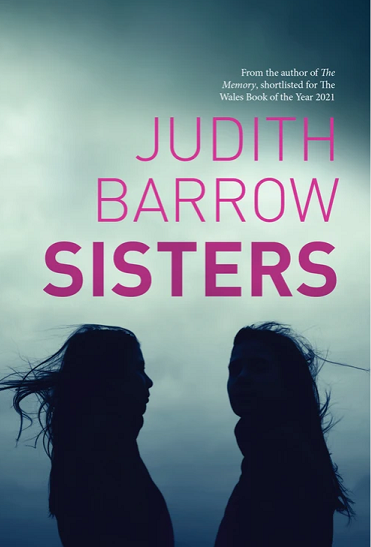
Delighted to share my review for the upcoming family saga, Sistersby Judith Barrow, available on pre-order for January 26th.
About the book
A moving study of the deep feelings – jealousy, love, anger, and revenge – that can break a family apart. … Sisters is another absorbing, emotional and thought-provoking creation from the wonderful Judith Barrow. Janet Laugharne
Two sisters torn apart by a terrible lie.In shock after an unbearable accident. Angie lets her sister Mandy take the blame, thinking she’s too young to get into trouble. But she’s wrong.
Mandy is hounded, bullied and finally sent to live with their aunt, where she changes her name to Lisa and builds a new life, never wanting to see her sister again. Angie’s guilt sends her spiralling into danger. Thirteen years later, they meet again at their mother’s funeral. Lisa starts to suspect something is wrong. Angie seems…