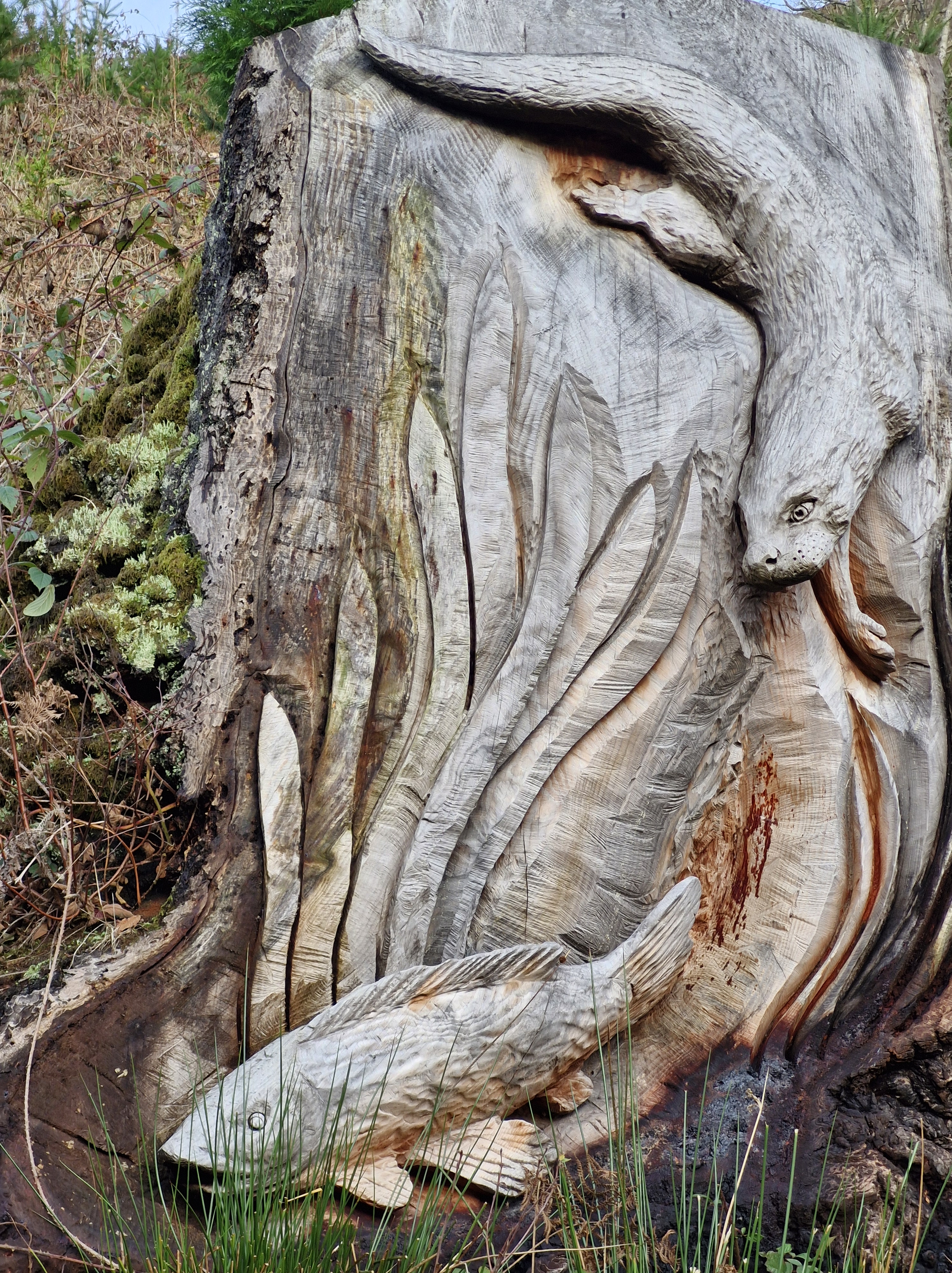
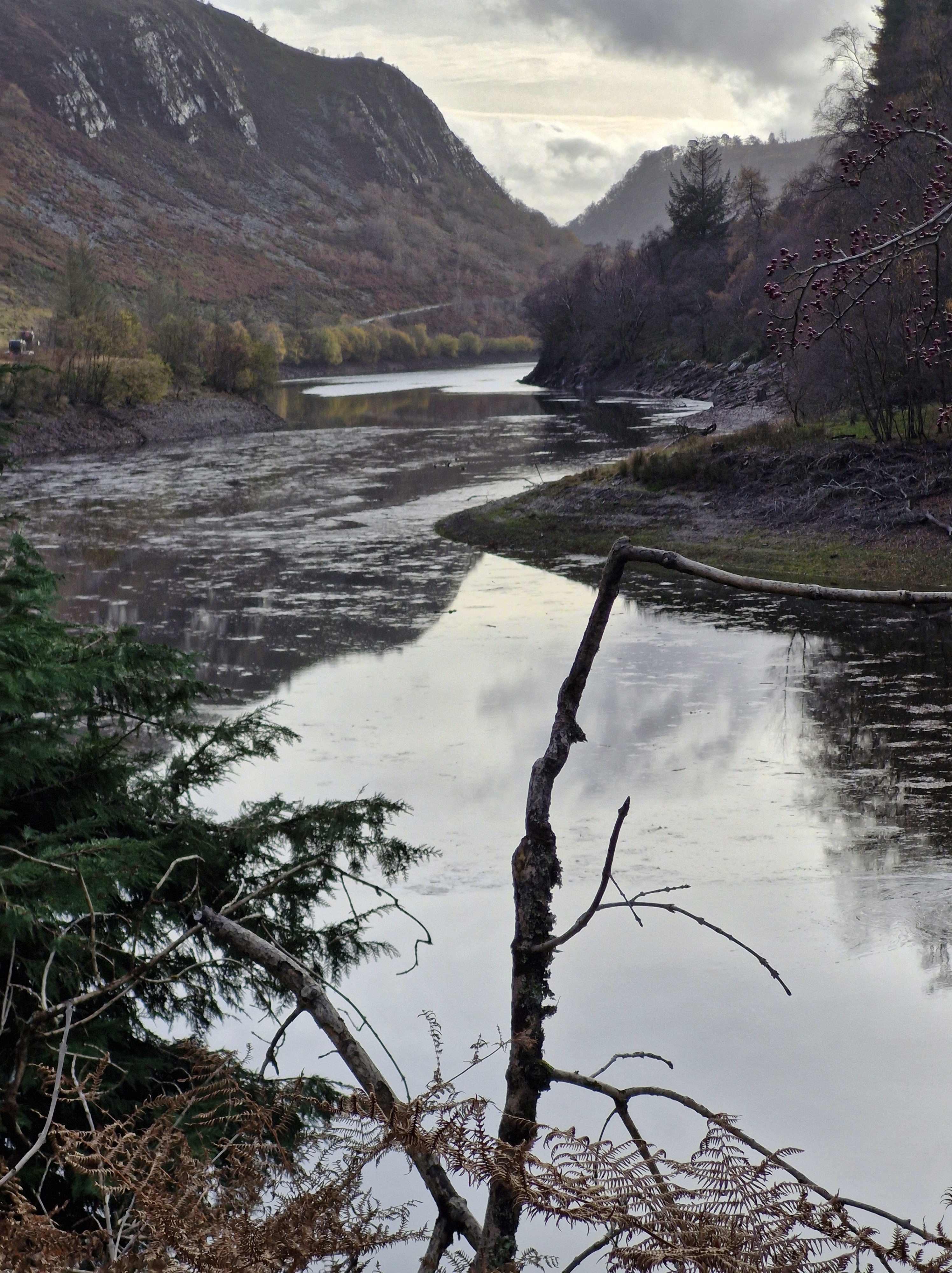
On our recent walk around Garreg Ddu Dam in the lower Elan Valley we noticed that, since we were last here, even more carvings had been created along the trail.
This area of land was originally a Victorian Douglas Fir plantation, clear-felled to reintroduce native species and increase biodiversity. The project to carve the trees lining the road was commissioned Dŵr Cymru Welsh Water and created by chainsaw sculptors Simon O’Rourke, Paul Edwards, and Matthew Crabb, who worked from ideas presented by schoolchildren from the community.
It was getting late in the afternoon, the day had been gloriously sunny and warm, but now dusk was settling in and the gathering clouds in the sky were showing signs of the rain forecast for the following day.
Foel Tower: a point of interest at the start and end of our walk around Garreg-ddu:Just upstream from the submerged dam at Garreg-ddu is the Foel Tower, the starting point for the 70 mile journey of the water supply to Birmingham.
The lower section of Foel Tower has a number of openings inside at different levels where a system of valves and cylinders can be raised and lowered to draw off water from the reservoir at the right depth for the current water level.
The above photograph was taken in 1947 showing the Foel Tower during very low water levels in the Garreg-ddu. Most of the openings in this image are normally underwater.
Foel Tower takes in water from the Claerwen Valley through a pipeline which takes water underground from the dam system. Water is also collected by Pen-y-garreg and Craig Gochhe, the two dams higher up in the Elan Valley.
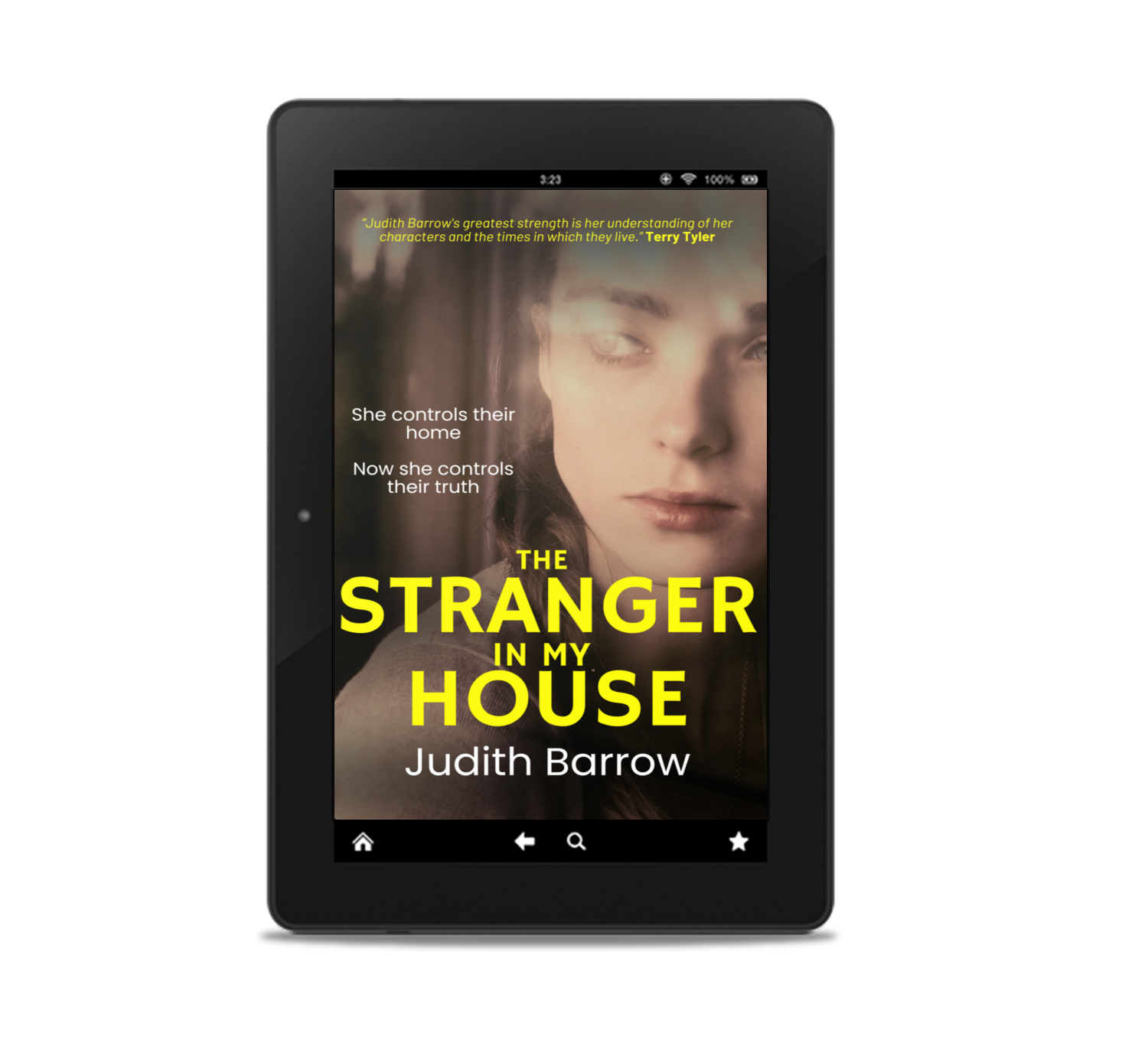
My latest book, published in November 2024 is The Stranger
Review for The Stranger: 5.0 out of 5 stars Storytelling in a class of its own… stunning.
“One of the author’s many strengths is in capturing the clear and authentic voice of a confused child – Mandy’s voice, in The Stranger, still haunts me, torn between her own grief, her sense of right and wrong, and her love for her family. And once more, in her latest book she wonderfully portrays the suffering of eight-year-old twins Chloe and Charlie – already grieving the loss of their mother, their lives torn apart by their father’s marriage to her former nurse, an evil manipulator of the highest order…“
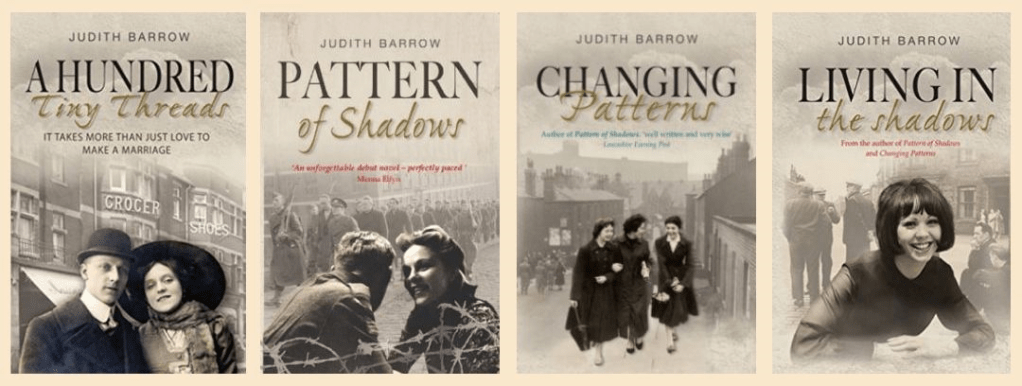
It’s eight years this month since the prequel, A Hundred Tiny Threads, to the Haworth Trilogy was published – so a little celebratory post – with an extra personal memory at the end – for one of my oldest books.
It’s 1911 and Winifred Duffy is a determined young woman eager for new experiences, for a life beyond the grocer’s shop counter ruled over by her domineering mother.
The scars of Bill Howarth’s troubled childhood linger. The only light in his life comes from a chance encounter with Winifred, the girl he determines to make his wife.
Meeting her friend Honora’s silver-tongued brother turns Winifred’s heart upside down. But Honora and Conal disappear, after a suffrage rally turns into a riot, and abandoned Winifred has nowhere to turn but home.
The Great War intervenes, sending Bill abroad to be hardened in a furnace of carnage and loss. When he returns his dream is still of Winifred and the life they might have had… Back in Lancashire, worn down by work and the barbed comments of narrow-minded townsfolk, Winifred faces difficult choices in love and life
A couple of reviews:
“When I emerged at the end of this book – during the reading, my immersion was total – it was with a sense of having experienced it all first hand, and of having deeply felt every moment. This was story-telling at its very best… and a book that will long linger in my memory.”
“I loved it… A page-turner that keeps you hooked. The story line has lots of twists and turns and you feel yourself moved on so many different levels. As the book unfolds it gives you moments of tenderness and love, hatred and spite all blended together with conflict, prejudice, guilt, grief and a desperate longing for change. Judith describes the period so well, with some very graphic, cruel and harrowing episodes, enabling you to empathise with each character in turn. I particularly like the fact that the story held together to the last page.”
Three year earlier, on the exact date – the 17th August – the book was published, I’d written the following…
My Grandad
My grandfather died seventy years ago this week. Obviously i never knew him and have only one small black and white photograph of him on my study wall. He’s standing in the backyard of the terraced house they lived in in Oldham. Lancashire. This is a poem I wrote about him a long time ago. My mother said he was gassed in WW1 and never recovered.
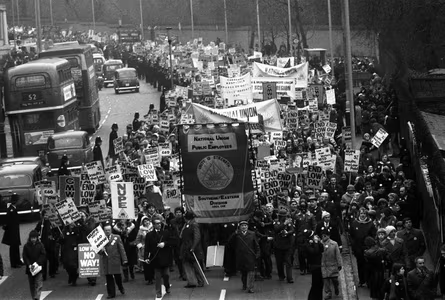
Part Two of The Stranger in my Houseis set against what is now called the Winter of Discontent – A term that comes from Shakespeare’s play Richard III, but it was used in an interview by the then Prime Minister James Callaghan and was taken up by the media. It lasted between November 1978 to February 1979 in the United Kingdom and, following opposition from the Trades Union Congress (TUC), took on the form of widespread strikes by both the private and public sector. Trade unions demandied pay rises greater than the limits Prime Minister, James Callaghan, and his Labour Party government imposed in an effort to control inflation.
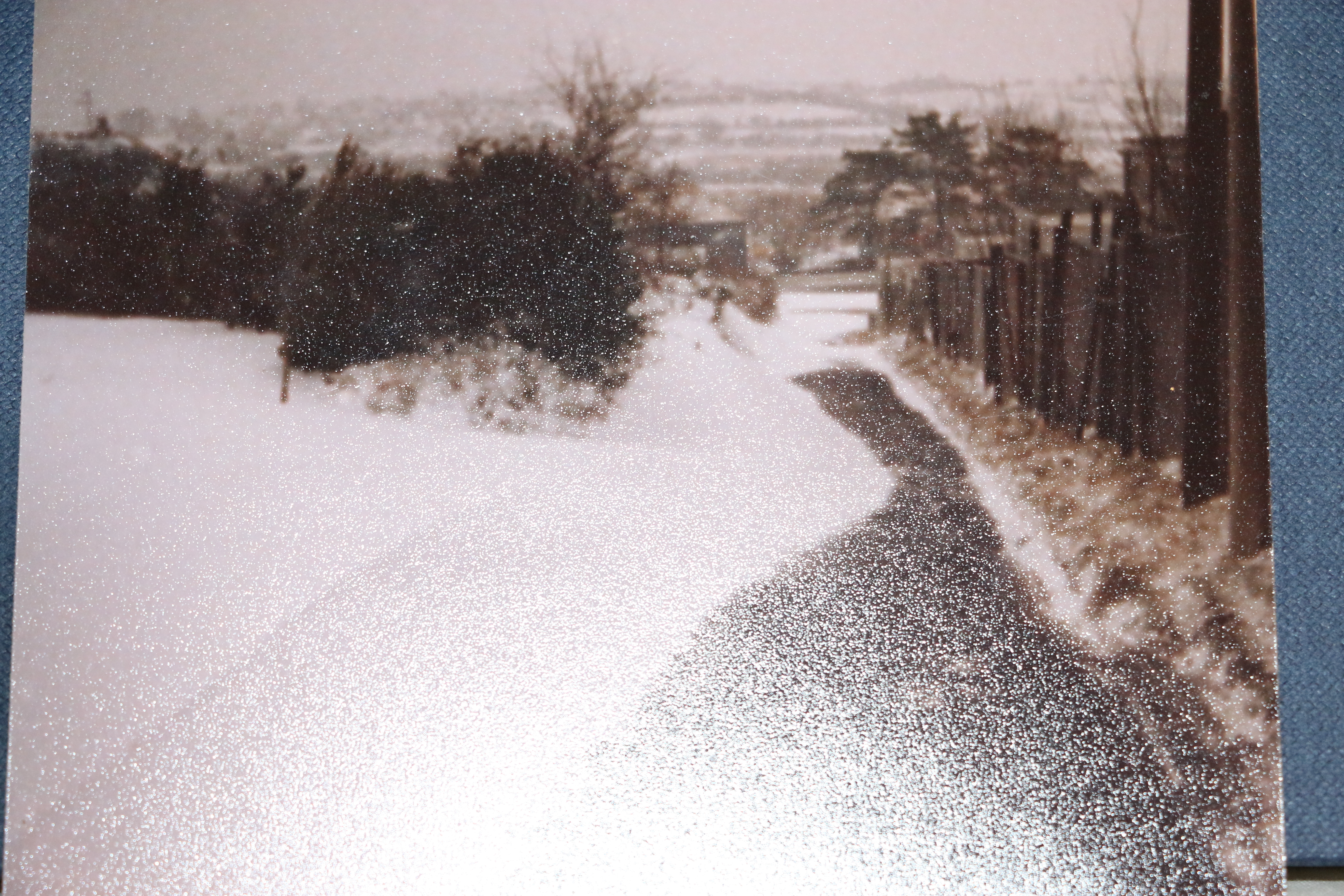
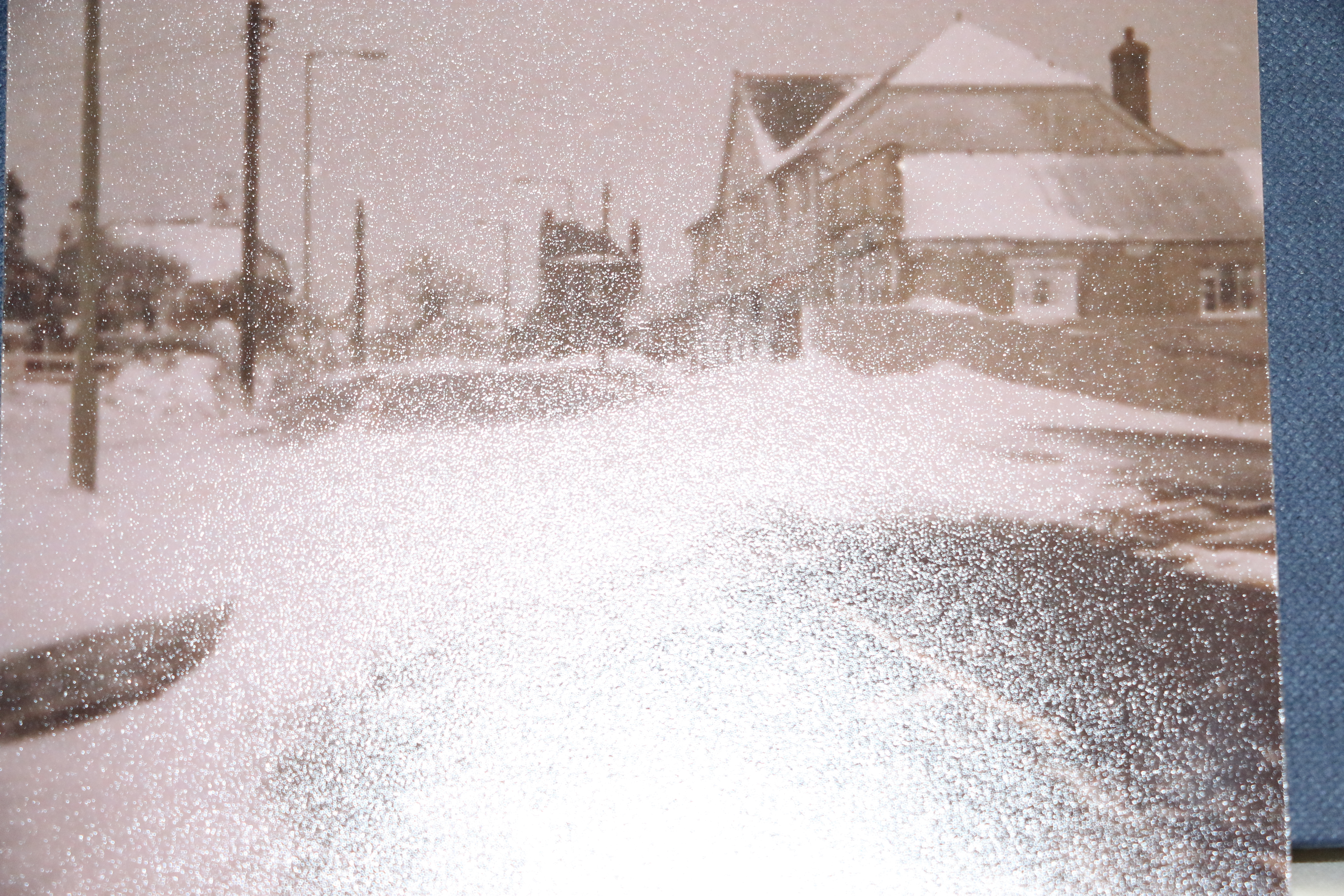
It was also the coldest winter in sixteen years. Heavy snowfall and freezing temperatures disrupted transport, businesses, and energy supplies.
In January 1979 (between the 1st and the 14th), some 20,000 railwaymen held four one-day strikes. There were strikes by haulage drivers, petrol tank drivers, and eventually municipal workers – 1,250,000 of them organised a one-day national strike on 22 January 1979.
The most notorious incident was the grave diggers’ strike on Merseyside, which hit the headlines with the press vilifying trade unions for their lack of sympathy with the bereaved, and, it was argued, with the needs of the nation.
But it was a strike by refuse collectors that came to symbolise the complete breakdown of UK public services. Local councils rapidly ran out of storage space as the binmen continued to strike, so rubbish was left in streets and open public spaces instead.
Photograph courtesy of The Guardian
Photo by Evening Standard/Hulton Archive/Getty Images)
A gripping ‘cuckoo in the nest’ domestic thriller
After the death of their mum, twins Chloe and Charlie are shocked when their dad introduces Lynne as their ‘new mummy’. Lynne, a district nurse, is trusted in the community, but the twins can see her kind smile doesn’t meet her eyes. In the months that follow they suffer the torment Lynne brings to their house as she stops at nothing in her need to be in control.
Betrayed, separated and alone, the twins struggle to build new lives as adults, but will they find happiness or repeat past mistakes? Will they discover Lynne’s secret plans for their father? Will they find each other in time?
The Stranger in My House is a gripping ‘cuckoo in the nest’ domestic thriller, exploring how coercive control can tear a family apart. Set in Yorkshire and Cardiff, from the 60s to the winter of discontent, The Stranger in My House dramatises both the cruelty and the love families hide behind closed doors.
“Judith Barrow’s greatest strength is her understanding of her characters and the times in which they live.” Terry Tyler
Grateful for this reader’s review. One of the first for The Stranger in my House, when it was published in November 2024.
Judith Barrow’s done it again! The Stranger in My House is a book that showcases her renowned credentials. The characters are superbly drawn, the tension grows steadily and with each turn of the page your heart is gripped by the dilemmas facing the young protagonists, twins Charlie and Chloe, and their well-intentioned father. As with The Memory (shortlisted for Wales Book of the Year) it’s the way Barrow takes the ordinary and everyday, that we recognise and identify with, and skilfully uses her eye for human behaviour to turn it into something that becomes a nightmare we can readily believe in. The story begins in 1967 and over the following decade the sense of time and place is expertly done without being intrusive. At the core of the tale is coercion and the reader can see how cleverly the others are being manipulated by the woman who undermines them and shatters their family bonds. My dislike for Lynne and her son Saul built with the book’s momentum. There was that fear that they would get away with unimaginable cruelty and malice. To counter that, were those whose innate love and kindness provided a heartwarming buffer. From the start, I was gripped and that grip tightened inexorably. It’s becoming a cliché to say that you couldn’t put a book down – but I couldn’t. I had to know what was going to happen next. It mattered. That is the hallmark of a great author.
“This gripping story of harrowing behind-closed-doors coercion has tremendous emotional pull.”
LoveReading Says
Domestic thriller fiction at its most heart-wrenching, Judith Barrow’s The Stranger in My House is also utterly un-put-down-able — readers will be desperate for a family broken by cruel coercive control to be reunited.
The novel opens in 1967 when twins Charlie and Chloe are introduced to their “new mummy” Lynne while they’re still bereft at losing their mother to cancer. Early on, Lynne’s behaviour causes alarms bells to ring for the twins — and readers — which only adds to the mounting tension and fear of where things are going, with their father, Graham, vulnerable to emotional manipulation, rendered powerless to do anything to stop his life from careering out of control, which it does at alarming speed.
Before Graham can catch his breath, he’s lost everything, as have his children, who are separated from their father and each other, while Lynne and her bully of a son continue their campaign of cruelty.
Years later, the twins are living separate lives in different parts of the country, both scarred but their hearts lifted by kind souls. And then comes a race-against-time to find each other and save their dad.
Though weighty and harrowing in subject, The Stranger in My House is grippingly easy-to-read in delivery, which makes it a powerful page-turner that will have fans of family drama thrillers reading long after they’d planned to turn out the lights.
Honno is an independent co-operative press run by women and committed to bringing you the best in Welsh women’s writing.
It was established in 1986 by a determined group of volunteers who wanted to increase the opportunities for Welsh women in publishing and bring Welsh women’s literature to a wider public. They asked the people of Wales to show their support for the new enterprise by becoming shareholders in the cooperative and in the first six months more than 400 people bought shares. Honno continues to be supported by hundreds of individual shareholders who believe in its work.
True to its roots the press still only publishes work by women of Wales. Most of Honno’s titles are novels, autobiographies and short story anthologies in English as well as Classics in both Welsh and English. We have in the past also published poetry, children’s and teenage titles and books in both Welsh and English.
Over the years the Press and its titles have been awarded many prizes.
It is guided by the Honno Committee of volunteers who set the strategic direction of the Press, decide the publishing programme and manage the office and staff. The Honno office is located in the mid-Wales coastal town of Aberystwyth.
Honno receives financial support from the Books Council for Wales.
Author Judith Barrow gives a lively account of her experiences moving to Pembrokshire in the 1970s and managing a holiday let with some interesting visitors, sometimes amusing and sometimes rather challenging.
Although all three of the books in the Haworth trilogy are based on the same family, they are also stand alone. And yet, to be completely honest, I do need to add this from one of the reviewers…
“This is the part where I’m supposed to tell you that each of these wonderful books can be read alone. But no, don’t do that. In fact, if you haven’t read any of them, you’re luckier than I am, because you can start with the prequel and read in chronological order. I chose to review these books as a set, and I believe that’s how they should be read. Every now and then, I come across books so beautifully written that their characters follow me around, demanding I understand their lives, their mistakes, their loves, and in this case, their families. Taken together, the Howarth Family stories are an achievement worth every one of the five stars I’d give them.“
Changing Patterns – a bargain!
Book Description:
May 1950, Britain is struggling with the hardships of rationing and the aftermath of the Second World War. Peter Schormann, a German ex-prisoner of war, has left his home country to be with Mary Howarth, matron of a small hospital in Wales. The two met when Mary was a nurse at the POW camp hospital. They intend to marry, but the memory of Frank Shuttleworth, an ex-boyfriend of Mary’s, continues to haunt them and there are many obstacles in the way of their happiness, not the least of which is Mary’s troubled family. When tragedy strikes, Mary hopes it will unite her siblings, but it is only when a child disappears that the whole family pulls together to save one of their own from a common enemy.
Excerpt:
16th June 1950
Sometimes Mary couldn’t believe he was there. Sleepless, she would reach out and touch Peter just to reassure herself that after five years apart they were together again. He’d given up a lot to be with her.
‘You are happy?’ He slung his arm around her shoulder and pulled her closer.
The breeze ruffled their hair. The tide was on the turn and Mary watched the waves collide and dissolve. High above, gulls hung motionless their cries lost in the air currents
‘Mm.’ Mary rested against him. The smell of the mown lawn on his skin mingled with the salty tang of spray blown off the sea and the faint smell of pipe tobacco. ‘You?’
‘Of course.’
She turned her head to look at him, brushed a few blades of grass from his cheek. In the four months since he’d found her he’d lost the gaunt pallor, the weariness, and gained a quiet contentment.
‘It is good, the two of us sitting here, alone,’ he said.
‘Tom won’t be long though, he’ll be back from Gwyneth’s soon; he said he was only just digging her vegetable plot over for planting tomorrow.’
‘I do not mean Tom. He is family.’
Mary allowed a beat to pass. ‘I know you didn’t, love. And I know what you really mean. But it’s not our problem. If people don’t like our being together that’s their lookout.’ She kissed him. His mouth was warm.
Smiling she drew back. ‘Tom?’ she murmured, her voice rueful.
They sat peacefully on the doorstep of the cottage, each savouring the other’s closeness.
Gradually the sun disappeared behind the cliffs. The trees became shifting silhouettes and the wind slapped the surface of the sea into rolling metallic arcs and carried the spray towards the cottage. Mary licked her lips, tasted the salt
‘It’s getting chilly.’ She shivered.
Peter stood, reached down and lifted her to her feet, holding her to him. ‘Ich liebe dich, my Mary.’
‘And I love you.’
A few moments passed before she forced herself to stand back and, giving him a quick kiss, take in a long breath. ‘Now,’ she said, ‘I’m late sorting tea out. If you put those things away, I’ll go and give that batter a whisk. I’m making Spam fritters to go with that mash from last night.’
She stood on the top step watching him walk down the gravel path to where he’d left the lawnmower and then glanced towards the cottage next door. Although it was only just dusk the window in Gwyneth Griffith’s parlour suddenly lit up and the oblong pattern spilled across the garden. Tom emerged out of the shadows swinging a spade in his hand and turned onto the lane. Mary waved to him and he waggled the spade in acknowledgement. ‘Tom’s coming now,’ she called out to Peter. ‘I’ll stick the kettle on. He’ll want a brew before he eats.’
The van came from nowhere, a flash of white. Mary saw it veer to the right towards Tom. Hurtling close to the side of the lane it drove along the grass verge, smashing against the overhanging branches of the blackthorn. Caught in the beam of the headlights her brother had no time and nowhere to go. Frozen, Mary watched as he was flung into the air, heard the squeal of the engine and the heavy thud of his body on the bonnet of the van. The spade clattered along the tarmac. Peter threw open the gate and was running before she could move.
‘Tom,’ she heard him yell. Somewhere, someone was screaming. She was screaming.
Seeing the results of the Wales Book of the Year Award 2024, and reading one or two of the books of the shortlisted authors over the last month, brought back memories of 2021 when I was nominated for the Literature Wales Book of the Year Award. It still feels strange.
The Memory was published around the first week of the first lockdown and I thought it became lost in all the disruption and anxiety of the pandemic. So, when I first heard that the book was being nominated, it was a complete surprise. Naturally I was also thrilled because, at that time,The Memory was so different from my first four novels, which are historical family sagas. And I wasn’t sure how it would be received by the readers who had enjoyed those books. So, to be recognised by Literature Wales for the Wales Book of the Year Award 2021, The Rhys Davies Trust Fiction Award, was a great accolade for me.
I believe we are all affected by our pasts; experiences that shape our present and future. And, as writers, memories feed our stories. Families fascinate me: the love, the loyalties, the rivalry, the complex relationships. Layers that are in all families. The casual acceptance of one another in a family can bring the best and the worst out in all of us, so there is a wealth of human emotions to work with. This is how The Memory evolved. A little of the background comes from a time when I was a carer for my aunt who lived with us. She developed dementia and I kept a journal so we could talk about what we’d done each day. Many years after she’d died, some of those recollections crept into The Memory. And then there are the memories from my childhood, when I had a friend who was a Downs Syndrome child. The affection she gave, the happiness that seemed to surround her, is something I remembered long after she died of heart failure at the age of eleven. And I wanted that love to be a huge part of the book, a main theme. Fundamentally it’s the story of a secret that is never discussed within a family, but which has had a profound lifelong effect on the relationship between the mother and daughter. The Memory is sometimes poignant, sometimes sad, but is threaded throughout with humour.
Reviewsfor The Memory:
“… As a reader, when a character becomes as completely real to me as Irene does, I often find myself wondering what happened next for her. But Irene’s story is so perfectly and elegantly resolved that I know without a shade of doubt what her future holds.The Memory is not a comfortable or easy read. But if you’re looking for a beautifully written, character-driven story with a dark base but superb resolution, it just might be the perfect choice.”
” …The writing is what I’ve come to expect from Judith Barrow. The effortless prose brings a fresh quality to the mundane and familiar. There’s also a building menace to the book and a sense of foreboding that drives you on right to the surprising end. The Memory is a remarkable book and I wholeheartedly recommend it.”
When The Memory was shortlisted for theWales Book of the Year Award in 2021 I was also pleased for Honno. I’d been published by them for many years and I believe it also gave them some much deserved recognition.
And I’m thrilled that Honno will be publishing my eighth book with them in November.
The Stranger in My House.
After the death of their mum, twins Chloe and Charlie are shocked when their dad introduces Lynne as their ‘new mummy’. Lynne, a district nurse, is trusted in the community, but the twins can see her kind smile doesn’t meet her eyes. In the months that follow they suffer the torment Lynne brings to their house as she stops at nothing in her need to be in control.
Betrayed, separated and alone, the twins struggle to build new lives as adults, but will they find happiness or repeat past mistakes? Will they discover Lynne’s secret plans for their father? Will they find each other in time?
The Stranger in My House is a gripping ‘cuckoo in the nest’ domestic thriller, exploring how coercive control can tear a family apart. Set in Yorkshire and Cardiff, from the 60s to the winter of discontent, The Stranger in My House dramatises both the cruelty and the love families hide behind closed doors.
“Judith Barrow’s greatest strength is her understanding of her characters and the time.” TerryTyler
Every now and again one my books receive a review that takes my breath away – that makes my day/week/month… even makes me think that, if I never write another word, this is what I’ll treasure. Something that says I succeeded in writing something I can be proud of.
This review from author Barb Taub covered not only one of my books, but the whole of the Haworth trilogy and the prequel. So chuffed was I that I copied, pasted and printed it off to pin on my notice board to remind me that I can write – even on the days when I am banging my head on the keyboard and writing xmjhnsdjhsdjhfjhf …
This is Barb’s review:
“We’ve all read epic family sagas—sweeping multi-generational tales like The Thorn Birds, The Godfather, Roots, the Star Wars franchise, and anything remotely connected to the British Monarchy. So as I read Judith Barrow’s Howarth Family trilogy, I kept trying to slot them into those multigenerational tropes:
*First generation, we were supposed to see the young protagonist starting a new life with a clean slate, perhaps in a new country. *The next generation(s) are all about owning their position, fully assimilated and at home in their world. *And the last generation is both rebel and synthesis, with more similarities to the first generation made possible by the confidence of belonging from the second one.
But the complex, three-dimensional miniatures I met in the first three books of the trilogy stubbornly refused to align with those tropes. First of all, there’s Mary Howarth—the child of parents born while Queen Victoria was still on the throne—who is poised between her parents’ Victorian constraints, adjustment to a world fighting a war, and their own human failures including abuse, alcoholism, and ignorance.When Pattern of Shadows begins in 1944, war-fueled anti-German sentiment is so strong, even the King has changed the British monarchy’s last name from Germanic Saxe-Coburg to Windsor. Mary’s beloved brother Tom is imprisoned because of his conscientious objector status, leaving their father to express his humiliation in physical and emotional abuse of his wife and daughters. Her brother Patrick rages at being forced to work in the mines instead of joining the army, while Mary herself works as a nurse treating German prisoners of war in an old mill now converted to a military prison hospital.
Mary’s family and friends are all struggling to survive the bombs, the deaths, the earthshaking changes to virtually every aspect of their world. We’ve all seen the stories about the war—plucky British going about their lives in cheerful defiance of the bombs, going to theaters, sipping tea perched on the wreckage, chins up and upper lips stiff in what Churchill called “their finest hour”. That wasn’t Mary’s war.
Her war is not a crucible but a magnifying glass, both enlarging and even inflaming each character’s flaws. Before the war, the Shuttleworth brothers might have smirked and swaggered, but they probably wouldn’t have considered assaulting, shooting, raping, or murdering their neighbors. Mary and her sister Ellen would have married local men and never had American or German lovers. Tom would have stayed in the closet, Mary’s father and his generation would have continued abusing their women behind their closed doors. And Mary wouldn’t have risked everything for the doomed love of Peter Schormann, an enemy doctor.
I was stunned by the level of historical research that went into every detail of these books. Windows aren’t just blacked out during the Blitz, for example. Instead, they are “criss crossed with sticky tape, giving the terraced houses a wounded appearance.” We’re given a detailed picture of a vanished world, where toilets are outside, houses are tiny, and privacy is a luxury.
The Granville Mill becomes a symbol of these dark changes. Once a cotton mill providing jobs and products, it’s now a prison camp that takes on a menacing identity of its own. Over the next two volumes of Howarth family’s story, it’s the mill that continues to represent the threats, hatred, and violence the war left behind.
Unlike the joyful scenes we’re used to, marking the end of the war and everyone’s return to prosperity and happiness, the war described in these books has a devastatingly long tail. When Changing Patterns takes up the story in 1950, Mary and Peter have been reunited and are living in Wales, along with her brother Tom.
But real life doesn’t include very many happy-ever-afters, and the Howarths have to live with the aftermath of the secrets each of them has kept. The weight of those secrets is revealed in their effect on the next generation, the children of the Howarth siblings. The battle between those secrets and their family bonds is a desperate one, because the life of a child hangs in the balance.
Finally, the saga seems to slide into those generational tropes in Living in the Shadows, the final book of the Howarth trilogy. Interestingly enough, this new generation does represent a blend of their preceding generations’ faults and strengths, but with the conviction of their modern identities. Where their parents’ generation had to hide their secrets, this new generation confidently faces their world: as gay, as handicapped, as unwed parents, and—ultimately shrugging off their parents’ sins—as family.
But I didn’t really understand all of that until I considered the title of the prequel (released after the trilogy). 100 Tiny Threads tells the story of that first generation, their demons, their loves, their hopes, and their failures, and most importantly, their strength to forge a life despite those failures. That book, along with the novella-sized group of short stories in Secrets, gives the final clues to understanding the trilogy. As Simone Signoret said, “Chains do not hold a marriage together. It is threads, hundreds of tiny threads, which sew people together through the years.” And it’s both those secrets and those threads not only unite them into a family, but ultimately provide their strength.
This is the part where I’m supposed to tell you that each of these wonderful books can be read alone. But no, don’t do that. In fact, if you haven’t read any of them, you’re luckier than I am, because you can start with the prequel and read in chronological order. I chose to review these books as a set, and I believe that’s how they should be read.
Every now and then, I come across books so beautifully written that their characters follow me around, demanding I understand their lives, their mistakes, their loves, and in this case, their families. Taken together, the Howarth Family stories are an achievement worth every one of the five stars I’d give them.”
An edited excerpt from the first of the trilogy, Pattern of Shadows. (Taken from the chapter where Mary Haworth, the protagonist – has just had her first date with Frank Shuttleworth.)
Frank stared into the flames for a couple of minutes and then said. ‘Tell me about your brother, Tom.Patrick told me he’s a Conscientious Objector. There doesn’t seem much love lost there.’
The anger flared immediately. ‘My younger brother has a big mouth. Tom’s a lovely bloke and entitled to his own beliefs.’
Frank held his hands up. ‘Whoa, I was only saying.’
‘Yes, well,’ Mary said, ‘for some reason, Patrick’s been jealous of him for as long as I can remember. Her voice faltered. ‘Look, I know what people think about COs. I’m not expecting you to feel any different. Let’s leave it for tonight.’
‘No. I want to know.’ Frank was insistent. ‘Tell me.’
Mary felt the clench of her stomach muscles. ‘Tom was always the odd one out, the only one in the family who still went to church when the rest of us lapsed years ago.’ How many times had she tried to understand the depths of Tom’s unquestioning faith? ‘His beliefs rule his life. It would have been easier for him if they didn’t. After it all came out, we discovered he’d belonged to a group in Manchester for ages. You know, meetings, talks on pacifism, how he felt about violence, how he felt it wrong to get involved with the war. When he first refused to sign up, he was given exemption, provided he continued to work in local government; he was in the Stationery Department. But he turned that down; he said he wouldn’t work for a government of a country at war.’ Mary met Frank’s stare. ‘He was sent to London to Wormwood Scrubs and he’s been there on and off ever since. They keep trying to make him do fire watching and he won’t do that either. They’ve extended his sentence loads of times. Dad won’t have his name mentioned in the house … won’t let Mam visit him, wouldn’t let him come home the times he’s been released.’
A memory of the last grubby bed-sit Tom lived in flashed into her mind. It had been in a part of Bradlow she didn’t even know existed, a maze of narrow streets lined with shabby back- to back terraced houses and filled with gangs of dirty kids and barking dogs. She’d studied the bit of paper with the address written on it before pushing her way past the two women smoking on the bottom step of a flight of stairs. The door to Tom’s room was open and for a moment she’d watched him sitting on the edge of the bed, his head in his hands, his arms sticking out of the sleeves of a jacket too small for him, his back shuddering with sobs.
‘They keep saying he has to do work that involves the war and he refuses. I think they do it for spite.’ Sparks flew from the fire onto the hearthrug and Frank reached out with his foot and stamped down on them. She couldn’t tell from his expression what he was thinking. ‘I admire what he did. I think it took a lot of courage.’
Frank leant forward, his hands clasped in front of him. Then he pressed his thumb against the first knuckle of each finger until it cracked. The noise jarred in the silence between them…
In halcyon days BC (before children), Barb Taub wrote a humor column for several Midwest newspapers. With the arrival of Child #4, she veered toward the dark side and an HR career. Following a daring daytime escape to England, she’s lived in a medieval castle and a hobbit house with her prince-of-a-guy and the World’s Most Spoiled AussieDog. Now all her days are Saturdays, and she spends them consulting with her occasional co-author/daughter on Marvel heroes, Null City, and translating from British to American.
I have a new guest on my blog today. I “met” Judith Barrow through Story Empire, then invited her to share her latest release The Memory. Please make her feel welcome as she gives us a behind the scenes look at what inspired her to write the book.
Thank you so much, Mae Clair, for hosting this guest post and promotion for my new book, The Memory.
Introduction Many people have asked what was the inspiration for The Memory and my answer is always – memories: memories of being a carer for two of my aunts who lived with us, memories of losing a friend in my childhood; a friend who, although at the time I didn’t realise, was a Downs’ Syndrome child. But why I started to write the story; a story so different from my other four books, I can’t remember. Because it was something I’d begun…












 Judith Barrow