And so, with Changing Patterns the Story of the Haworth Trilogy continues: Sequel to Pattern of Shadows and the book before Living in the Shadows. #Excerpt #weekendRead #Promotion #Novelines #Honno

Although all three of the books in the Haworth trilogy are based on the same family, they are also stand alone. And yet, to be completely honest, I do need to add this from one of the reviewers…

“This is the part where I’m supposed to tell you that each of these wonderful books can be read alone. But no, don’t do that. In fact, if you haven’t read any of them, you’re luckier than I am, because you can start with the prequel and read in chronological order. I chose to review these books as a set, and I believe that’s how they should be read.
Every now and then, I come across books so beautifully written that their characters follow me around, demanding I understand their lives, their mistakes, their loves, and in this case, their families. Taken together, the Howarth Family stories are an achievement worth every one of the five stars I’d give them.

Changing Patterns – a bargain!

Book Description:

May 1950, Britain is struggling with the hardships of rationing and the aftermath of the Second World War. Peter Schormann, a German ex-prisoner of war, has left his home country to be with Mary Howarth, matron of a small hospital in Wales. The two met when Mary was a nurse at the POW camp hospital. They intend to marry, but the memory of Frank Shuttleworth, an ex-boyfriend of Mary’s, continues to haunt them and there are many obstacles in the way of their happiness, not the least of which is Mary’s troubled family.
When tragedy strikes, Mary hopes it will unite her siblings, but it is only when a child disappears that the whole family pulls together to save one of their own from a common enemy
.

Excerpt:

16th June 1950

Sometimes Mary couldn’t believe he was there. Sleepless, she would reach out and touch Peter just to reassure herself that after five years apart they were together again. He’d given up a lot to be with her.

‘You are happy?’ He slung his arm around her shoulder and pulled her closer.

The breeze ruffled their hair. The tide was on the turn and Mary watched the waves collide and dissolve. High above, gulls hung motionless their cries lost in the air currents

‘Mm.’ Mary rested against him. The smell of the mown lawn on his skin mingled with the salty tang of spray blown off the sea and the faint smell of pipe tobacco. ‘You?’

‘Of course.’

She turned her head to look at him, brushed a few blades of grass from his cheek. In the four months since he’d found her he’d lost the gaunt pallor, the weariness, and gained a quiet contentment.

‘It is good, the two of us sitting here, alone,’ he said.

‘Tom won’t be long though, he’ll be back from Gwyneth’s soon; he said he was only just digging her vegetable plot over for planting tomorrow.’

‘I do not mean Tom. He is family.’

Mary allowed a beat to pass. ‘I know you didn’t, love. And I know what you really mean. But it’s not our problem. If people don’t like our being together that’s their lookout.’ She kissed him. His mouth was warm.

Smiling she drew back. ‘Tom?’ she murmured, her voice rueful.

They sat peacefully on the doorstep of the cottage, each savouring the other’s closeness.

Gradually the sun disappeared behind the cliffs. The trees became shifting silhouettes and the wind slapped the surface of the sea into rolling metallic arcs and carried the spray towards the cottage. Mary licked her lips, tasted the salt

‘It’s getting chilly.’ She shivered.

Peter stood, reached down and lifted her to her feet, holding her to him. ‘Ich liebe dich, my Mary.’

‘And I love you.’

A few moments passed before she forced herself to stand back and, giving him a quick kiss, take in a long breath. ‘Now,’ she said, ‘I’m late sorting tea out. If you put those things away, I’ll go and give that batter a whisk. I’m making Spam fritters to go with that mash from last night.’

She stood on the top step watching him walk down the gravel path to where he’d left the lawnmower and then glanced towards the cottage next door. Although it was only just dusk the window in Gwyneth Griffith’s parlour suddenly lit up and the oblong pattern spilled across the garden. Tom emerged out of the shadows swinging a spade in his hand and turned onto the lane. Mary waved to him and he waggled the spade in acknowledgement. ‘Tom’s coming now,’ she called out to Peter. ‘I’ll stick the kettle on. He’ll want a brew before he eats.

The van came from nowhere, a flash of white. Mary saw it veer to the right towards Tom. Hurtling close to the side of the lane it drove along the grass verge, smashing against the overhanging branches of the blackthorn. Caught in the beam of the headlights her brother had no time and nowhere to go. Frozen, Mary watched as he was flung into the air, heard the squeal of the engine and the heavy thud of his body on the bonnet of the van. The spade clattered along the tarmac. Peter threw open the gate and was running before she could move.

‘Tom,’ she heard him yell. Somewhere, someone was screaming. She was screaming.

Links to buy:

Amazon.co.uk: https://tinyurl.com/4wj2jedc

Amazon.com: https://tinyurl.com/nj87jz6k

Where We Walked – @Malham Tarn #Walks #Photographs @Yorkshire Dales #MondayBlog

Malham Tarn is a shallow glacial lake three hundred and seventy seven metres above sea level, making it the highest lake in England. Situated above the village of Malham in the Yorkshire Dales National Park, it’s owned by the National Trust. It’s also the source of the River Aire; water flows out of the southern end of the lake and disappears underground to reappear as the River Aire at the foot of Malham Cove about one and a half miles away. Later, we were told by someone local that Malham Tarn is unusual because the water doesn’t sink into the ground. Apparently, during the Ice Age glaciers scraped away the the limestone down to the ancient slate layer underneath, and because slate is impermeable, it doesn’t let the water through. Then, when the glacier melted, the mouth of the Tarn was sealed by banks of clay and gravel.

I studied the map. ‘You said we were having an easy day today.’

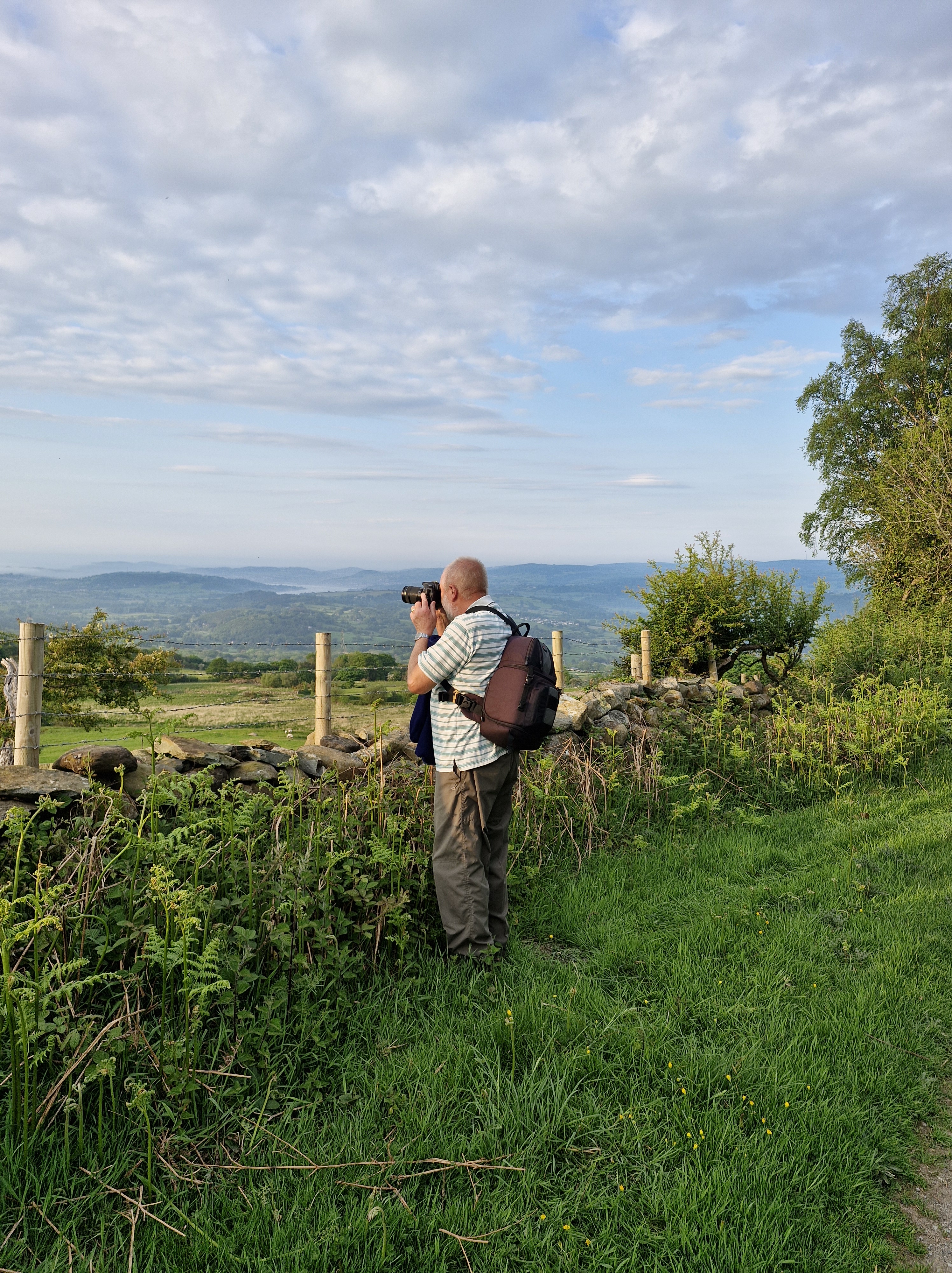
‘I told you; eleven miles,’ said the photographer.

‘No, you said a mile.’

It’ s all flat, so it is easy… most of the way.’ And off he strides…

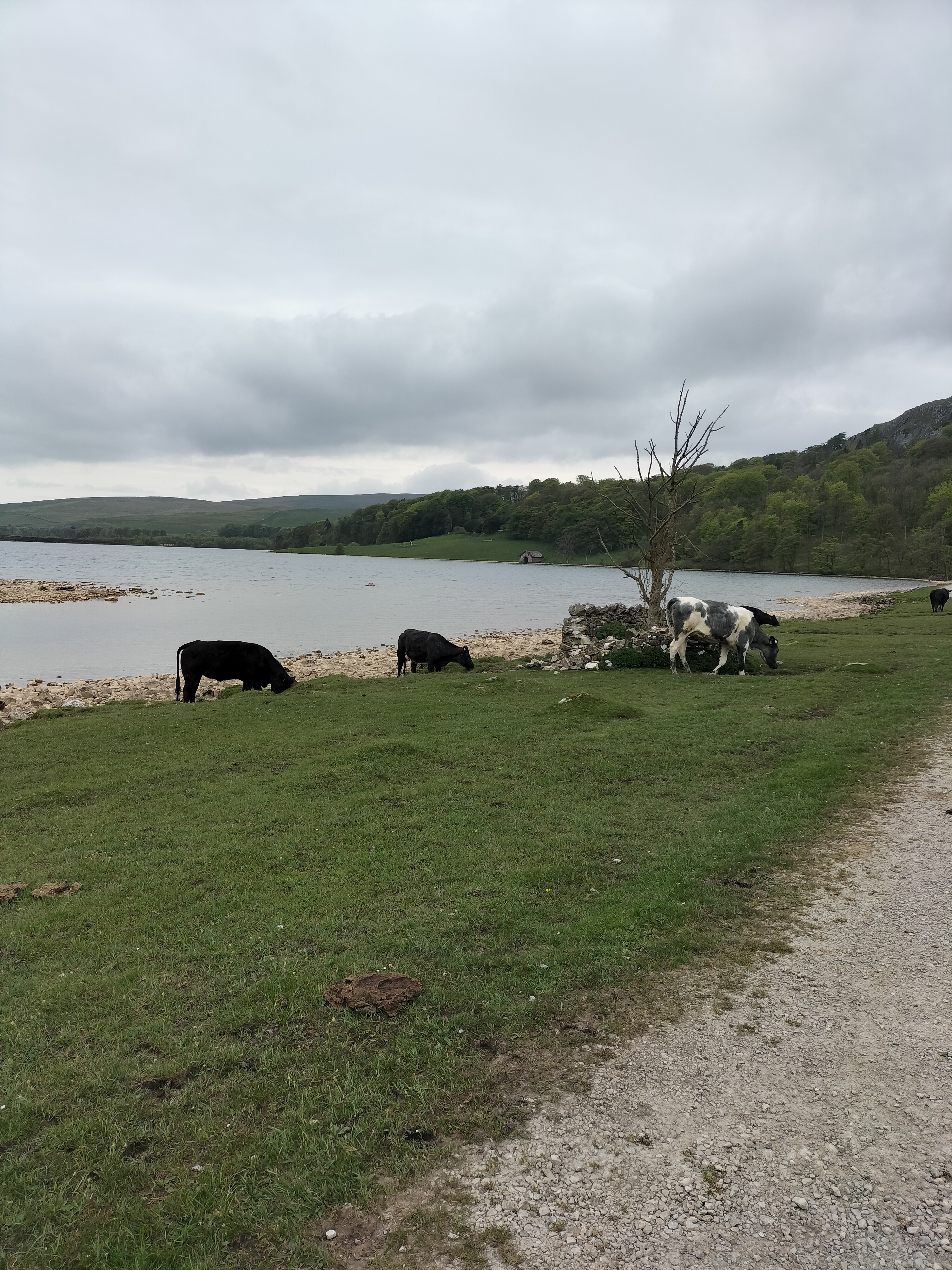
Towards some cows. Who look at us with interest and then decide to follow.

All the way as we walked along the shore of the tarn, through a gate and along a path into the woods.

We passed Tarn House, which was built as a hunting box in the late-18th century, and is now now owned by the National Trust. Used as a Field Studies Centre, there is an Orchid House, which usually has an exhibition area. Seeing the exhibition subject on our day, I passed by.

The house itself must once have been quite grand. It still is impressive, though obviously needs money spending on it.

There isn’t a lot of open water in the area, and, in the Stone Age, the lake was inundated with herds of wild animals, and consequently brought hunters from far and wide. Archaeologists have found the remains of their campsites and stone tools along the shoreline. We walked down to the bird hide.

Although we saw Canada geese, a pair of mallard ducks, a greater-spotted woodpecker – and many sparrows, this was the only other wildlife we found

But what was really impressive was the man-made track that leads to the National Nature Reserve. We leisurely followed the boardwalk through the reserve for the next half an hour.

We came out of the reserve onto an unmade track . I expected to turn right to retrace our steps.

‘No left, we’re only halfway around the walk,’ the photographer said. Earlier on I’d seen this in the distance.

Reassured that he’d said the walk was a flat walk, I’d just admired the shape of Great Close Scar. I said nothing. I was saving my breath … and waiting…

More next time!

Where We Walked: Llyn y Fan Fach and Llyn y Fan Fawr. #Walks #Lakes #Mountains #GloriousScenary #Wales #Photos #ProbablyNeverAgain

Llyn y Fan Fach is a glacial lake in the Brecon Beacons situated beneath Picws Du mountain, the second highest peak of the Carmarthen Fans in the Carmarthenshire section of the Black Mountain in the west of the Brecon Beacons. (The name Brecon Beacons has recently reverted to its old Welsh name, Bannau Brycheiniog, which means “the peaks of Brychan’s kingdom”)

For anyone interested Brychan Brycheiniog was a legendary 5th-century king of Brycheiniog (Brecknockshire, alternatively Breconshire in Mid Wales.

Brychan depicted in a window of the church in Brecon, Wales.

There is one thing I want to say before we go any further with this post.

Never believe the stats!

Distance: 9.2 miles (14.8km) circuit (Let’s just say Circuitous! Or, if you’re really wanting to be pedantic – like a dog’s hind leg… or two!)
Elevation gain: 720m (Gain is the right word. The exhilaration of getting anywhere near that height makes one feel as if one has reached the top of the world. If you can get enough breath to get that far!)
Difficulty:
Moderate (if you can call the initial mile of a one in ten ratio upwards on a stony, gravelly track, followed by steeper narrow paths – Moderate.
The Llyn y Fan Fach car park near is reached by a winding single track road (with the added bonus of few signposts in an area that the SAT NAV doesn’t recognise – we went in a complete circle at one point) and is remote with no facilities. At all (Am I selling it to you yet? Hmm? Well… I will… later. Honest.).

All the previous being said, we had a wonderful day’s walk. Hike… I should have said hike, here (Or even … climb!)

Actually, when we arrived there was a group of young people from London who were walking the area as part as their Duke of Edinburgh Award. Very chatty – when they stopped to get their breath – which was as often as us. So I didn’t feel that decrepit!

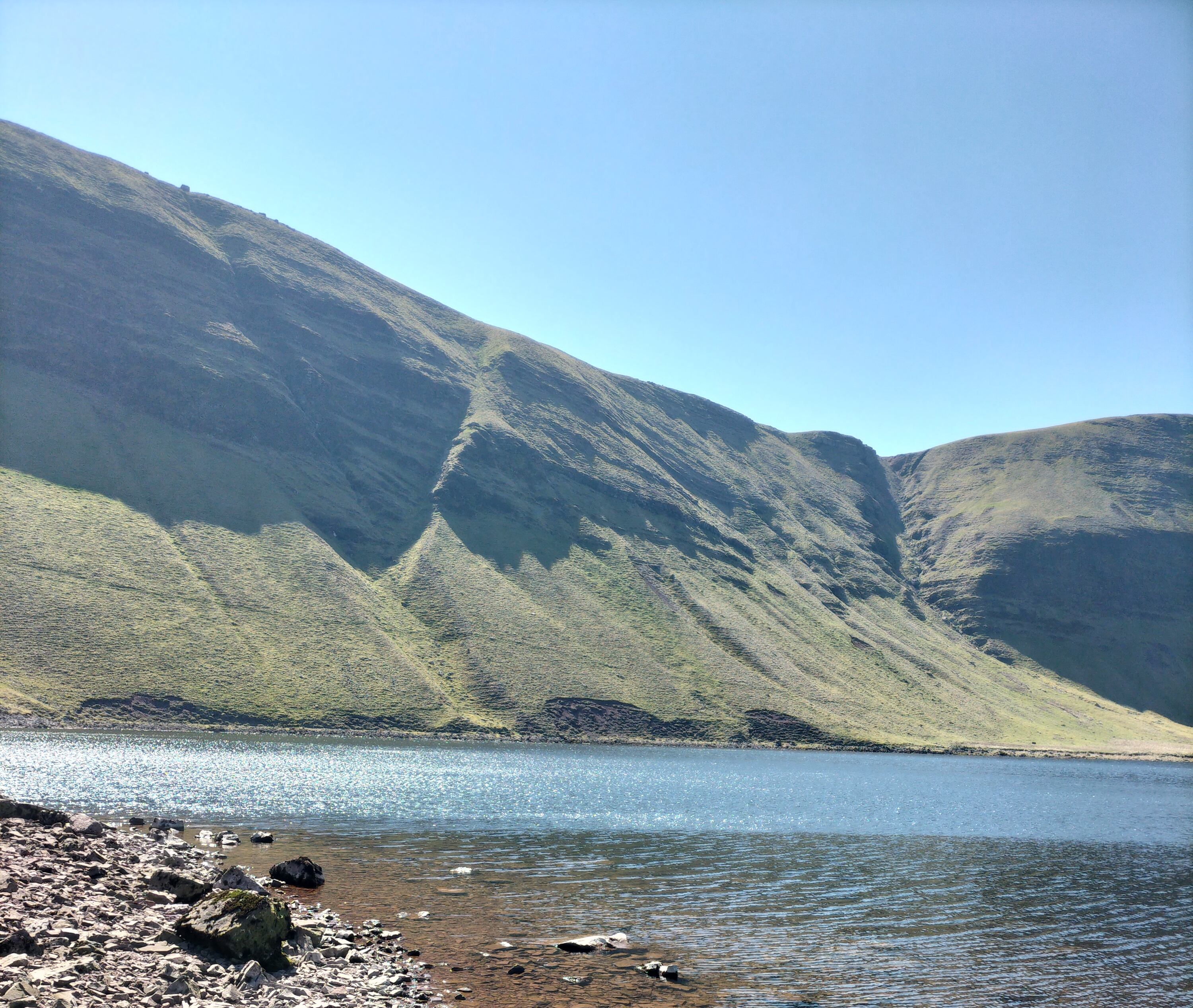
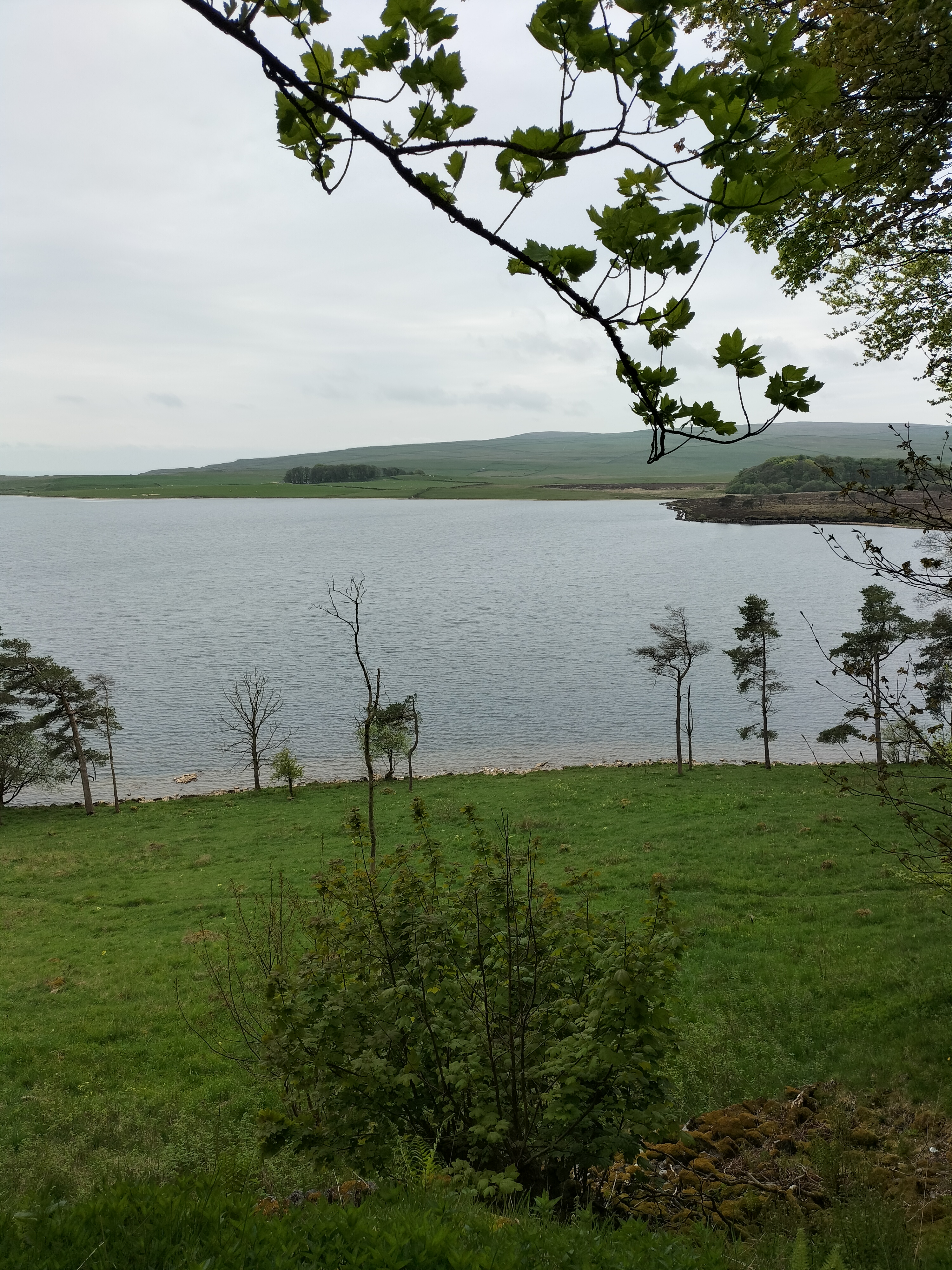
And, of course, we had a picnic sitting by Lyn y Fan Fach, a beautiful lake surrounded by magnificent craggy mountain peaks. Sheltered by a wall, with the sun warm on our backs, we watched the grass swaying under the clear water, the surface a glistening reflection of the sky. The only sounds were the rustling of the wind, the cries of the skylarks, and, in the distance, the faint voices of people walking along the ridges of the Picws Du mountain

Which gave the photographer a chance to peruse the area.

Llyn y Fan Fach is renowned for Welsh Folklore. One folklore legend is the myth of ‘The lady of the lake’. In the folktale, a young farmer of the 13th century spotted the most beautiful girl he’d ever seen emerge from the lake, she was a princess from the kingdom of fairies. He courted the fairy princess by baking her bread and after three attempts he succeeded in winning her hand in marriage on the condition that if he hit her three times she would leave him. He complied easily because she was so beautiful and they were happy for years bringing up a family at his farm near Myddfai, with her magic dowry of farm animals. In time the inevitable happened he hit his wife (reported as apparently playfully!?) and she disappeared back into the lake taking her prized animals with her, leaving the farmer with her sons. The sons once grown became known as the “Physicians of Myddfai” who became physicians to the English royal court..

Further to the east, beneath the peak of Fan Brycheiniog, there is another larger lake called Llyn y Fan Fawr. These lakes and peaks can be visited through a combination of mountain walks. We studied the climb to the right. A very steep climb. And decided to take the easier route to the left. Easier for some – see below – the photographer in the distance, eager to get more photo opportunities.

It was so clear we could the rise and fall of the land for miles, it was stunning.

The path often disappeared under the mounds of long tough tussock grass and patches of boggy water. Though awe inspiring it felt very isolated: a few people far above us on the ridges of Fan Brycheiniog, a man striding, then sitting down, in the distance, a group of young men studying compasses and maps. We stopped – often – when skylarks rose and fluttered in front of us, desperate to take us away from their nests in the undergrowth. The wind came in strong cold bursts, and after we’d walked another mile, we knew, however disappointing it was, that we should turn back; not try to reach the other lake, Llyn y Fan Fawr, beneath the peak of Fan Brycheiniog, The speed we were going, we would chance being there after dark. Perhaps we shouldn’t have lingered so long at the first lake. Or set out earlier in the day. Or not got lost.

So, after a couple of photo shots, we made our way back across the land and down the track to the car. The Duke of Edinburgh students were still somewhere on the ridge. Knowing how they had dreaded the climb I didn’t envy them. And yet, not having achieved what we set out to do…

Still, a wonderful day in all.

Until the next time we attempt this walk …. or not.

Libraries are Important. #Readers #Books #Libraries #Librarians #Pembrokeshire #Wales

Image courtesy of Pixabay

When I was a child my mother took me every Saturday to the small library in our village. I was allowed six books – usually all read by the Wednesday (I was one of those kids who read by torchlight under the bedclothes – and got away with it for years!) I would then wait, not always patiently, until the weekend, when we would go again. I think it was a great relief to both my mother and myself when I was at last allowed to walk to the library by myself.

By the way… In the very olden days libraries were named from the Latin “liber”, meaning “book.” In Greek and the Romance languages, the corresponding term is “bibliotheca”. Or, if you want to go with the medieval version “Calque of Old English bōchord (‘library, collection of books’), equivalent to book +‎ hoard.”

Just thought you might want to know that.

Anyway, when I was a child – libraries were just… libraries. The place one went to to borrow books. For free!!

Image courtesy of Pixabay

Today, libraries are still one of the few free services left. Libraries are used for many different reasons; they contain not only books. magazines, newspapers, manuscripts, but also CDs, DVDs, e-books, audiobooks etc. They connect us to information. And, important in these days, they are also community hubs where authors (if they’re lucky) can go to give talks, hold workshops. It’s where people can connect with other people. They are safe havens.

Reading for pleasure, is one of the most important things one can do, so what we need to make sure of is that future generations have the opportunity to do just that. Books represent the chance for us not only to enjoy the work of so many brilliant writers, but to also to grow, to change, to see life from other points of view. We will only ever see life through our own perspective … unless we read.

In our area, the Pembrokeshire County Council has approved its budget for 2023-24. We will have a Council Tax rise of 7.5%. It would be wonderful if the value of libraries and librarians were understood; if those in authority – those with access to their council budgets – acknowledged this importance for every generation. If enough funding were to ploughed into libraries to preserve them.

Image courtesy of Pixabay

Each month on the Libraries Wales website, they focus on introducing an author based in or writing about Wales. I am thrilled to be the author for April 2023. And I am more than happy, alongside other friends who are also writers, to talk about the value of books and the enjoyment of reading. Just give us the chance!!

Where We Walked #photographs #walks #MondayBlogs #Pembrokeshire #Wales

We found Pembrokeshire by lucky accident. With three children under three years of age, we didn’t want to go far on our annual holiday. Wales didn’t seem that far away from Yorkshire, well, not as far as Cornwall… we thought. We found the house we’ve lived in for over forty years by accident. Being auctioned we thought it fun to dream, to put in a bid. We’ll never get it… we thought. We did. With the optimism of youth and dreams of living near the sea we sold our house in Yorkshire. It’ll be an adventure… we thought. And we could always move back if we don’t settle. We’ll give it five years. We didn’t need five years. Although we moved to Pembrokeshire in the depths of November to a house with no electricity, heating, and not nearly enough furniture to fill a large five bedroomed house, we knew we’d done the right thing. Despite all of us muffled in so many layers of clotihng we looked like a set of Michelin Men ( remember those advert?), we were happy – we were bringing up our children in a wonderful place.

Over the years we’ve walked many times around the Llys – y- Fran reservoir, now called the Llys-y-Fran Country Park.

Back in the day (as my grandad used to say), the walk around the reservoir (about seven miles) was more of a hike and a scrabble around rocks, trees, and, sometimes, through streams. There’s still a little negotiating of streams, as I mention later.

But first the technical and public information bits…

Llys-y-Fran Country Park is three hundred and fifty acres in all, which includes the two hundred and twelve acres of the reservoir. In the parish of the village Llys y Fran, the community of New Moat, it’s on the southern slopes of the Preseli Mountains.

Llys-y-Frân dam was constructed between September 1968 and 1972.The final concrete was laid on the nineteenth May 1971, completing a total of over 500,000 tons of the stuff since the project began. By May, the depth of water had risen to forty feet but it was only on the fifth of December 1971, exactly nine months after impounding had started, that the reservoir overflowed for the first time.

The reservoir was officially opened by HRH Princess Margaret, Countess of Snowdon, on Tuesday, the ninth of May, 1972.

The dam is a hundred feet (thirty metres) high and the lake is fed by the River Syfynwy. The water is used by homes and industry in south Pembrokeshire and is managed by Welsh Water. It’s one of eight-one reservoirs in Wales.

The forecast for the day was good, so we donned walking boots and rucksacks and set off. I’m cheating a little here – the photograph below was taken on the last stretch of the homeward-bound section, as we looked back with smugness on how far we’d walked.

Back to the beginning… These days the walk is a wider, if still steep and winding in places, gravelly track around the circuit of the lake, and is interspersed with cycling routes of varying degrees of difficulty. I promise you, (and am most disappointed that I forgot to ask husband to photograph it), there was one route highlighted by a sign of a skull and crossbones… with a note that the route was only for those of the highest skill and fitness … (and, I added to myself, the most crazy!).

“There’s a lot of water to cross, isn’t there?” I remarked, after wobbling on strategically-placed rocks and tree trunks in one particularly wide stream.

“Well, it is a reservoir,” he replied, striding manfully through the water.

“Sarcasm is the lowest form of wit!” Was the only remark I could summon up, as I stopped trying to balance and sloshed after him.

The whole time we walked we met only two cyclists and three couples with dogs. The sun shone (most of the time) and there was just a slight breeze that moved the grasses, the patches of daffodils, the leaves and petals of the primroses, the early gorse. Except for the calls of the Canada Geese and, at one point, the noisy squabble of seagulls, it was peaceful. Through the woodland there were stunning views all along the way.

We stopped for a picnic. I won’t admit we stopped to catch our breath – although we did do a bit of puffing up those steeper parts. I’ll even go as far as to say it stopped me talking … sometimes! Anyway, we were ready for a bite to eat, a coffee, and another photograph opportunity .

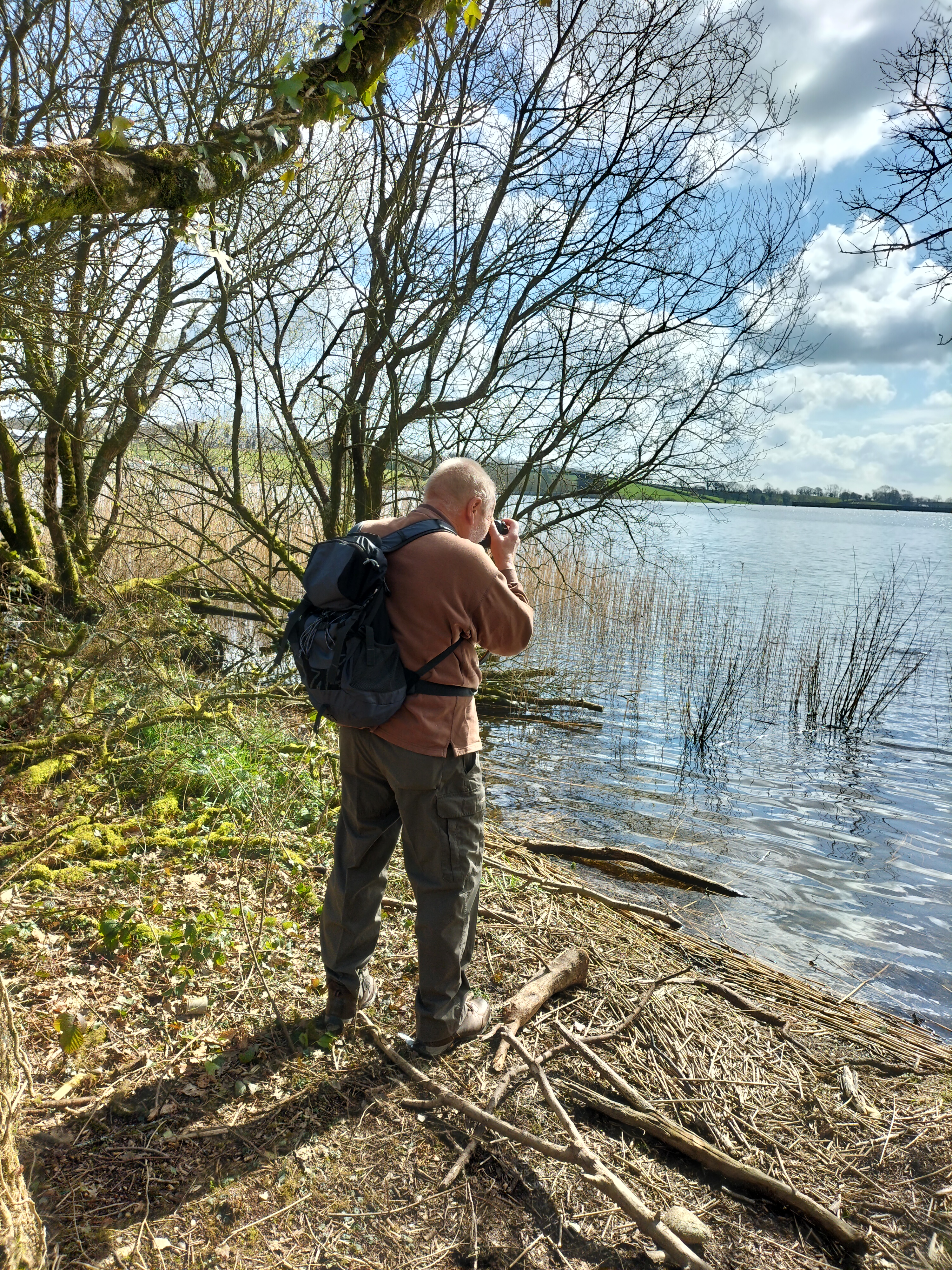
The photographer! What isn’t seen here is the robin who followed us around for a least a mile after we’d fed him some crumbs, and is a few inches behind David, patiently waiting for him to move (he had his foot on a crust of bread).

What used to take us two and a half hours to walk this trail, this time took us over three and a half. I claim mitigating circumstances – we stopped often ( very often) for husband to take photos. Oh … and to eat the picnic.

And I refuse to talk about the fact that we both walked like ducks the day after!

N.B. The word llys translates into English as “court” and y frân translates as “[of] the crow“. Just thought you might like to know that.

One of the highlights of my time so far on www.showboat.tv – my interview with Debby Campbell, daughter of Glen Campbell. #Interview #starstruckwho me? #songs #books #TuesdayBookBlog

Interviewing Debby, who is one of the easiest people to talk to, despite her and her father’s fame. She is so open, so honest, so interesting. And it was fascinating to delve into the reasons she wrote her book.

Over the last few years, I have interviewed many authors and writers of various genres. It’s fun, something I enjoy. Pre-pandemic it was in the studios, but since it’s been through zoom which means it’s easier to chat with anyone from all over the world.

The great thing about www.showboat.tv is that, unlike many other online interviews, these chats are edited. So any waffling (usually on my part), any stumbling or stuttering, or, as they say “Up North” any faffing about, is never seen by the audience.

And the other, brilliant part of the whole process, is that it brings the authors and their books, to the attention of readers and viewers all across the world.

What more could a writer ask? My future posts will be about some of the authors I’ve interviewed so far. I’ll be asking them a little more about them selves and how they enjoyed ( or dreaded!) the experience. How it was for them… kind of thing!!

About Debby Campbell

Country music singer and activist for Alzheimer’s, Debby Campbell was born in Albuquerque, New Mexico in 1956 to Diane Kirk and Glen Travis Campbell. She is the eldest of 8 children and the daughter of the most famous “Rhinestone Cowboy” Glen Campbell. Debby loved singing from an early age and spent many summers with her dad on tour, and in the television studios with his Glen Campbell Goodtime Hour television show.

Debby graduated high school in England living with her mom and step-dad Jack, while her step-dad was in the Air Force. Her dad, Glen became a world sensation, and would perform in England and send for Debby so she could spend time with him.

In her early 20’s, Debby married and became a mother of 3, two boys and a girl. She lived in Italy, and the US during this time and currently loves being a grandmother to 6 grandchildren and 1 great-grand child.

In the mid 80’s Debby became a flight attendant and today, remains flying international as well as domestic.

In 1987 Debby became part of her dad’s show on tour as a featured singer, along with her full time job as a flight attendant. She toured and traveled with the Glen Campbell show for 24 years, which included travels to Europe, Australia, New Zealand, Tasmania and Bermuda and so many more. Many of the Glen Campbell fans became loyal fans & friends of Debby’s and she has remained friends with them today.

Her appreciation for Country music landed her with her own show in Branson, Missouri at the Roy Clark Theatre in the early 90’s. She continued her career as a featured singer at the Grand Palace with her dad and then on to her Dad’s Theatre –The Glen Campbell Goodtime Theatre and ending with a residency at the Andy Williams Moon River Theatre.

Debby’s bragging rights include hosting the Jerry Lewis MDA Telethon, performances at the Grand Ole Opry, opened for greats and Grammy Award artist such as Charlie Daniels, Jerry Reed, Eddie Rabbit, Colin Raye, and performing the National Anthem for the National Finals Rodeo in Las Vegas. She is an author of her recently released book titled “Life with My Father Glen Campbell”. She has also been credited with recording duets with her dad on “United We Stand”, “Let It Be Me”, and “Little Green Apples” and on multiple recording of Glen’s “Live with South Dakota Symphony” on CD and DVD. As Glen recorded some of his final music, Debby was instrumental on background vocals.

Debby is active with the Alzheimer’s cause and finds time for her first priority, family and friends. She golfs, enjoys bowling, travel and of course singing.

Link to Debby’s website: http://DebbyCampbellmusic.com/

Burning Bridges: Life With My Father Glen Campbell

The Glen Campbell story is one of exceptional musical talent, a glittering career and a frequently disturbed personal life. In August, 2017, after battling Alzheimer’s disease, his death was announced to the world.

This celebratory Omnibus enhanced edition of Burning Bridges: Life With My Father Glen Campbell includes both an interactive digital timeline of his life, filled with videos and images of live performances and interviews, as well as a Spotify collection of the greatest recordings that Glen Campbell ever made.

As a studio musician Campbell contributed to countless Sixties and Seventies records; as a solo artist he produced the classic hits GalvestonBy The Time I Get To PhoenixWichita Lineman and Rhinestone Cowboy; he had a successful US TV show, co-starred with John Wayne in the film True Grit, and was lauded for his talents. However, a series of failed marriages saw this shining star fall heavily into serious substance abuse, and the fabric of his life unravelled.


Persistent short-term memory loss resulted from this turbulence and Glen Campbell would have few constants in his life as the years waned on. One of them, however, was the co-author of this book, his daughter Debby. She witnessed his struggles and suffering, both musically and personally, as well as the beginning of his decline into Alzheimer’s disease.

Burning Bridges: Life With My Father Glen Campbell is a loving but unflinching reminiscence of a multi-talented musician, a troubled man and a father. Debby Campbell provides a poignant, eye-witness account of a musical legend like no other.

Links to buy:

Amazon – kindle version: Burning Bridges: Life With My Father Glen Campbell

Amazon hard Cover: Burning Bridges: Life With My Father Glen Campbell

A short note from Showboat tv

Actually, two zoom interviews have been uploaded with the incredible Debby Campbell, daughter of the legendary country singer, Glen Campbell. In Booksmart, she talks to Judith Barrow about her book documenting her life of the road with her father, while on Inside Notes, she discusses her latest album plus her new single “Sunflower”.Watch them for a limited time free of charge on the homepage www.showboat.tv
And here Showboat TV tells us how to watch anytime

BECOME A SUBSCRIBER AND WATCH MORE

Our Pricing Plans…

FREE: 0.00 GBP

No Subscription:

  • Access full archive on demand -NO
  • Access all spotlight pages -NO
  • Watch featured programmes -YES
  • Watch 7 daily screens -YES
  • Watch live broadcasts -YES

1.49 GBP

1 week

Access full archive on demand -YES

  • Access all spotlight pages – YES
  • Watch featured programmes – YES
  • Watch 7 daily screens – YES
  • Watch live broadcasts – YES
  • Recurring payments – N0

2.99 GBP

  • Monthly
  • Access full archive on demand – YES
  • Access all spotlight pages – YES
  • Watch featured programmes – YES
  • Watch 7 daily screens – YES
  • Watch live broadcasts – YES
  • Cancel any time – YES

Our Past Shapes Our Present And Our Future. (Whether We Like That Or Not) #BOTY2021 #memories #secrets #TheMemory #ThursdayThrowback @honno

Seeing the results of the Wales Book of the Year Award 2024, and reading one or two of the books of the shortlisted authors over the last month, brought back memories of 2021 when I was nominated for the Literature Wales Book of the Year Award. It still feels strange.

The Memory was published around the first week of the first lockdown and I thought it became lost in all the disruption and anxiety of the pandemic. So, when I first heard that the book was being nominated, it was a complete surprise. Naturally I was also thrilled because, at that time,The Memory was so different from my first four novels, which are historical family sagas. And I wasn’t sure how it would be received by the readers who had enjoyed those books. So, to be recognised by Literature Wales for the Wales Book of the Year Award 2021, The Rhys Davies Trust Fiction Award, was a great accolade for me.

I believe we are all affected by our pasts; experiences that shape our present and future. And, as writers, memories feed our stories. Families fascinate me: the love, the loyalties, the rivalry, the complex relationships. Layers that are in all families. The casual acceptance of one another in a family can bring the best and the worst out in all of us, so there is a wealth of human emotions to work with. This is how The Memory evolved. A little of the background comes from a time when I was a carer for my aunt who lived with us. She developed dementia and I kept a journal so we could talk about what we’d done each day. Many years after she’d died, some of those recollections crept into The Memory. And then there are the memories from my childhood, when I had a friend who was a Downs Syndrome child. The affection she gave, the happiness that seemed to surround her, is something I remembered long after she died of heart failure at the age of eleven. And I wanted that love to be a huge part of the book, a main theme. Fundamentally it’s the story of a secret that is never discussed within a family, but which has had a profound lifelong effect on the relationship between the mother and daughter. The Memory is sometimes poignant, sometimes sad, but is threaded throughout with humour.

Reviews for The Memory:

“… As a reader, when a character becomes as completely real to me as Irene does, I often find myself wondering what happened next for her. But Irene’s story is so perfectly and elegantly resolved that I know without a shade of doubt what her future holds.The Memory is not a comfortable or easy read. But if you’re looking for a beautifully written, character-driven story with a dark base but superb resolution, it just might be the perfect choice.”

” …The writing is what I’ve come to expect from Judith Barrow. The effortless prose brings a fresh quality to the mundane and familiar.
There’s also a building menace to the book and a sense of foreboding that drives you on right to the surprising end.
The Memory is a remarkable book and I wholeheartedly recommend it.”

When The Memory was shortlisted for the Wales Book of the Year Award in 2021 I was also pleased for Honno. I’d been published by them for many years and I believe it also gave them some much deserved recognition.

And I’m thrilled that Honno will be publishing my eighth book with them in November.

The Stranger in My House.

After the death of their mum, twins Chloe and Charlie are shocked when their dad introduces Lynne as their ‘new mummy’. Lynne, a district nurse, is trusted in the community, but the twins can see her kind smile doesn’t meet her eyes. In the months that follow they suffer the torment Lynne brings to their house as she stops at nothing in her need to be in control.

Betrayed, separated and alone, the twins struggle to build new lives as adults, but will they find happiness or repeat past mistakes? Will they discover Lynne’s secret plans for their father? Will they find each other in time?

The Stranger in My House is a gripping ‘cuckoo in the nest’ domestic thriller, exploring how coercive control can tear a family apart. Set in Yorkshire and Cardiff, from the 60s to the winter of discontent, The Stranger in My House dramatises both the cruelty and the love families hide behind closed doors.

“Judith Barrow’s greatest strength is her understanding of her characters and the time.” TerryTyler


Ann Hatton ( Ann of Swansea) and Sarah Siddon #FamousSisters #relationships #families #stage #actresses, #authors #poetry @honno

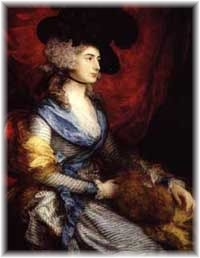
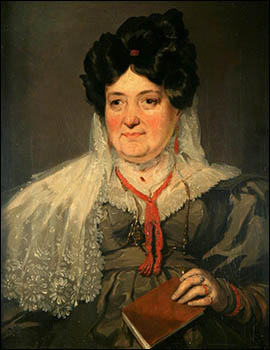
Sisters Ann of Swansea and Sarah Siddon

Ann Hatton and her older sister Sarah, were the daughters of Roger Kemble and Sarah Ward, who led a troupe of travelling actors. Sarah was born in Brecon in July 1755, Ann, otherwise known as Ann of Swansea, in Worcester in April 1764. There were ten other siblings.

All, except Ann, were early performers on stage with their parents.Considered by her family to be unsuitable to be on stage, owing to a disability (she had a slight limp), Ann was more or less excluded from the family. Later in life she often said she received little love from her parents, and that her education was neglected.

In contrast Sarah was well educated, adored by her parents, and performed her first major Shakespearean role, as Ariel, at the age of nine.

Yet both fell in love with men whom their mother and father thought unsuitable. Ann, at the early age of sixteen, married a man called Curtis who was actually already married, and was later convicted and jailed for bigamy. She was considered to have brought disrepute on the family and was cast out by them; their only concern was their determination to validate their respectability within the theatrical world.

Sarah was dealt with in a different way. Initially sent away to work as a lady’s maid because she began a relationship with William Siddons, (one of the members of her father’s troupe), she was soon forgiven by her parents, who gave their blessing for her to marry William. Sarah was then allowed to continue her acting career. She was so outstanding that she was noticed by David Garrick, actor, playwright, theatre manager and producer, who took her to London to appear on the stage at Drury Lane, although her first role at Drury lane wasn’t a total success.

Rejected and isolated Ann became increasingly depressed and suicidal, actually attempting suicide in Westminster Abbey. She lurched from one catastrophe to another. After her failed marriage she attempted to earn her own money by working for a Dr James Graham, a sex therapist, who ran a business called the Temple of Health and Hymen, in Pall Mall. Her family was enraged to discover he advertised the lectures Ann gave as “given by Mrs Curtis, Mrs Siddons’ younger sister”.

In 1783, Ann produced her first volume of poems, (Poems on Miscellaneous Subjects). Again she gained her family’s wrath; she published the collection under the name of “Ann Curtis, sister of Mrs Siddons”.

The Kemble family was determined to disassociate themselves from Ann, so Sarah, joined with one of their brothers, granted Ann a yearly allowance, but only with a condition that Ann lived at least a hundred and fifty miles away from London.

The annual payment meant that Ann’s reputation and station in society became more acceptable, and in 1792 she married William Hatton.

They emigrated to America, and it was here that she wrote her opera libretto Tammany (otherwise known as The Indian Chief), which was given its première on Broadway. This was the first known libretto written by a woman.

Following the triumph of her libretto, Ann and William returned to Britain, and by 1799, had settled in Swansea in South Wales, where they ran a bathing-house and lodgings near the coast until William’s death in 1806. She then moved to Kidwelly. One of her poems, Swansea Bay, describes her emotions as she left Swansea. Eventually, she returned to Swansea in 1809 where she settled down to write her poetry and Romantic novels. These encapsulated themes of social and moral parody,(sometimes with gothic leitmotifs). She used the pseudonyms of “Ann of Swansea” and Ann of Kidwelly.

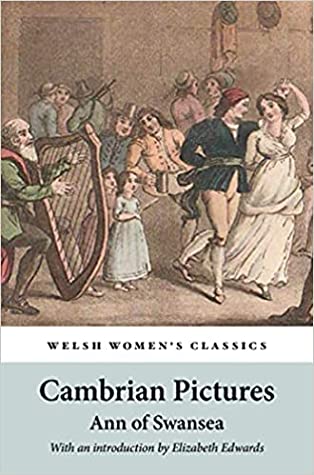
Many of her books were set in Wales; Cambrian Pictures, published by my publishers, Honno, is one of them.

Sarah and her husband William, took up the life of a travelling thespian, playing many parts all over the country. She cleverly chose roles that made her more popular, that protected her image and preserved her reputation as a wife and mother of five children, as well as an actress. This helped her to avoid any rumourmongering and scandal that usually plagued actresses at the time. She ultimately became Britain’s most renowned and highly paid actress in the 1780s, much sought after by equally famous painters, such as Sir Joshua Reynolds, to sit to have her portrait painted. She even gave private readings for the king and queen at Windsor Castle and Buckingham House. Reputed to have a striking stage presence she became most famous for her role as Lady Macbeth; a role she was reported as played to perfection, and she was also called the Queen of Tragedy.

But, after thirty years the marriage between Sarah and William became strained and they separated.

She retired from the stage in June of 1812, playing Lady Macbeth in Macbeth. So enthralled by her performance were the audience that they continued clapping when she finally left the stage and the play ended there.

She died in 1831 and was buried in St. Mary’s, Paddington. Her funeral was attended by thousands, and a statue of her was later created by Francis Legatt Chantrey and erected in Westminster Abbey (ironically, as I said, earlier, the place where her sister, Ann attempted suicide after her first marriage to the bigamist, Curtis, and when she was both ostracized by her family, and desperately poor). .

Ann died and was buried in 1838 in a churchyard in High Street, Swansea. She left most of her belongings to her servant Mary Johns, executor of her will, as a “very small remuneration for her affectionate, honest and undeviating conduct” for almost 16 years.

At no time in my research for this post, did I discover that the two sisters ever met again.

It occurred to me that, sometimes, it is only through fate and coincidence that estranged families are forced into contact. And so it is for the two sisters, Angie and Mandy (later known as Lisa) in my next book, Sisters. Due to be published by Honno on the 26th January 2023, I’m thrilled that it’s now available to be pre-booked.

.

Remembering Past Places in our Memories #memories #writerslife #houses #holidays #family #amusementparks #countries #SundayVibes

There are places that remain in our memories, the details may become slightly blurred, nostalgia may colour our thoughts, but they don’t fade. And how those places made us feel at the time is the one thing that remains.

This is a round-up of the Places in our Memories posted over the last few weeks. There have been some wonderful memories shared by writers from all over the world who have joined in the series so far:

Thorne Moore tells us about her first real grasp of history. “The past was just under my feet and nothing was permanent after all…”

https://tinyurl.com/2vmwx53r

Carol Lovekin recalls how much her mother has influenced her life

https://tinyurl.com/26ua74jt

Sally Cronin enthralls us with memories of her childhood of Ceylon, now known as Sri Lanka, 

https://tinyurl.com/yc32zjh9

Robbie Cheadle tells us about her life as a child and how she’d lived in twenty-one houses and attended fourteen schools, before the age of twelve. And of her love for her sisters…

https://tinyurl.com/4cpjuk7h

Teagan Ríordáin Geneviene remembers an old amusement park, a memory that gave background to her books…

https://tinyurl.com/473desej

D G Kaye poignantly recalls one memory that is forever engraved in her mind and heart of her beloved husband.

https://tinyurl.com/yd8835yn

Terry Tyler recalls family holidays on the Norfolk coast, and the genuine gypsy caravan in the garden of their holiday home.

https://tinyurl.com/2z5rh3mu

Alex Craigie shares memories and photographs of her childhood home.

https://tinyurl.com/35pkn288

And then there are my own memories of the street I lived in until the age of five, and the area where I grew up.

https://tinyurl.com/zu7wu94u

Tomorrow we begin another round of Places in our Memories. I hope you enjoy reading them as much as I do.

Walking the Taff Trail – Well a small section of it anyway. And more of a stroll than a walk. #walks #cycling #photos #ThursdayThrowback #memories #history

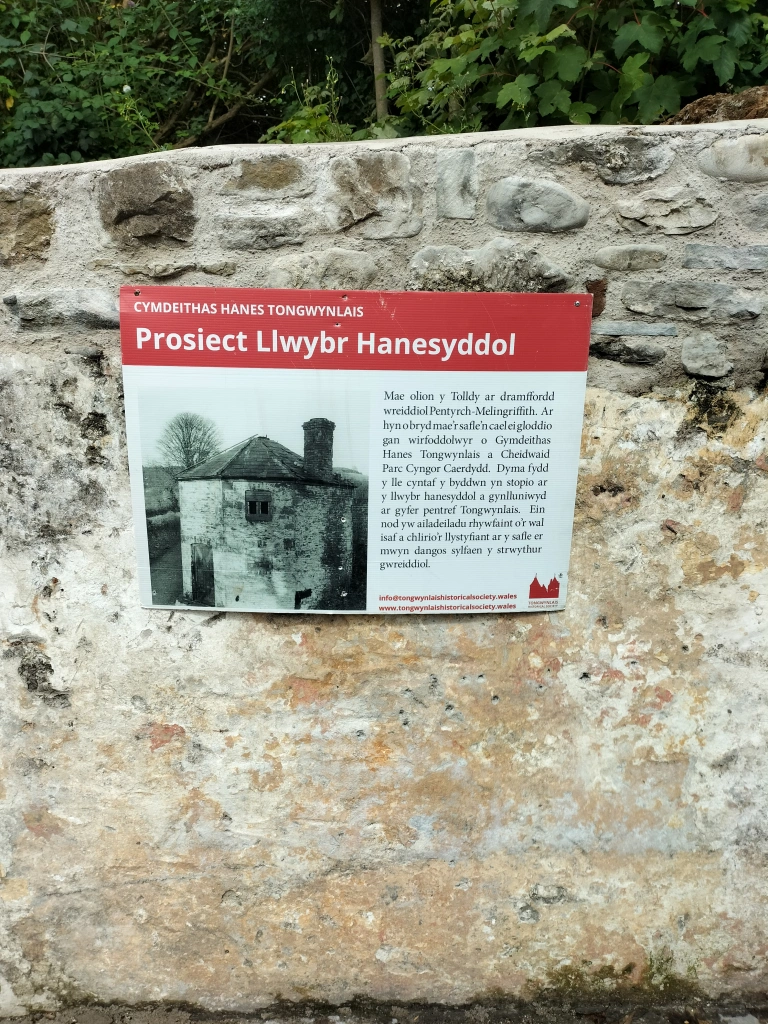
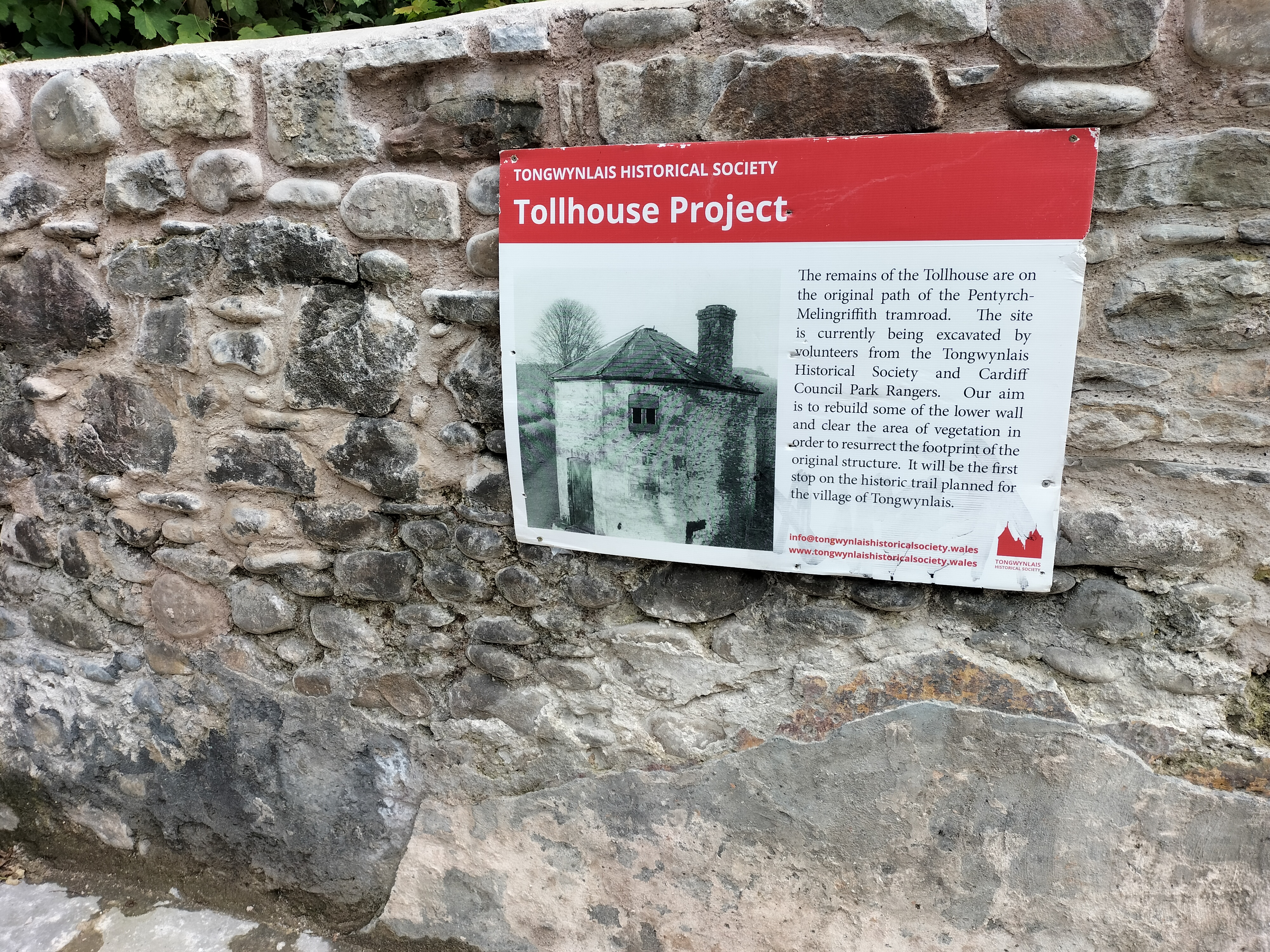
An update to my post: Tongwynlais: Historic tollhouse given new lease of life:https://www.bbc.co.uk/news/uk-wales-62718289

Edmundo Ferreira-Rocha, of Cardiff council’s Urban Park Rangers, and councillor Linda Morgan cut the ribbon at the opening ceremony. © Tongwynlais Historical Society.

© Tongwynlais Historical Society.

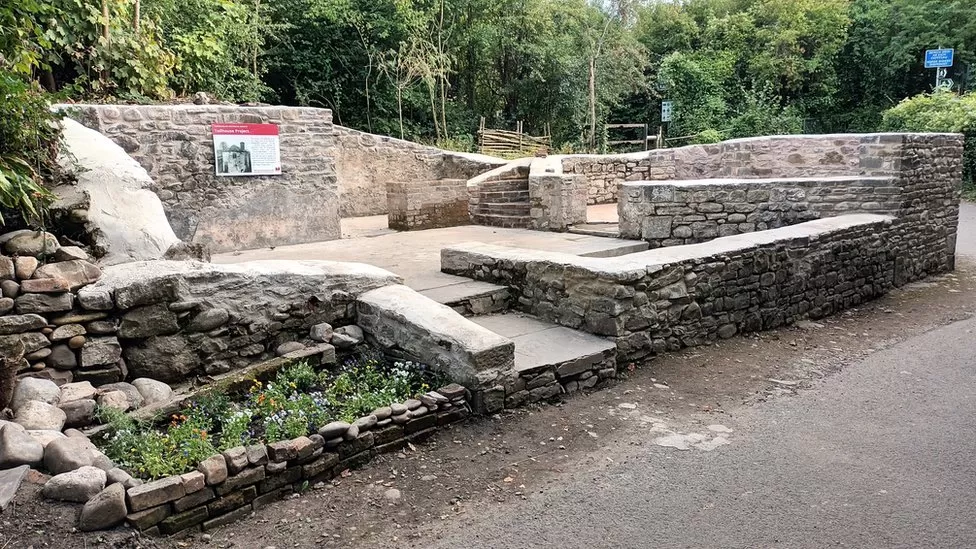
Villagers have restored the shell of a historic “unloved eyesore” tollhouse demolished more than 70 years ago. The original building was among hundreds used to collect money from 18th and 19th century travellers. Volunteers in Tongwynlais, on the edge of Cardiff, have spent more than a year rebuilding it as the first step towards creating a local history trail. “Our volunteers have been fantastic,” said Sarah Barnes, of the Tongwynlais Historical Society.

*******************************************************************************************************

Before this wonderful restoration granddaughter and I walked the Taff Trailso thought you might like to see the before and after. Or, in the case of this blog, the “after and before”.

Put a lovely sunny day, with a dog desperate to go a walk, with a granddaughter who needs to be dragged from her mobile and bribed by the thought of a chocolate brownie and a drink of Sprite, and there was only one place to head for, the cafe in the garden centre at the end of the Taff Trail in Radyr.

The Radyr section of this lovely river walk is one we’ve done often

But this time we decided to meander along various smaller paths, even though we needed to retrace our steps numerous times. I was so glad we did because look what we found:

The tollhouse, once used by the Pentyrch and Melingriffith Iron and Tinplate Works in the late 1800s

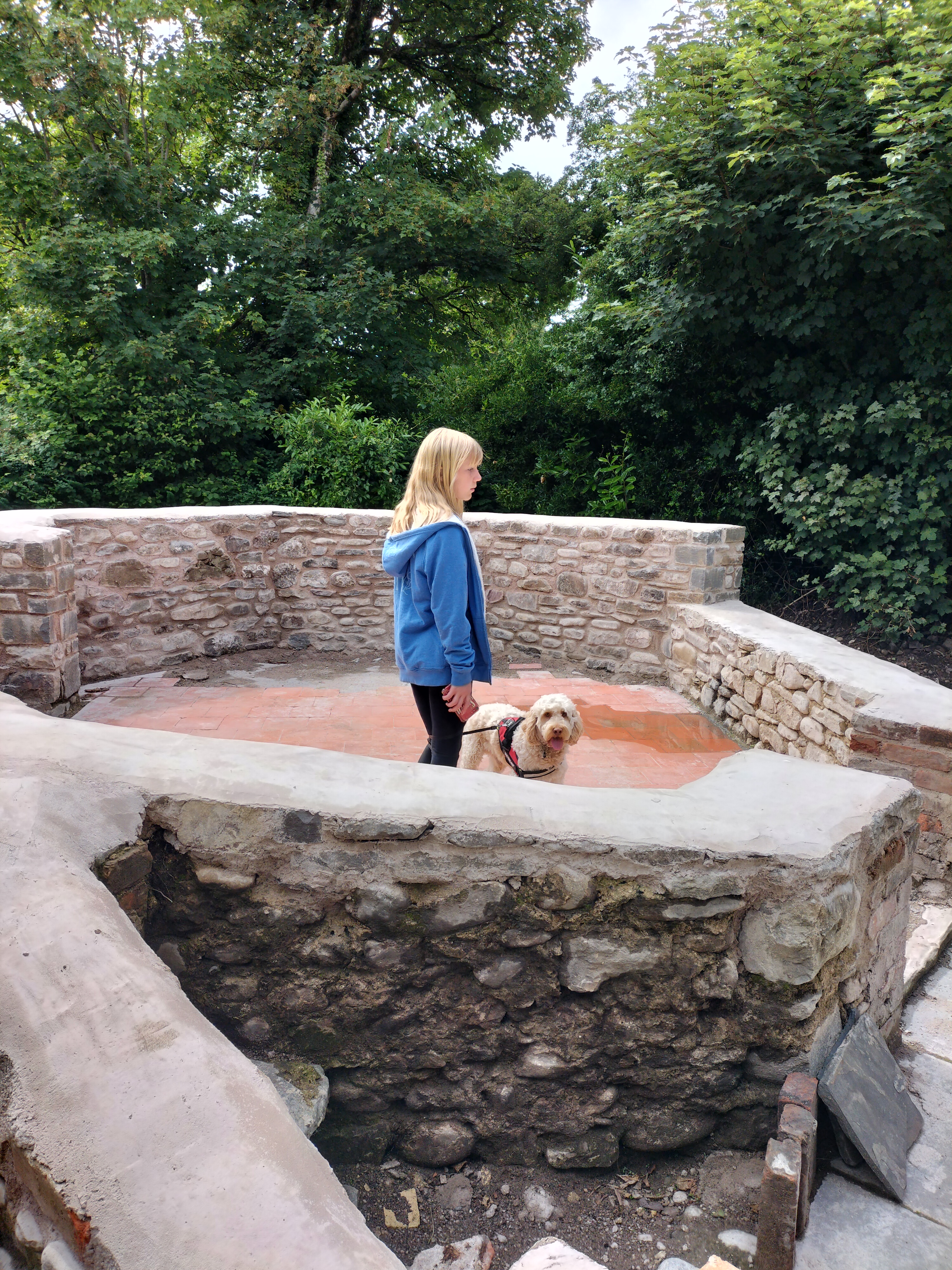
Thanks to the Tongwynlais Historical Society ( co-founders,Sarah Barnes and Rob Wiseman) the Tollhouse returns to life. What was once nothing more than a few visible bricks covered in 70 years of vegetation, is now a recognisable shell complete with growing wildflower garden

I thought I’d better seek permission to add some of the photographs from the Tongwynlais Historical Society. I made contact with a very helpful chap, Jack Davies, whose fascinating website also contains an article about the Tollhouse and other history of the village: https://tongwynlais.com/history/

Granddaughter, Seren, with soulful companion, Benji, who patiently waited to continue his walk.

Seren also very kindly leant a hand to point out this lovely heart shaped stone, with a wonderful inscription:

Which immediately brought to mind (well, my mind anyway), my book, The Heart Stone, which was published by Honno, in 2021: So, never one to pass up on an opportunity…

The inspiration for The Heart Stone partly came from research for my degree on The First World War some years ago; a subject that both fascinates and repulses me. At the time I’d found my grandfather’s army records and discovered he’d volunteered to join the local Pals Battalion with two of his friends, although they were all underage.

I only ever remember him as a small man who spent his days in a single bed under the window in the parlour, who coughed a lot, and was very grumpy. He died when I was eight.

There was no conscription at the beginning of the war. The Pals Battalions were formed, to answer Lord Kitchener’s call for volunteers, by encouraging local magistrates to drum up community spirit and patriotic fervour.

 The gist of the speeches used were that young men,”…  should form a battalion of pals, a battalion in which friends will fight shoulder to shoulder for the honour of Britain and the credit of their town and villages.”

 My grandfather was gassed in 1916 near the Somme. He was also shell-shocked and was unemployed for the rest of his life. Once, my mother told me he had never spoken of his experience but had suffered nightmares for as long as she could remember. And that there were whole streets around the house where they’d lived where the men had never returned.

It’s a haunting image.

Four years ago, after my mother passed away and we were clearing her home, I found my grandfather’s army papers again.

 During the following week, whilst my husband and I were walking along the Pembrokeshire coastal path, we found a smooth stone, almost heart shaped, placed on top of a cairn amongst the Marram grass. Picking up the stone to examine it, a folded paper blew from underneath. There had been words on it but were, by then, indecipherable.

 A love note, I thought; a love note under a heart shaped stone.

 A love note, under a heart shaped stone, from a young man who had never returned.

 And so The Heart Stone started to form.

The Heart Stone was published by Honno Press in Feb 2021

And a Review of The Heart Stone:

https://amzn.to/3bCkx8w

And a buying link:

Amazon.co.uk: https://amzn.to/3hupbc1

Also available from Honno

And a little bit about me:

I’m,originally from Saddleworth, a group of villages on the edge of the Pennines, but have lived in Pembrokeshire, Wales, for over forty years.

I have an MA in Creative Writing with the University of Wales Trinity St David’s College, Carmarthen. BA (Hons) in Literature with the Open University, a Diploma in Drama from Swansea University. I’m also is a Creative Writing tutor and hold workshops on all genres.

And here I am:

https://twitter.com/judithbarrow77
https://www.facebook.com/judith.barrow.

An easy walk… I thought!. Warren Wood (beginning with a Short Visit to the Water-Break-its-Neck waterfall) @Powys #Wales #photographs #walks #holidaymemories

The sunny day disappeared as we walked through the short steep-sided gorge – following in the footsteps of Victorian tourist to the Water-Break-its-Neck waterfall, around a mile from the village of New Radnor ( Maesyfed – the Welsh name), in the county of Powys, Wales.

It was a spectacular sight. Yet, beyond the sound of the water it was strangely silent.

The water tumbled through the black slated rocks, a silvery mesmerising flow, to the small stream and creating a fine rainbow mist in the air. Yet there was an eerie and ephemeral feeling to the fallen, bare oak branches laced with lichen and boulders covered in dark green moss and surrounded by curtains of gently swaying ferns.

We made our way back along the narrow path. I thought we would be taking a slow ramble along the walking trails in Warren Wood – so named for the labyrinth of rabbit warrens that kept the locals fed for centuries, now dwarfed by towering beeches, oaks and conifers.

Husband had other ideas. ‘Let’s walk up the road to the top of Warren Wood,’ he said, pointing vaguely to the left as we left the path. ‘We could get some brilliant photographs.

‘How far is it?’

‘Not far.’

I’ve been caught out by “Not far”, before. Why do I always believe him?

If only I’d read the Nature reserve signage:

In the 1800s The Victorian landowners planted trees on the moorland, to provide a landscape of scenic beauty thus creating a forest, part of Radnor Forest which was once a royal hunting ground. In those days it wasn’t an area covered in trees but an unenclosed piece of land, legally set aside for the Norman kings to hunt deer. Today, Radnor Forest is a land of hill farming and moorlands, steep narrow valleys and hills, rising up to the highest point in Radnorshire, Black Mixen at 650 metres.
Note the words, ‘steep’, hills, and 650 metres. What we didn’t know, was that the wide concrete road in front of us was not only steep but has many twists and turns – and always upwards before it got to 650 metres.

Two and a half hours later, with stops for photographs, we reached the top… I thought. We sat on a convenient rock, drinking from our second bottle of water.

‘We could go on for a bit longer?’ Husband said.,looking around. ‘The road carries on.’

‘The proper road stops here not up there.’ I pointed to the dirt track behind us. Steep dirt track.

I’I bet we could get brilliant photos, though. I’ll go and check.’ Ten minutes later he was back. ‘Come on, it’s a fantastic view.’

We walked in silence. Well, to be honest I had no breath to use up in conversation.

Though the views were wonderful. We could see as far away as Hereford and beyond…..

‘Ready to go back?’ Husband asked.

I didn’t think I could face that road again. ‘We could try going that way?’ I point to a gentle downward sloping track.’It looks like it’s going back to the start.’

‘It doesn’t.’

‘It does.’ I insisted.

I should,perhaps have said, before now – I have little sense of direction. We stumbled/slid down walked for over an hour with the wind whistling through the tall conifers that lined the ever-steeper, downward track. I became increasingly aware of a brooding silence, each time I said cheerfully,’It has to lead to somewhere…’ and, ‘We’re going in the right direction…’. Until we weren’t… we rounded a corner- to see the road end in a turning point for the Forestry Commission. A thick forest faced us…Hmm…

Back we went,stopping every fifty paces to catch our breath. To be fair there were only a few recriminations. Although I did hear some mutterings – which I ignored. Later,we worked out that we had walked thirteen miles – seven more than we had planned.

The following day we creaked our way rambled sedately around the fields where we were staying near Bettws Cedewain, a place in a sheltered valley on the banks of the river Bechan. around five miles from Newtown. The village grew around the crossing of the river where a church was founded by St Beuno in the sixth century. I read that the name of the village is thought to derive from the Welsh word ‘Betws’ – which means a prayer house or bead house where the number of prayers had been counted on beads by the earliest church-goers in Cedewain.

This is My Mum.

This is My Mum.. She’s the one on the left. Next to her (the dark-haired toddler, is her sister Olive, who lived with us for many years) …

mum & Olive when babies

This is My Mum, a photograph taken in her early teens …

mum young woman1

This is My Mum –  The girl on the left …

Mum around sixteen

This is My Mum, elegantly posed in her late teens…

mum - young woman

This is My Mum in her Auxiliary Territorial Service (ATS) uniform during the war…

mum in Army

This is My Mum – on her wedding Day to Dad. Sitting in a car in a photographer’s studio with a pretend background …

Mum & Dad - wedding day

This is My Mum – with my sister and me – I’m the grumpy-looking blond one…

mum in her thirties

mum with us on the beach

This is My Mum in her forties outside the house she lived in until 2014 …

mum around forty five

This is My Mum in her sixties, enjoying the sun in the garden …

mum in the back garden

This is My Mum -aged eighty, at our son’s wedding …


mum purple suit

This is My Mum …

mum thrfee months ago

This is My Mum …

I will give her some dignity so I won’t show her as she is now;  a small frail figure huddled under the bedclothes. She  sleeps most of the time, only speaks the odd disconnected word, she’s doubly incontinent and can’t feed herself, 

My Mum would not have wanted to live like this. I do not want her to have to to live like this. I wouldn’t want to live like this  What I should say is … ‘exist like this.’

 You’ve seen the photographs of my mum as she was. That’s how I want to remember her.  In a similar way, that’s how I want my children to remember me.

This why I wanted to write this post. 


Blogging – And How I Got it Wrong

I think I’ve had the wrong idea about blogging. When I first started writing a blog it was to introduce myself to others and to get to know other writers/ authors/poets/artists. Oh and to find different genres of books.

One of my first blogs that disappeared into the ether and was apparently seen by no one! http://www.judithbarrow.co.uk/11-random-facts-about-me/

But I’ve been lucky; I’ve made some online friends along the way who, I hope, would be the kind of friend I’d like to have in ‘real’ life. Some, especially, have been so supportive.

http://bit.ly/1F9PBUW

http://bit.ly/1LLzdQ6

/ http://bit.ly/1KvuYJR

http://bit.ly/1KVVozc

http://uviart.blogspot.co.uk/p/guest-interview.html

http://thestoryreadingapeblog.com/

And I’ve tried to help and support in return.

But lately I’ve noticed two things. There have been posts asking for more followers (one in particular was asking to raise the numbers because it was her/his birthday). And the others have been blogs to celebrate that a certain number of followers has been achieved.

Chasing numbers.

Now don’t get me wrong; if that’s what’s important to these bloggers, that’s fine, it’s no business of mine. And there has to be a reason for ‘upping the ante’ to get to a certain number of followers. For instance, perhaps, for authors, it’s about finding new readers, or, for certain causes, it’s to highlight that charity/society/ organisation.

And then I read this from Hugh: http://linkis.com/hughsviewsandnews.com/Sy3Um

And I remembered Hugh’s blog from a while ago: http://linkis.com/hughsviewsandnews.com/Lf7r6

I read it again. I mulled over this for a while. I looked back at some of my own posts. I saw who’d commented and/or shared. I thought about it. I left the thought to simmer.

Wise advice in both posts.

And it’s occurred to me that I jumped on the band wagon – so to speak – and I’ve  dutifully followed everyone who, I’ve been informed, follows me.

But I have a problem (well, actually I have lots of problems – thought I’d add that bit before I heard a wave of snorts of derision; ‘a problem, Judith?’ ‘Just the one problem?’) My problem is I have two sites I blog from, purely by choice. It’s been a deliberate choice. I use my other site: http://www.judithbarrow.co.uk/ initially for my personal posts, the ones I actually write myself: about my life and the things that have happened to me, my own interviews with authors, my reviews of the books I read for Rosie Amber’s Review Team; https://rosieamber.wordpress.com/ . On this site: https://judithbarrowblog.com/   I copy the blogs from the first site but mainly I use BarrowBlogs to mention/promote other authors, other bloggers’ interviews with authors, other peoples’ thoughts on all sorts of subjects.

Having the two sites works for me.

And I do try to follow the excellent advice given here: http://dreambigdreamoften.co/2015/08/30/how-to-share-your-way-to-more-exposure/

So what to do? I don’t want to be like the blogger who wrote a post saying that she had so many followers she’d stopped reading anything they wrote and just ‘liked’ the posts. I try to read everything I’m sent. And yes, I know that’s probably daft and very few do that. But I do!

I’ve made a decision! I’ve decided it’s quality not quantity. Besides I’ve noticed that the same bloggers who do  like my contributions to the blogging world, also share other types of posts I’m interested in; what I would choose to like, share and comment on. I won’t name them; it wouldn’t be fair. But they do know who they are.

So, I’m thinking, why not just follow and share their posts?

To sum up, I’m taking Hugh’s advice and have trawled through the bloggers I’ve been following for ages and who he calls ‘Ghost Followers’. I’ll carry on much the same when it comes to commenting and sharing stuff I’ve enjoyed reading – but I’ll keep an eye out and delete those who ‘pretend’ to follow but don’t. Please don’t think of that as a threat, it’s not; it’s what I intend to do for ‘self – care’.

I read this today http://yadadarcyyada.com/2015/08/27/message-in-a-bottle/  and I know that the way I blog isn’t perfect (or even close to it) And it’s up to anyone to decide whether  I’m interesting or boring and to follow or not

But the bottom line is I can’t carry on supporting those who I never see hide or hair of.

I’ll always try to acknowledge anybody who takes the trouble to let me know they’ve seen any of my personal posts; it’s only courteous and I enjoy the banter.  I do like meeting and chatting to people but …  I need to stay connected with my ‘friendly’ bloggers

And, like you all, I have a life away from here. And a book to write

See you on the other side of the screen.

Judith

Oh – a bit of a promotion here:

Links to my books:

Amazon .co.uk:

http://amzn.to/1z7ojhY

http://amzn.to/1N3GPQ6

http://amzn.to/1Fth8jR

Amazon.com:

http://amzn.to/1IxMhTA

http://amzn.to/1EsonO3

http://amzn.to/1Kn8QBU

Honno.co.uk:

http://honno.co.uk/index.php

http://bit.ly/1O2M7IL

http://bit.ly/1JGhULC

http://bit.ly/1Un5iPu

med full colour honno logo

Where’s the Most Unusual Place You’ve Had a Book-Signing?

I arrive at my book-signing event to be greeted with a small table covered with an immaculate table cloth, my books already displayed, a notice announcing my presence  and, as always, a lovely vase of flowers as a centrepiece. The staff are friendly and chatty (today it’s Carolyn … and Sharon, complete with big smiles ). I already know them; after all I’ve been holding book-signings here for the last five years and I’ve been a customer of the shop for more years than I care to remember. Nothing unusual in that, I hear you say; we’ve all done events in stores we know. But this venue is special, this is our local chemist, Kilgetty Pharmacy. And, when first forced to admit to myself that I needed to go forth and sell, this was the second local event I was welcomed to.

206

Putting on a pose – me with Jane Gilbert (who owns the shop with her husband, Bart)

I’d talked with Jane about my writing for years (I’m not sure she ever thought I’d be published but she was always tremendously encouraging). Anyway, the day that Pattern of Shadows came out I couldn’t wait to show her. Without hesitation she asked, would I like to hold a book-signing in the shop. I was thrilled – thought there was nothing odd about appearing at a chemist. Up to date I’ve been four times, they’ve sold loads of my books,and I’ll be there again just before Christmas.

Kilgetty Pharmacy isn’t just a place where people go to have prescriptions filled; it’s an Aladdin’s cave of  goodies. It’s where I’ve bought gorgeous scarves and unusual handbags.  Husband tries to ban me from going into the  shop; the temptations to buy are always too strong!

And their claim to fame? In 2013, in a UK wide Easter  competition held by Bronley for the best window display, this chemist  won first prize. I believe the prize was a jolly to Paris for two of the staff!!

200

198212

211

208

A few shots of the busy shop … er … well it was busy until I produced my mobile to take photos … then the staff scuttled off and customers disappeared. (I made the mistake of asking permission.) Hah!

202

Two kind ladies who did agree to pose, while looking for a present. There are treasures for all kinds of occasions: Engagements, Weddings, Births,, Birthdays (from one to a hundred years old!)) Celebrations of all kinds, Cards, Festive ornaments, Treats for pets, Treats for the birds in the garden … and … and …

Highlight of the day? No less than three sales  reps came in to sell their stock to the shop … and I sold  a signed copy of one of my books to  each of the . Yay!!

204

My thanks go to  Jane & Bart Gilbert, Carolyn Finlay,, Sharon, Val, Linda, Carolyn Jones,  Jane Goldsmith and Sue  for a great day. See you next time!

So, all you authors out there – a challenge! Where’s the most unusual place  you’ve held a book signing? Do please tell – with photos if possible!

Links:

http://amzn.to/1fPSfJ5

https://www.facebook.com/judith.barrow.3

https://twitter.com/barrow_judith

https://plus.google.com/+JudithBarrowauthor

LinkedIn: http://bit.ly/1fNP6t2

Bit of self publicity here:

Hush! The first two books of the trilogy are on offer at £1.89 at the moment.

Pattern of Shadows: http://amzn.to/1Denx74

Changing Patterns: http://amzn.to/1MxOvJ0

Living in the Shadows: the last of the trilogy, published in July: http://amzn.to/1JzO3Jh

All also available in paperback on Amazon and from my publishers

http://www.honno.co.uk/med full colour honno logo