Or rather strolled!.This walk was part of a couple of the short walks we had over our stay as guests with one of the members at the Loch Rannoch Highland Club.
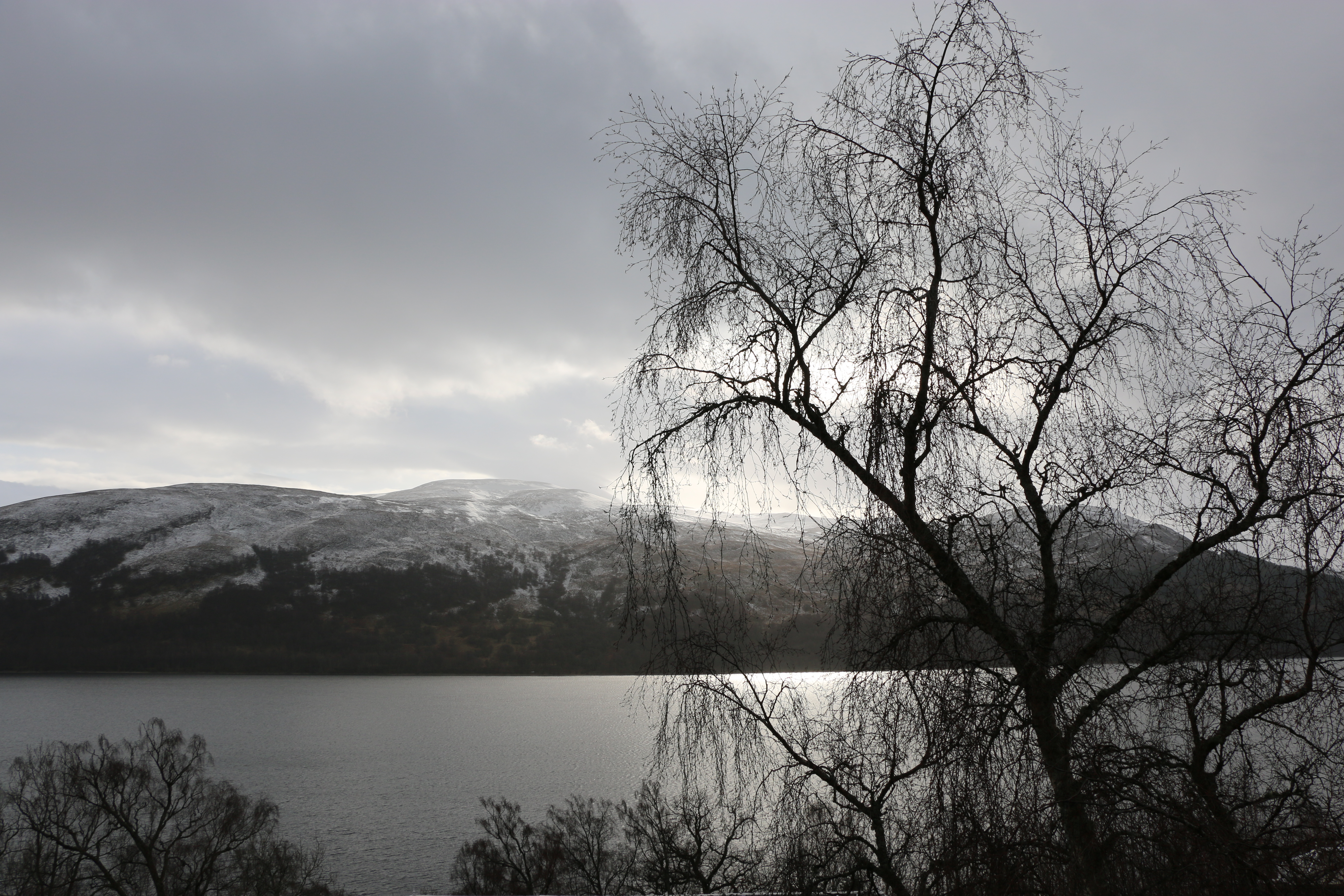
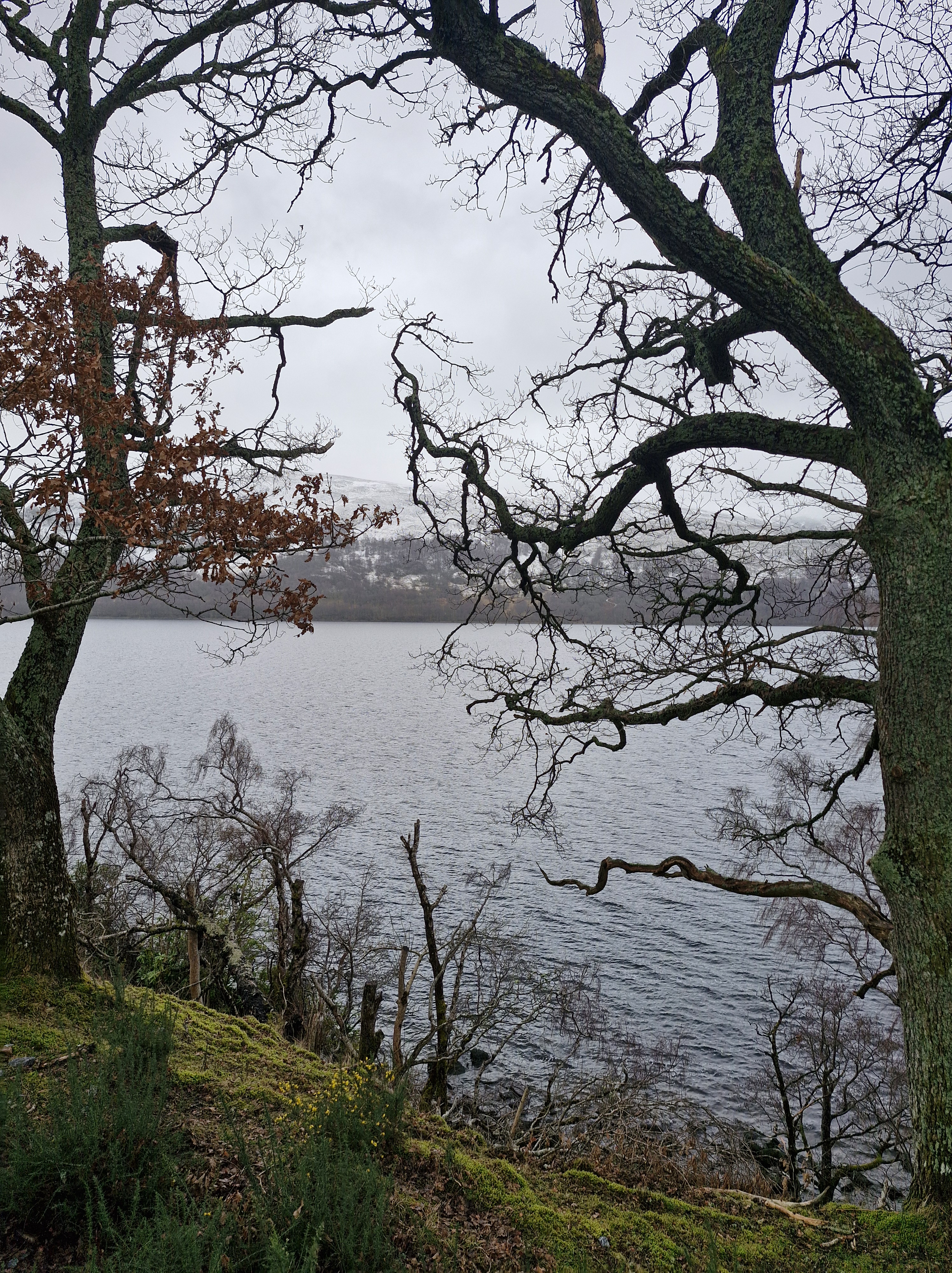
It truly is a wonderful place to stay, with every one of the lodges overlooking Loch Rannoch. The Photographer took this photo on our first night we arrived. We were hooked!It snowed, but soon cleared and we had four glorious days. The Triangle walk was an easy morning’s stroll that we found on the third day.
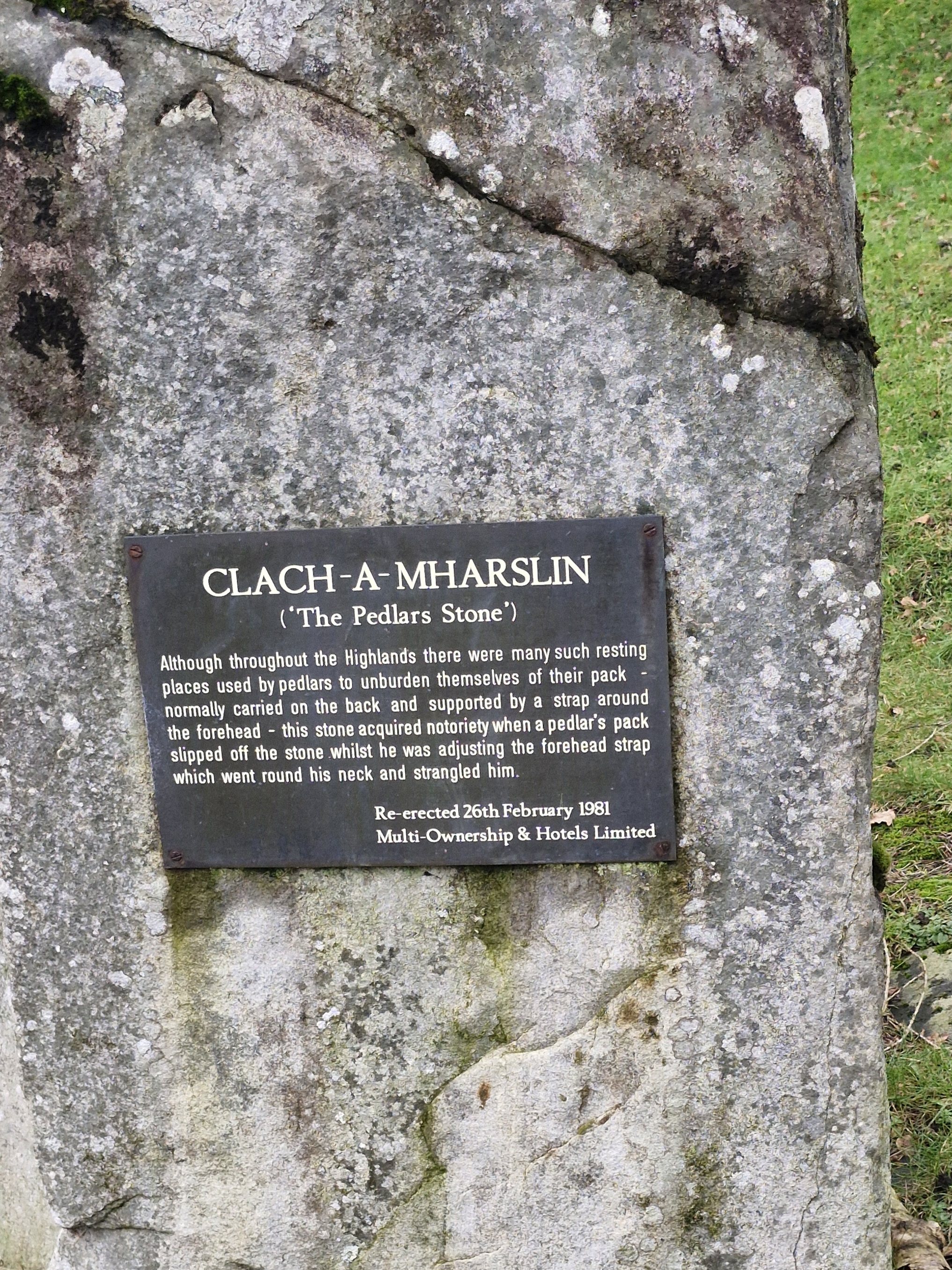
We’d previously passed a stone on the edge of the grounds of the club. That morning we stopped to read the inscription.
Hmm – not a cheerful tale! The Clach-a-Mharslin (Stone of the Packman) is the legend of a pedlar, travelling with a pack slung over his shoulders. Sitting down by the stone to rest, he put his pack on top of the stone. The pack slipped down the back of the stone, the loop tightening around his neck. Trapped, the heavy pack strangled him.
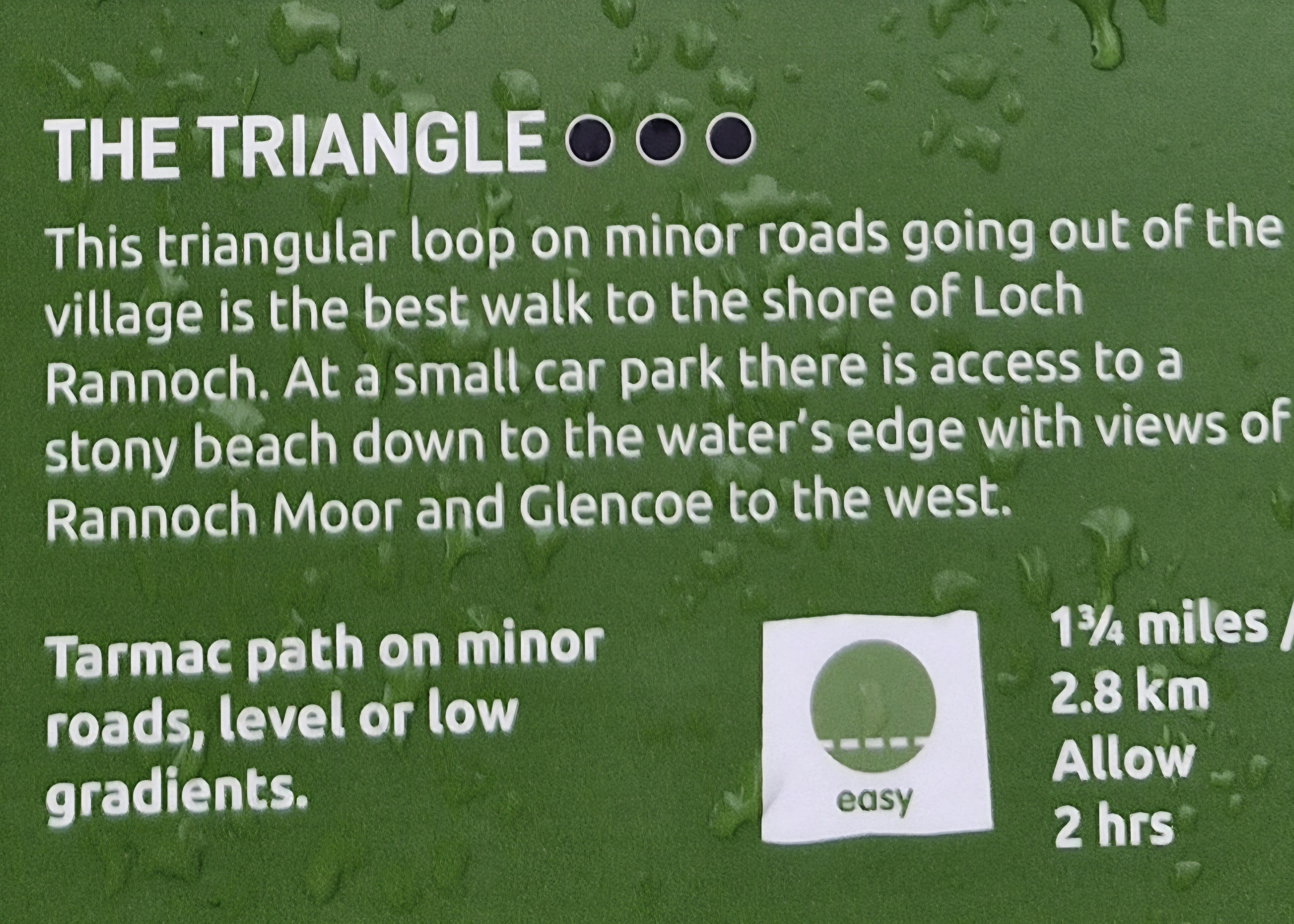
The Triangle walk is exactly what it says: we headed south from the loch to Kinloch Rannoch.Following our map, we left the village and walked along a lane for half a mile along the road that eventually leads to Aberfeldy.
Believe it or not, there are deer here. We had trouble spotting them as well – they were all lying down.
We turned right onto Bunrannoch road, a long stetch of lane near the edge of the Dall Estate, which dates back to 1347. (We were told by the man in the village shop – the residents of Kinnloch Rannoch are such a friendly lot – that the estate surrounds Dall House, built in 1855 as the new seat of the Robertson Clan (Clan Donnachaidh) and gifted by Robert the Bruce for service in the Scottish Wars of Independence.)
There is little to be seen of the old Rannoch village. But we were lucky enough to chat with an elderly man who explained that there were possible plans for another archeological dig being planned. And that the mounds were the remains of a settlement: three prehistoric roundhouses, two larger early historic monumental roundhouses, and five medieval longhouses. He also said that in the 1990s, archaeological digs at Bunrannoch had discovered some bronze axes, and that, in the nineteenth century, a bronze armlet, a form of Scottish Iron Age jewellery belonging to aristocracy and a symbol of power and prestige in the first and second centuries AD, was found. Artefacts all now in collections in the National Museum of Scotland.
It just shows – always stop to chat to fellow walkers!!
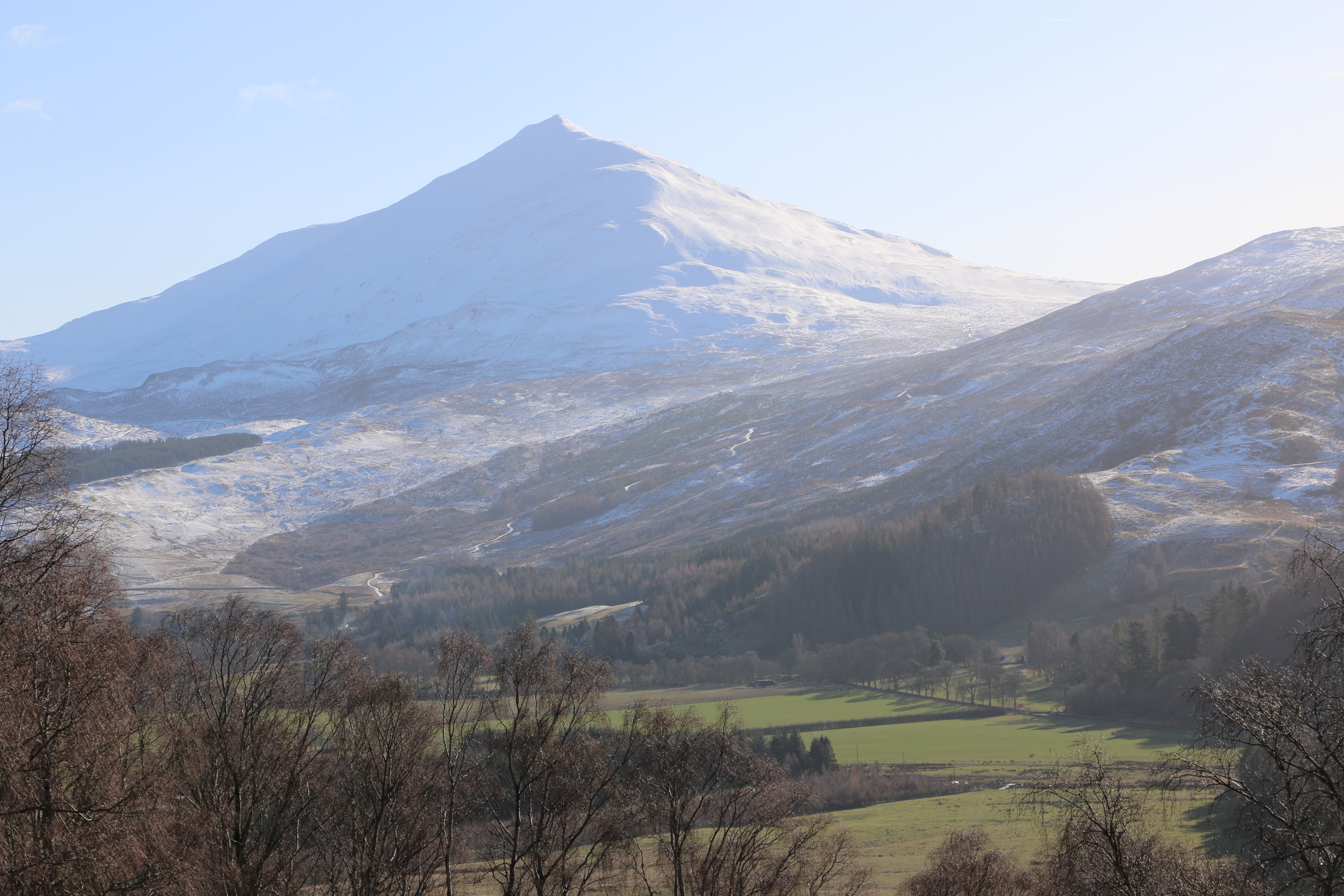
The walk passes the base of Schiehallion, one mountain we weren’t tempted to climb. Though the Photographer was so impressed by the symmetry of it he took many photographs.
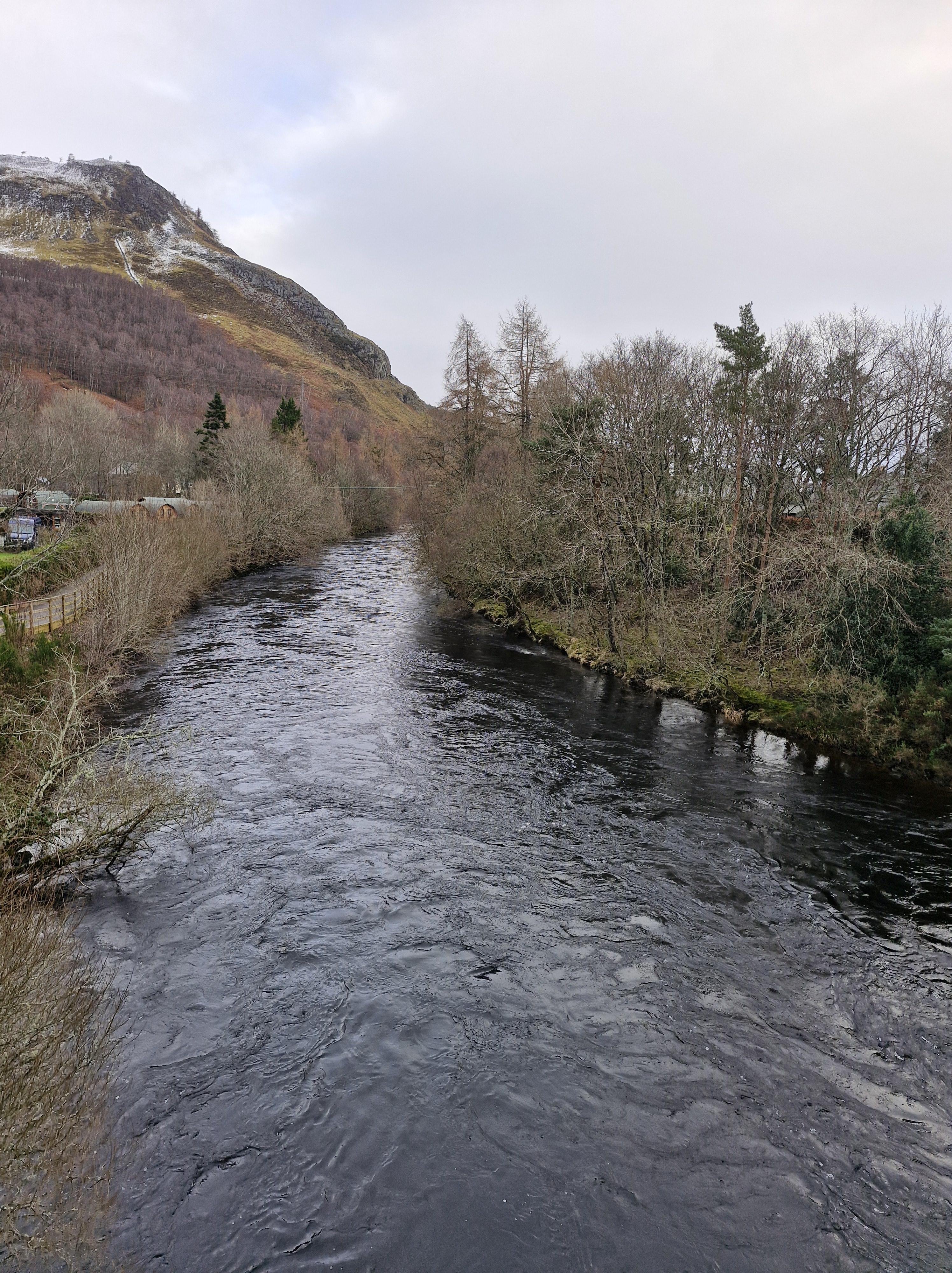
And back to the village. Triangle completed, a lovely easy stroll. We crossed the bridge over the Tummel River. The water was high and deep, swiftly running after all the many previous weeks’ rain.
There’s an inscription on Rannoch Bridge that reads “THIS BUILDING ERECTED A.D. 1764 AT THE SOLE EXPENSE OF HIS MAJESTY OUT OF THE ANNEXED ESTATES”. It’s obviously propaganda intended to show the personal generosity of George 111 after the 1745 Jacobite Rising when the British government confiscated the estates of Highland leaders who supported the rebellion. Though the profits gained were used to fund trade and agricultural developments in Scotland and, I guess, went someway, maybe, to improve stewardship of the estates forfeited.
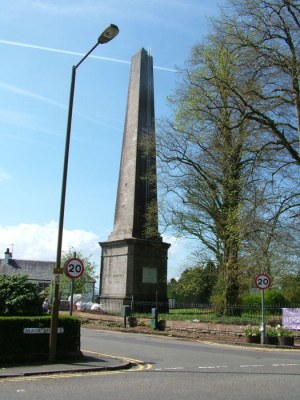
At the village square we stopped at the Buchanan monument, Dedicated to Dugald Buchanan (1716–1768), a famous Gaelic poet known for religious poetry, such as Judgement Day. He was crucial in translating the New Testament into Scottish Gaelic and operated a school in the area.
Previously, this was also the site of gallows.
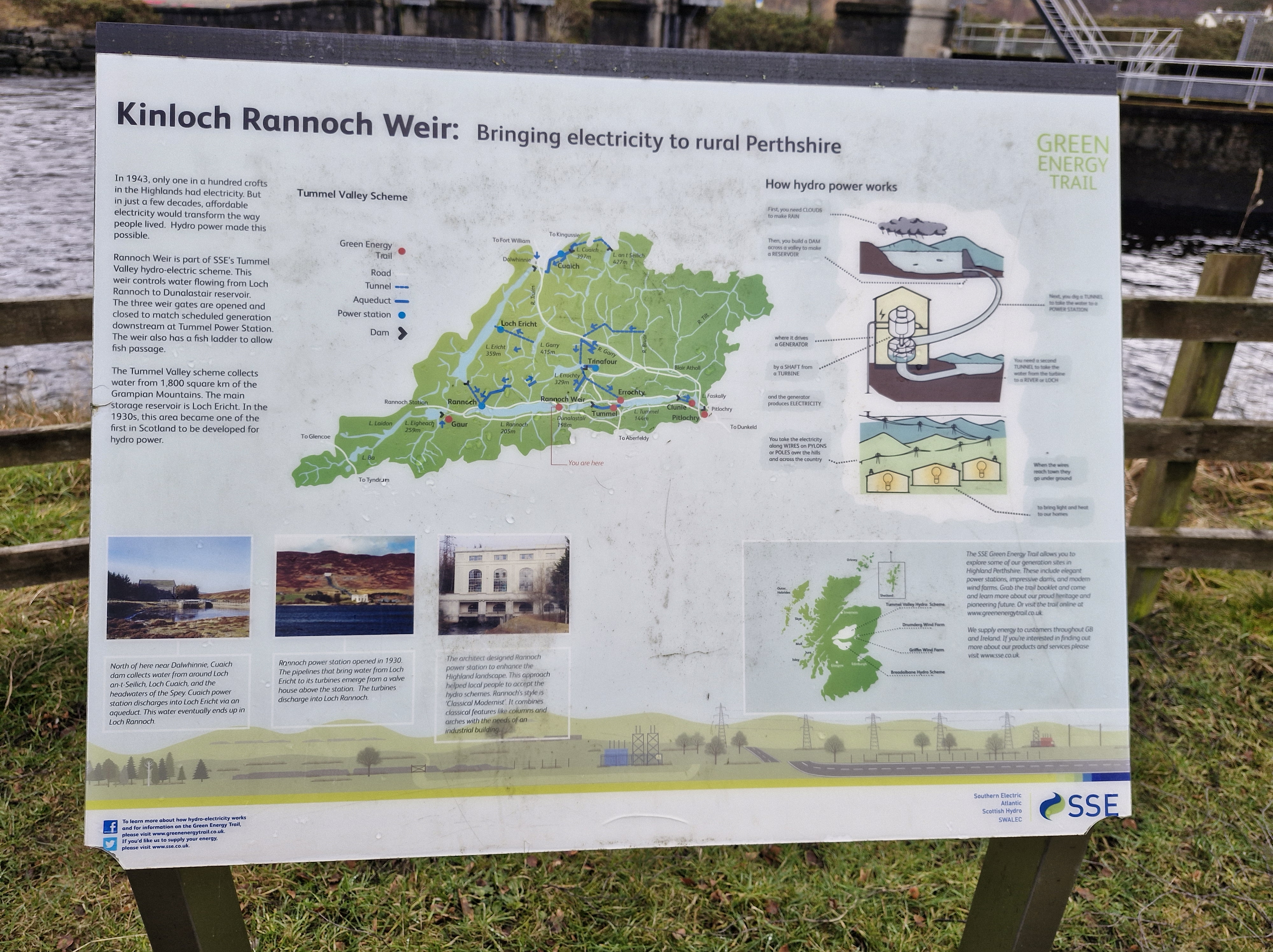
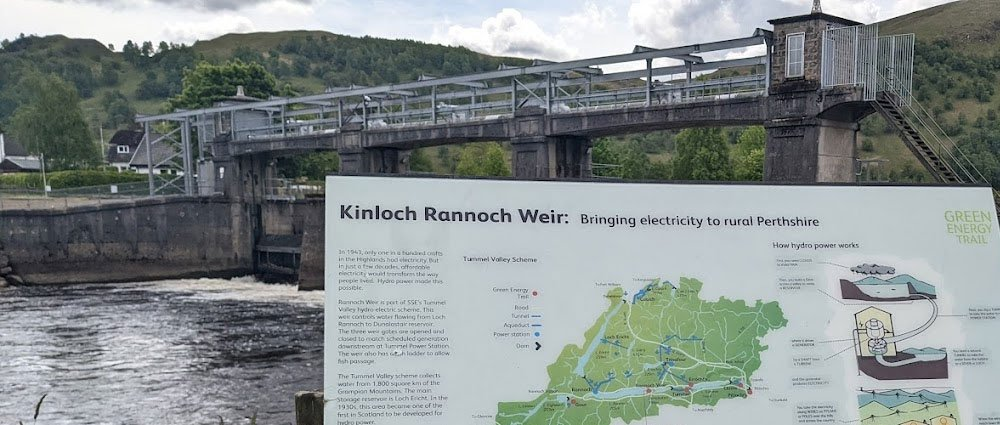
And then took the path alongside the Tummel river, past the weir. Kinloch Rannoch Weir is a low-level dam located at the eastern end of Loch Rannoch, and controls the outflow of water into the River Tummel towards Dunalastair Reservoir. As part of the wider Tummel Hydro-Electric Scheme, it regulates loch levels for environmental and power generation purposes. It is a Grade B listed structure and is believed to date back to the 18th century.
A short walk, but one that gave us a chance to discover a little of the history of Kinnloch Rannoch.
Arriving back at lodges that evening, we treated ourselves to a meal at the Loch Rannoch Highland hotel, the independently-owned hotel that’s on the same site as the club. We could have used the pool and spa there, but not having brought our swimsuits – well we forgot, it was February after all – we didn’t. However we did have some excellent food there.
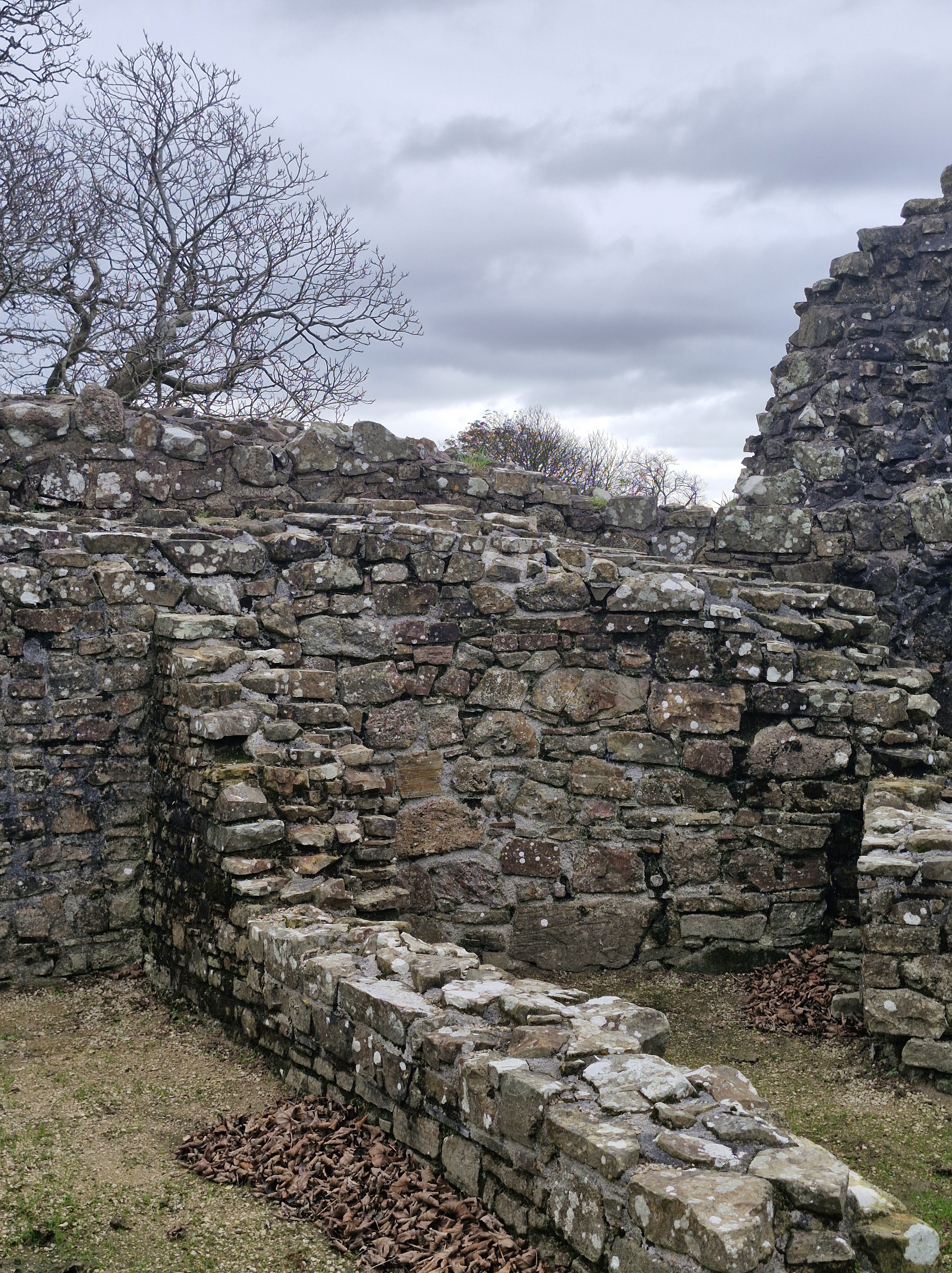
Following a recce for a Narberth U3a future Stroll and Photo at Llys-y- Fran, we took a diversion to Wiston castle. Even though not long enough for a walk, the castle and nearby church are historically interesting.
The castle was builtby an early Flemish settler with the unusual name of Wizo (in Latin) or Gwys (Welsh). Wizo was one of the powerful Norman lords who took control of southern Wales in the decades following the Norman Conquest. The settlement was called Wiston, which was an old Flemish/Saxon word for Wizo’s enclosure. And I am reliably informed, by someone who knows far more about these things than I do, that Wiston is pronounced Wizon,
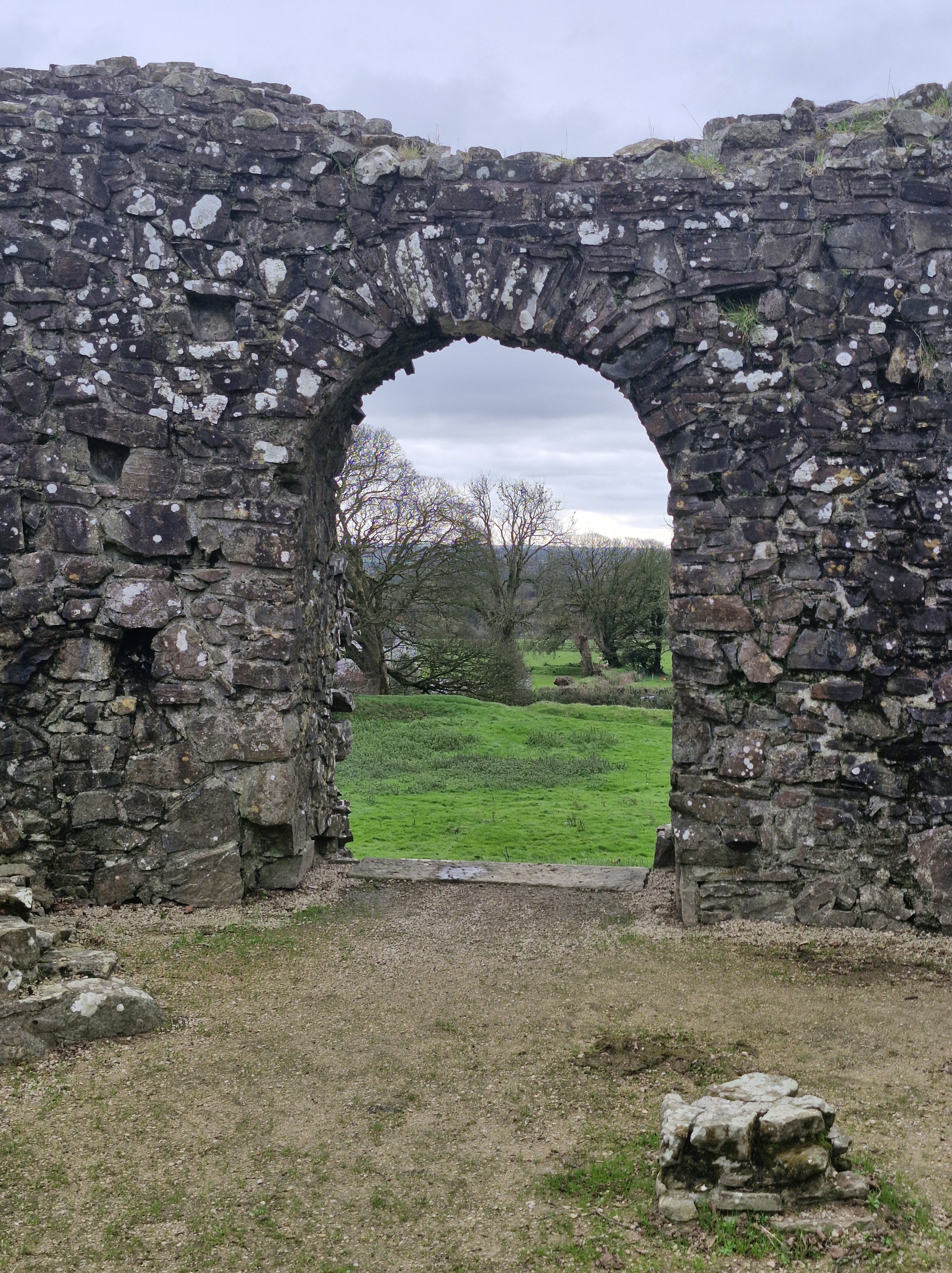
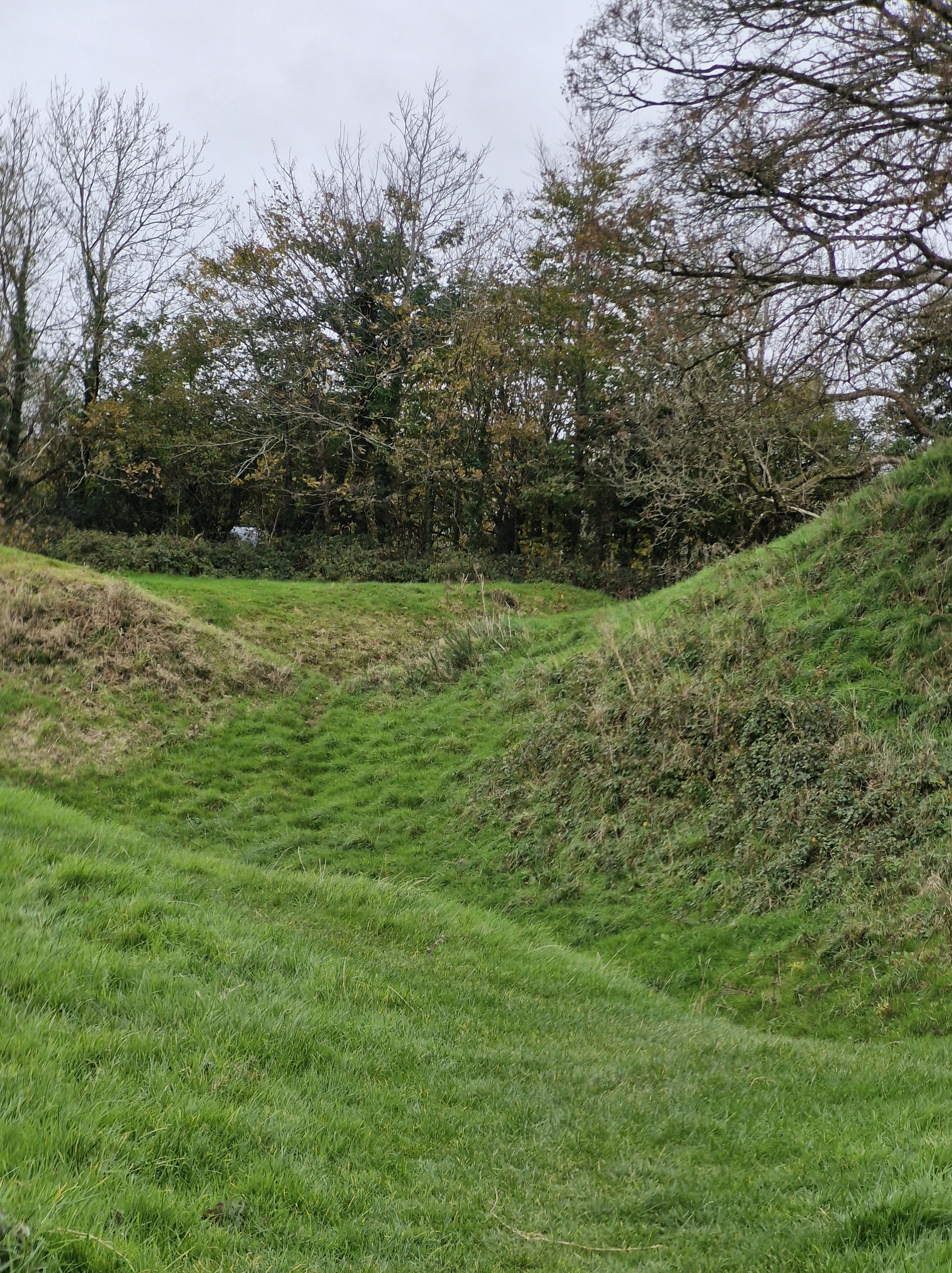
Wiston is one of the best-preserved motte-and-bailey castles in Wales, (A bailey is an enclosed courtyard within a castle, typically surrounding a central mound (the motte), a small mound or hill which was fortified in the past).
The castle is first mentioned in documents in 1147 when it was attacked by the Welsh, and then again byHywel Sais, who was the son of The Lord Rhys who ruled this area of Wales, in1193. The castle was again attacked and destroyed in 1220 by Llywelyn ap Iorwerth (Llywelyn the Great).There is more information of the history of Wiston castle here:
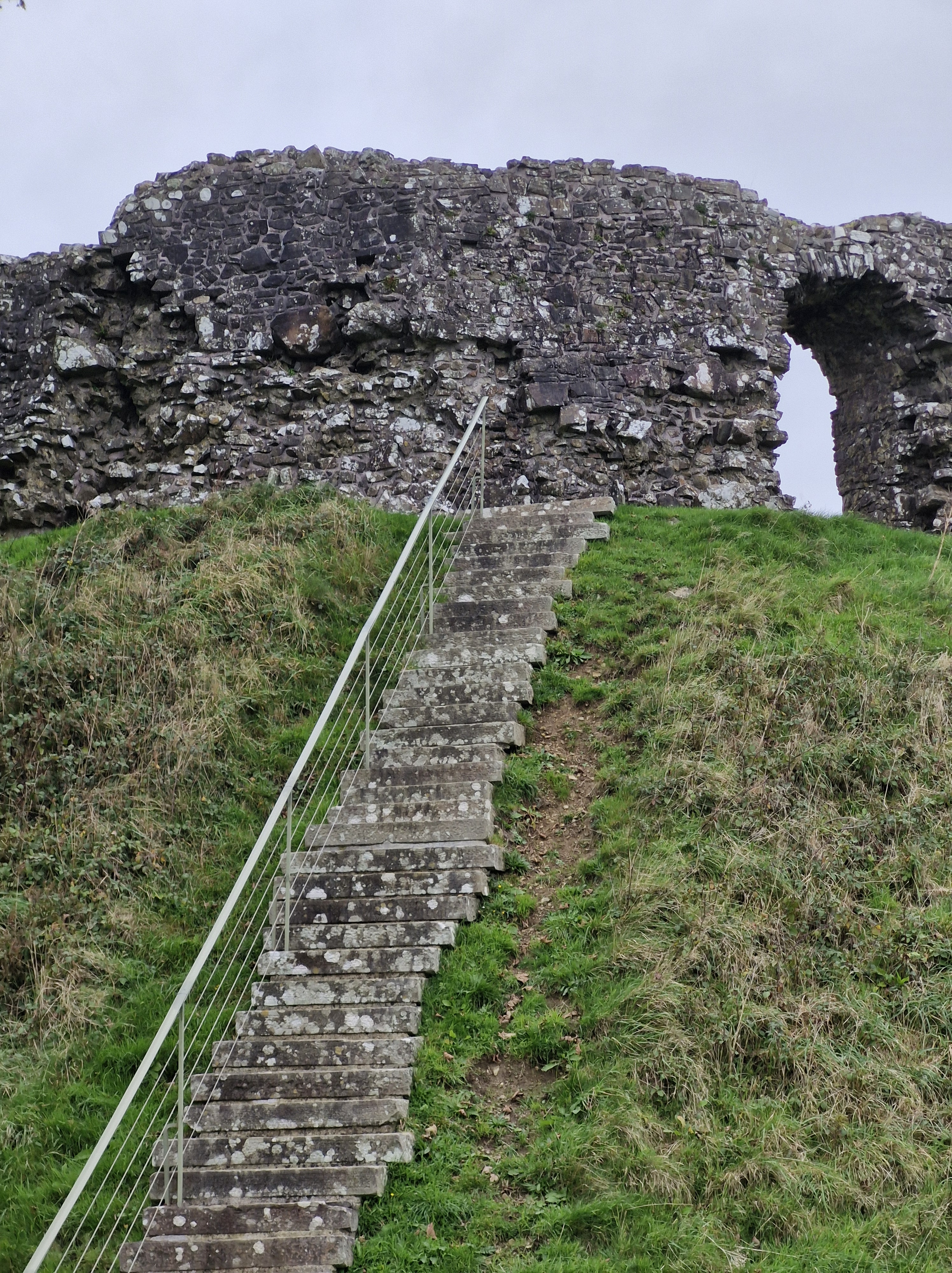
There are forty-nine steps … I counted!
The Keep was a large fortified enclosure. This would originally be an early thirteenth century timber tower within a palisade. The present sixteen-sided stone shell keep was a replacement and would have risen another story with a parapet. The entrance was barred by a stout wooden door and the residential upper floor was reached by stone steps just inside the doorway.
A deep ditch surrounds the base of the mound, separating it from the bailey (the enclosed courtyard within a castle) to the south, and connecting with the moat of the outer bailey on the eastern and western sides. This would have contained essential buildings like stables, barracks, and a chapel – the fortified area where soldiers, servants, and livestock lived and where the day-to-day activities of the castle took place.
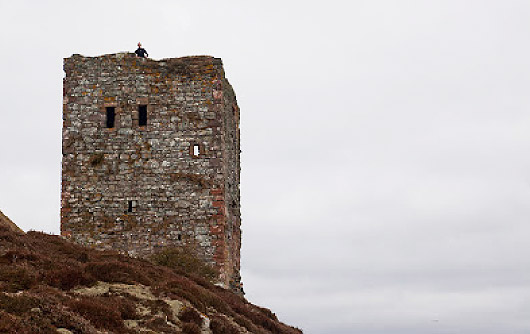
Impressive stone walls.Spot the lookout!
And, of course, who goes up … must then go down. Much easier!
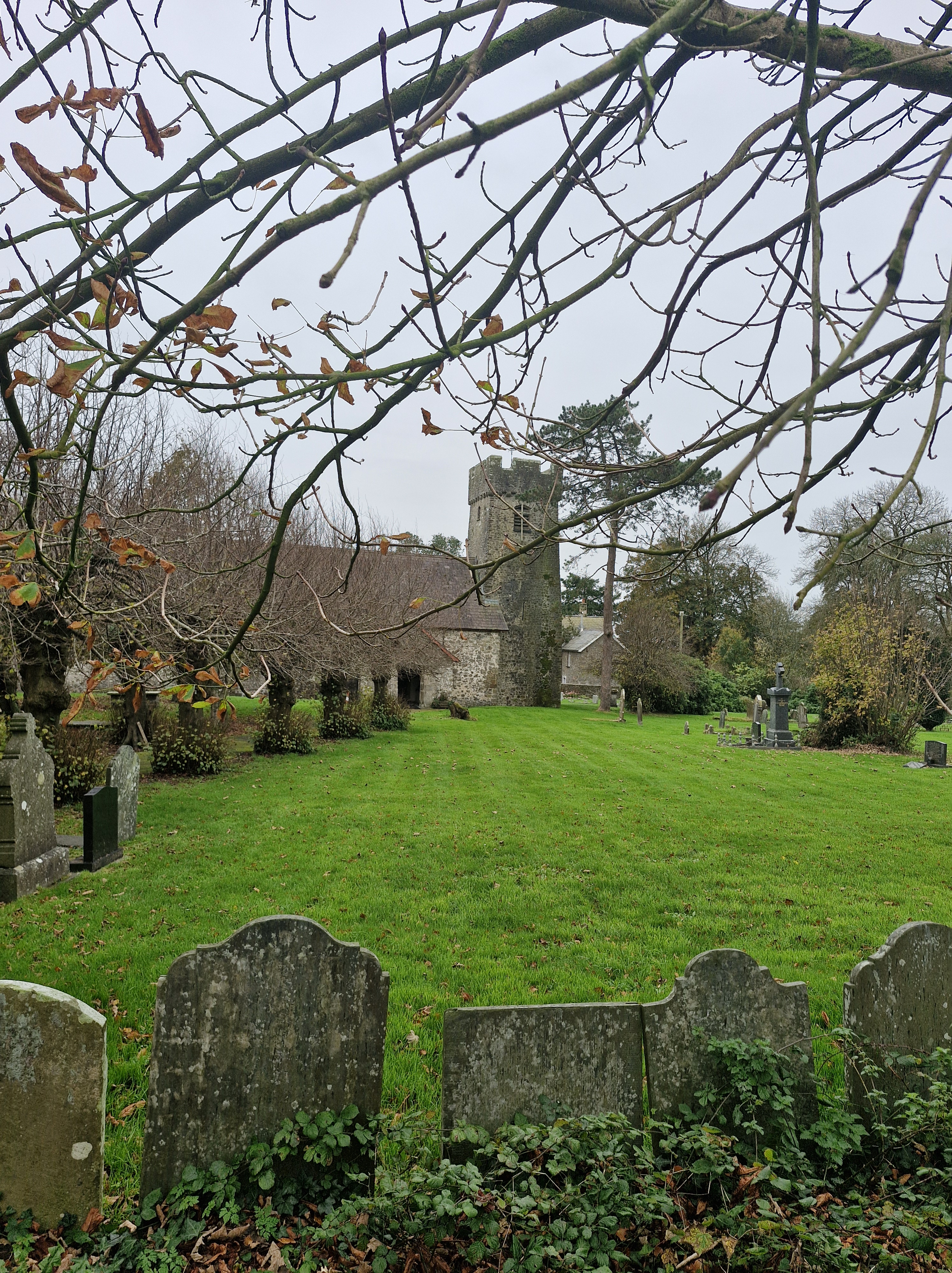
The Church of St Mary Magdalene.
Wizo also founded the church nearby at the same time. Though altered by subsequent generations, the church is essentially a Norman building, entered by a very simple doorway made of large slabs of local red sandstone.An interesting church to visit at a later time, I think.
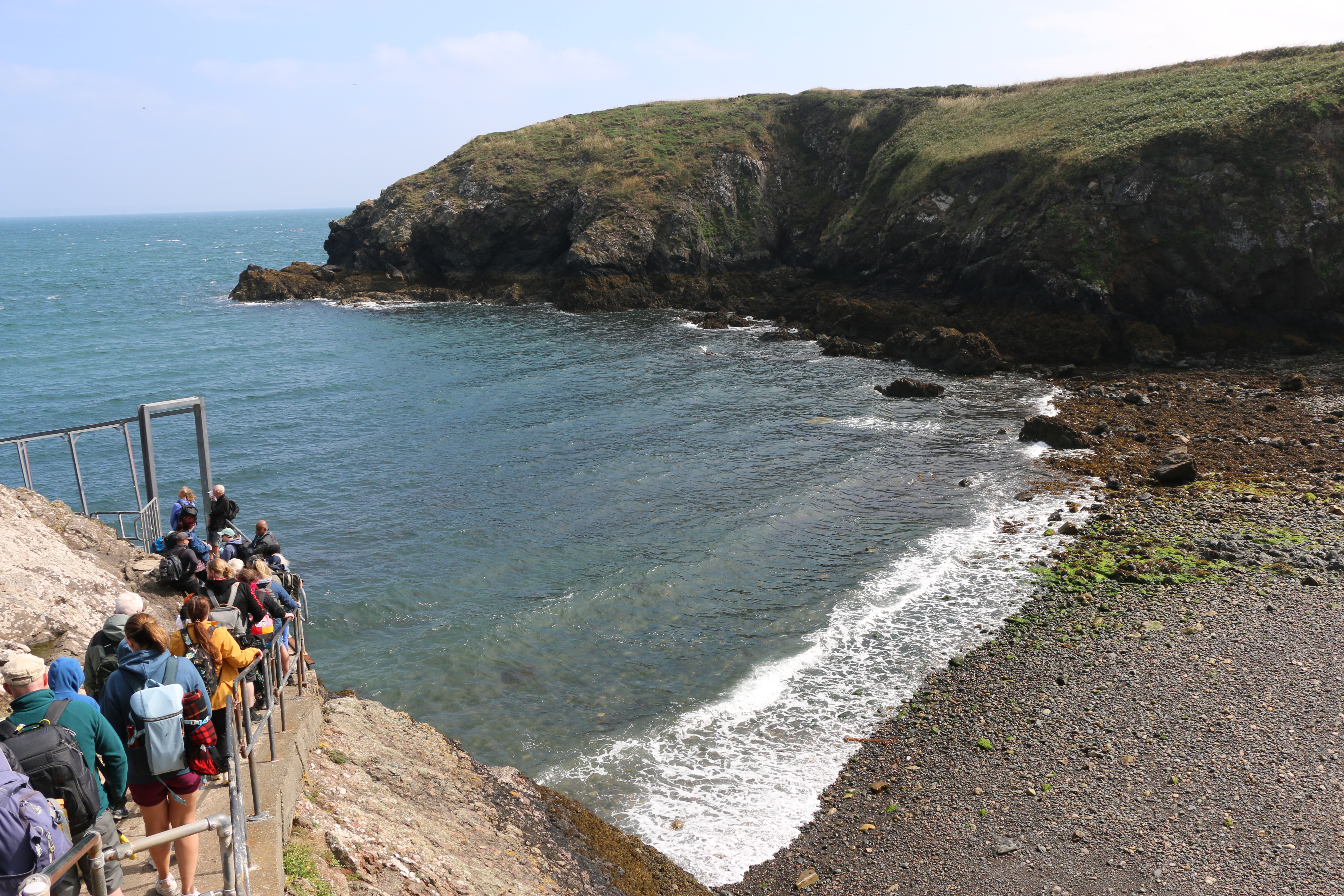
At long last! After living in Pembrokeshire for the last forty-six years and despite walking many miles of the Pembrokeshire coast, and meandrering around a lot of the Welsh countryside discovering wonderful places, lakes, waterfalls … scenary, we hadn’t been on Skomer island. This week we finally managed to go.And it was a glorious day’s adventure.
Boarding the Dale Princess
Arriving on Skomer …
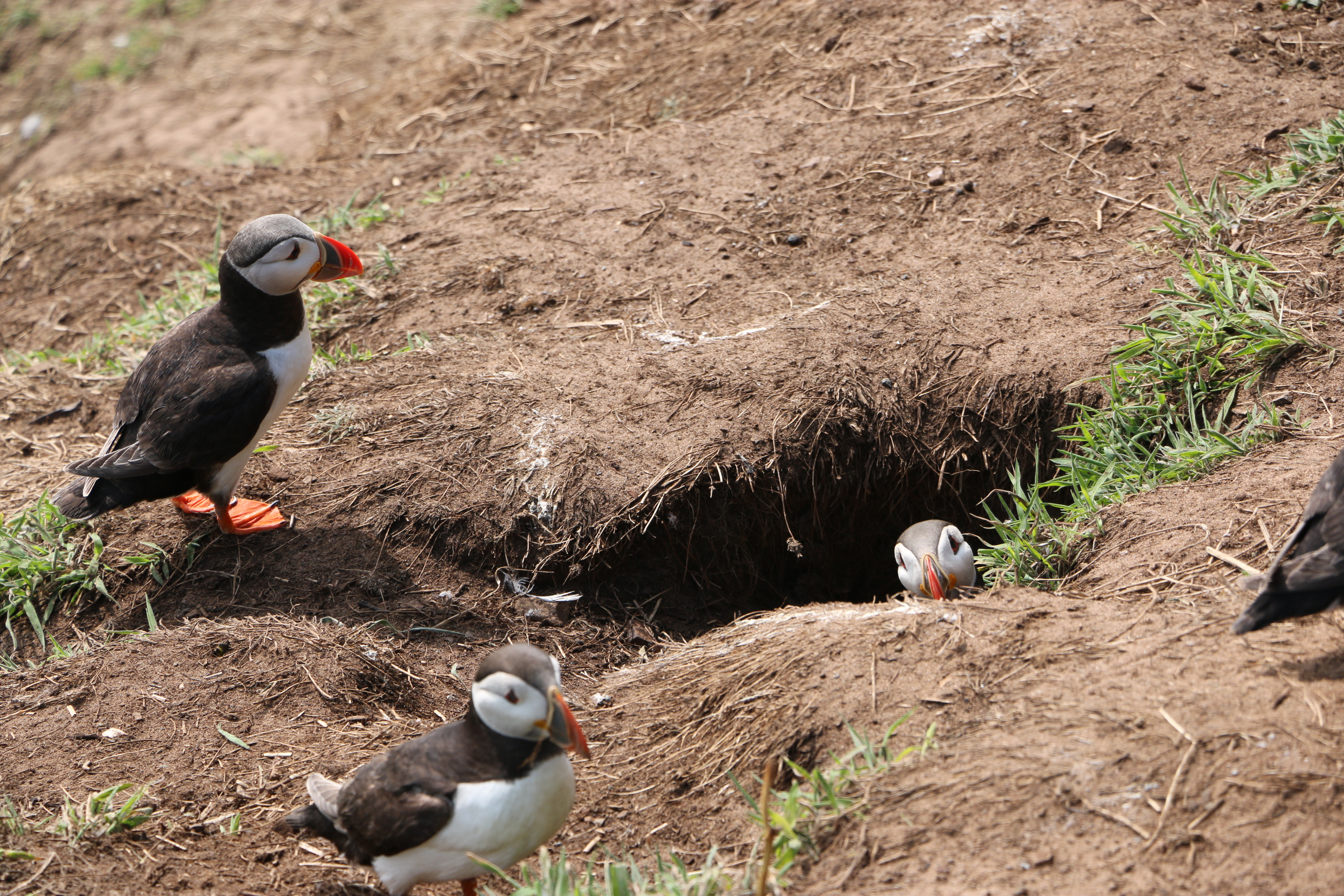
To be greeted by numerous curious puffins who seemed as interested in us as we were in them….
Skomer is internationally important for seabirds and, of course, there are necessary rules to protect the birds so we were told where and how we could walk the paths. One of the National Trust volunteers told us about the numerous species of birds on the island which included the Puffins – now in their last week before they leave the island – we were so lucky to see them.
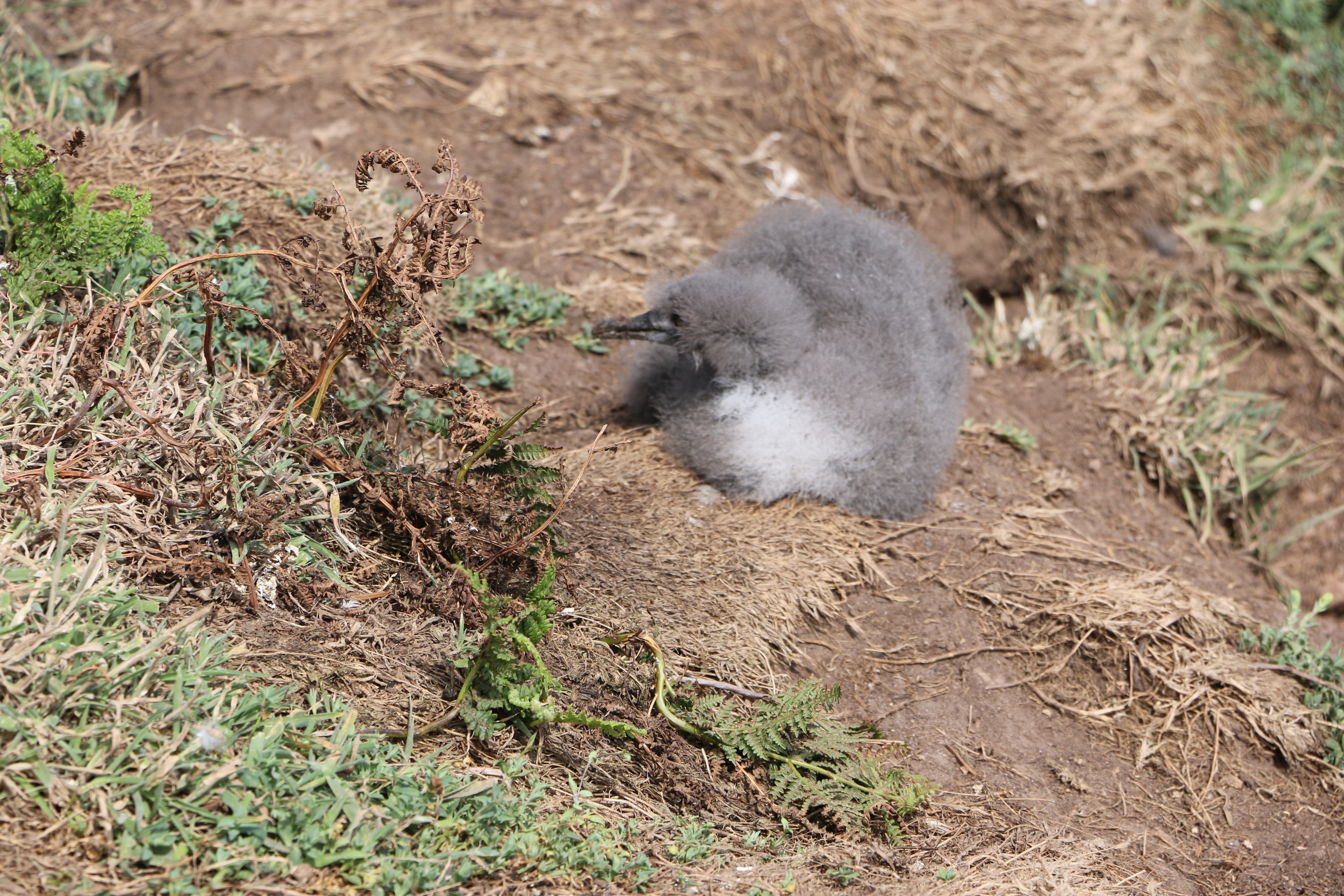
The colony ofManx Shearwaters is the largest colony in the world. Unfortunately we found quite a few remains of these on the narrow paths, apparently caught by the Great Black-backed Gulls. Later in the day we came across a crowd of people watching a Manx Shearwater chick which had wandered out of its ground nest. Seeing the amount of Gulls flying overhead, we hoped it managed to shuffle back to safety.
We weren’t lucky enough to see the Storm Petrels that are usually here on the island (they probably were but our binoculars were of slightly less quality than those hired out for five pounds by the National Trust). But we did see Guillemots, Razorbill, Kittiwakes, and so many of the ubiquitous Carrion Crows and Ravens
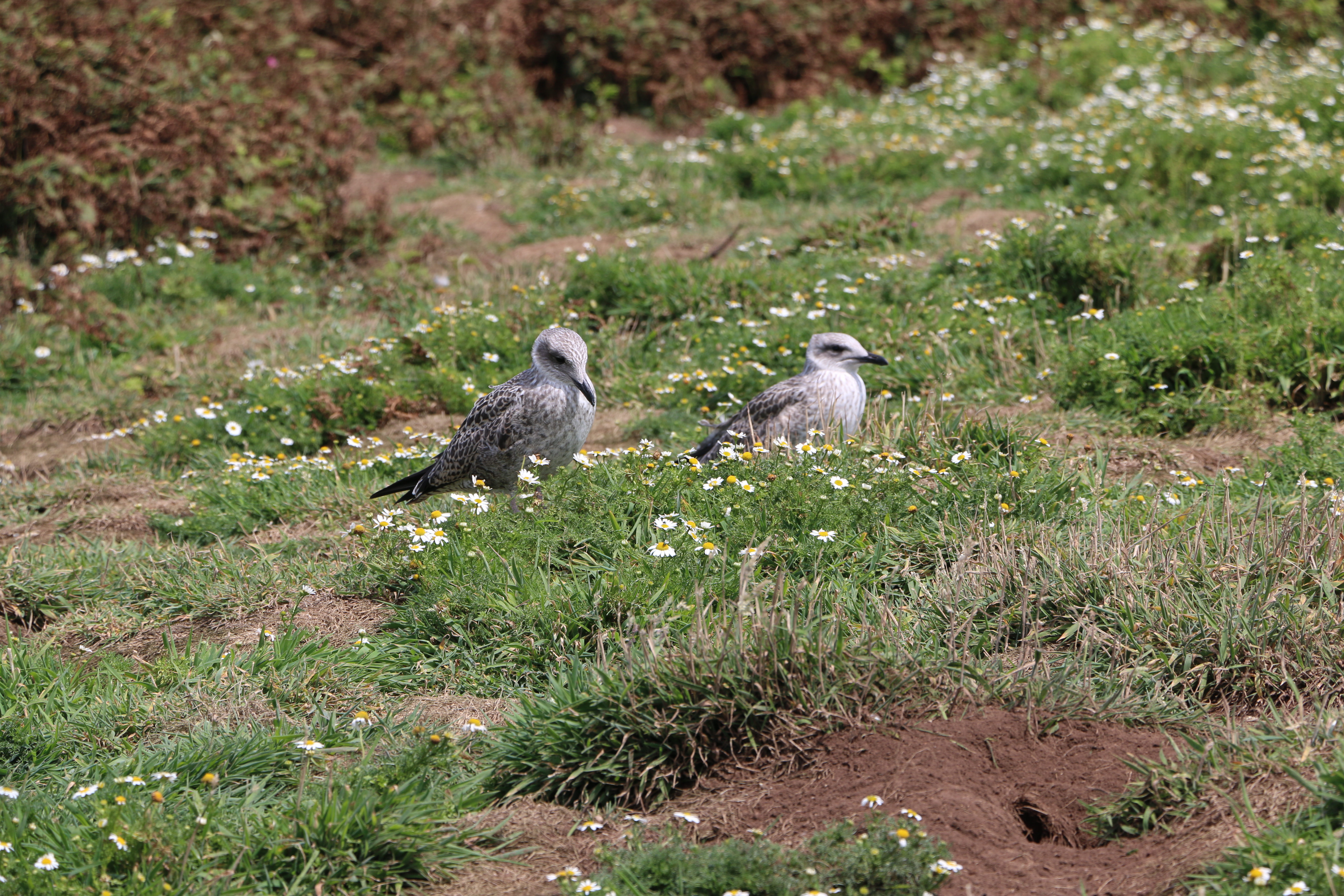
And at the Bird Hide, we watched Fulmars, Herring, Lesser and Great Black-backed Gulls as well as a pair of Canada Geese around the North Pond. (Well, I think they were Canada Geese, the Photographer said they were … ducks!) Huh!
Two watchful Kittiwakes
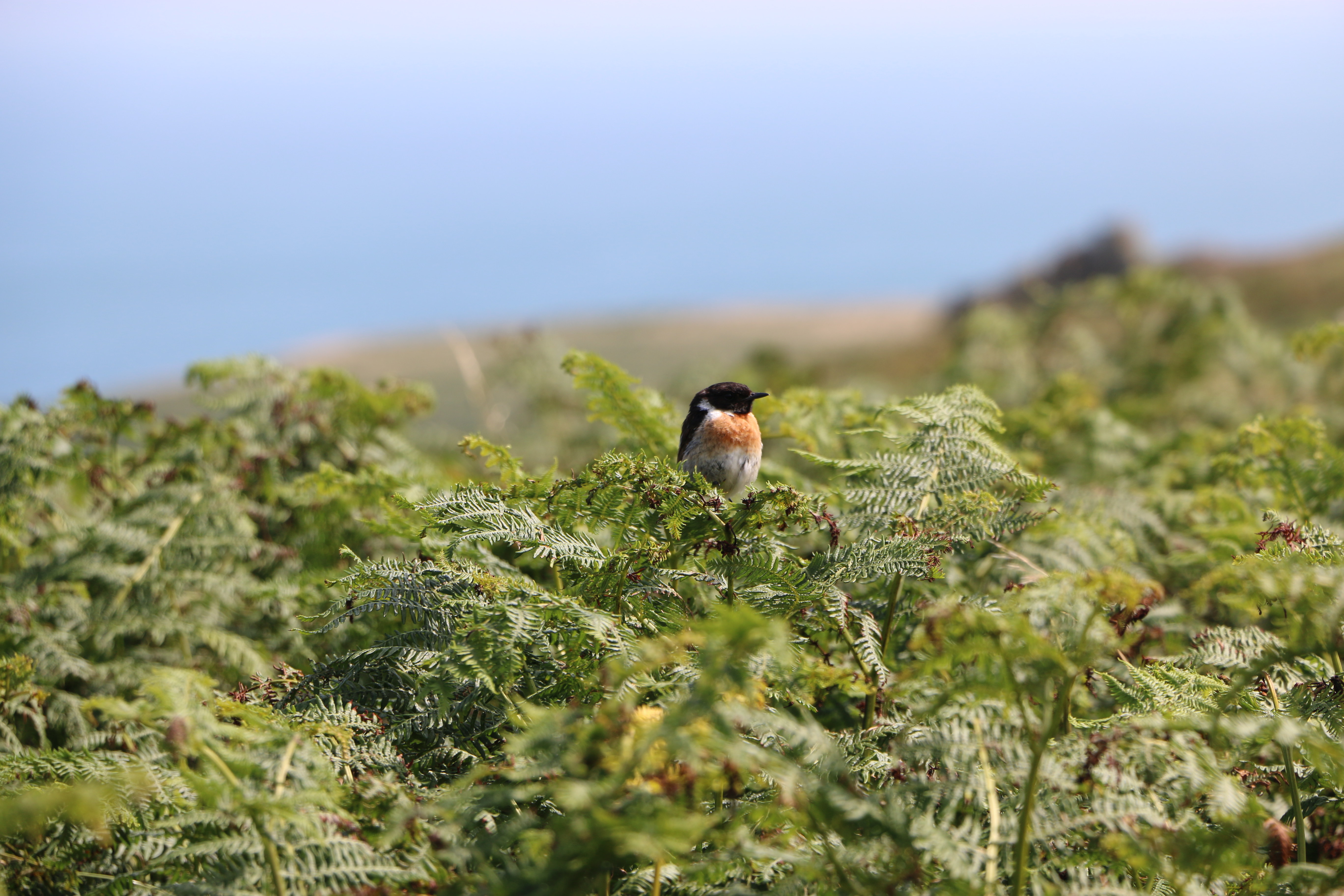
And, later in the day we were followed by a pair of these little birds – we think they were trying to lure us away from their nest.
We thought they were Stonechats – or Linnets – but maybe someone more knowledgeble will be able to correct us?
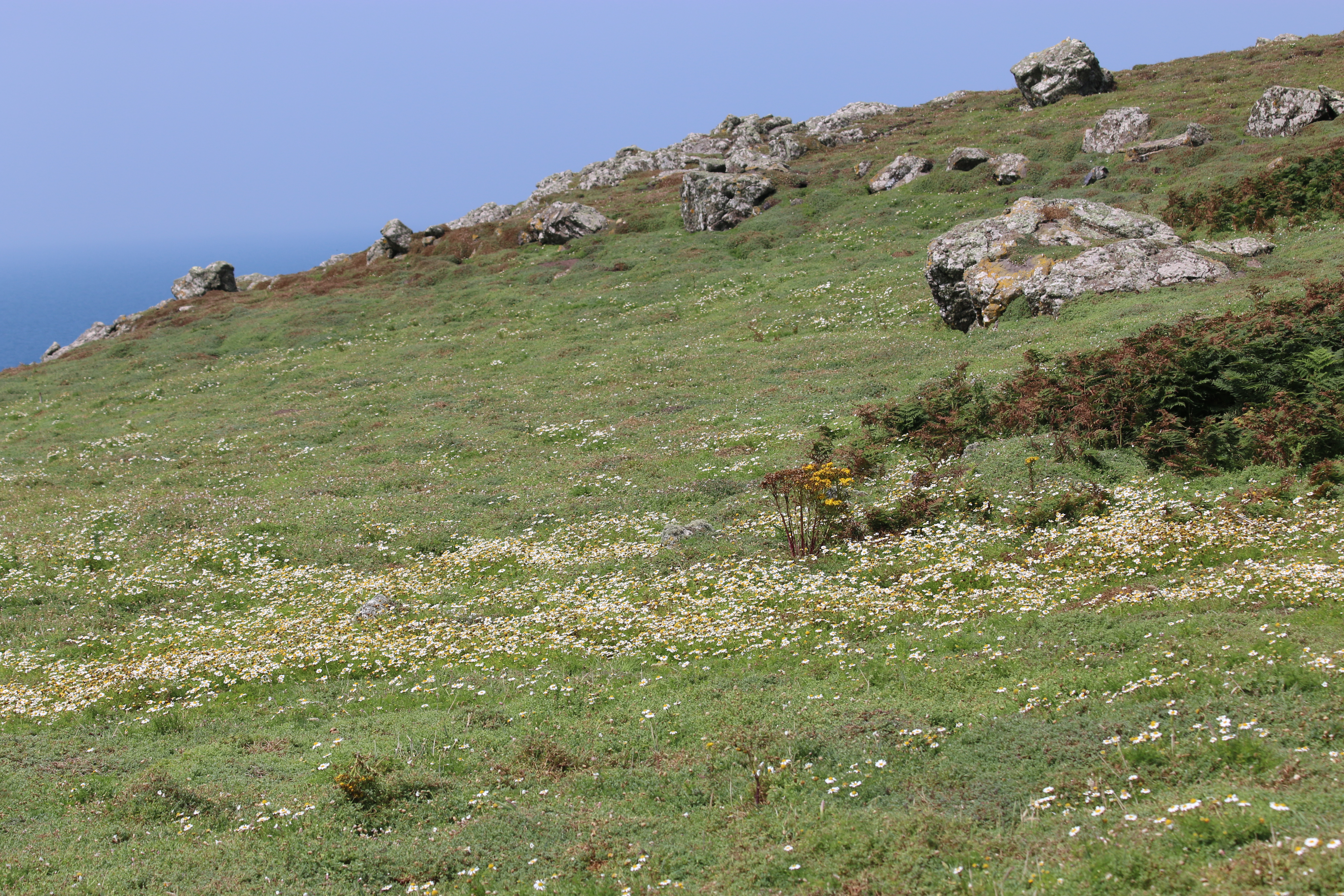
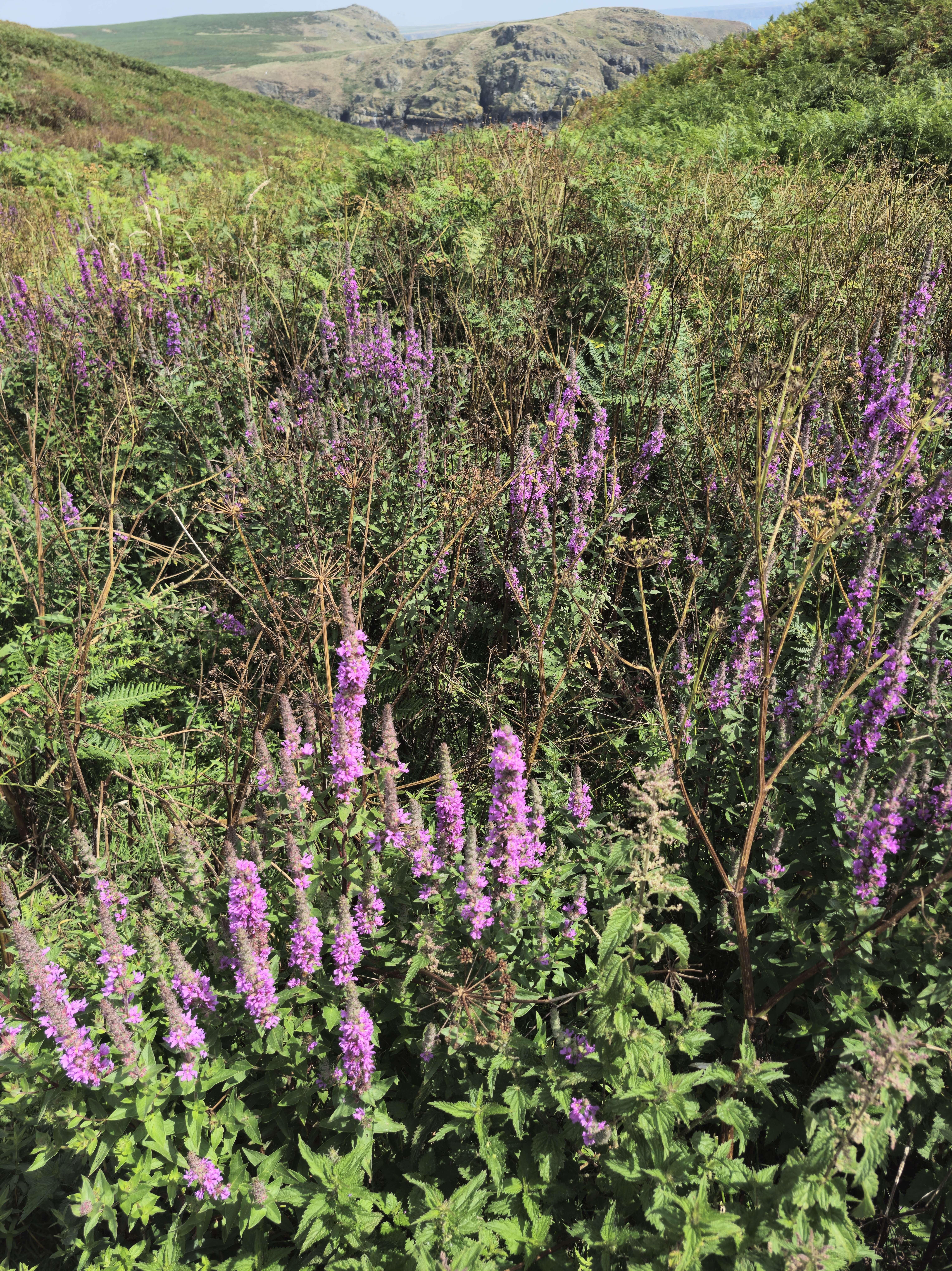
Some of the paths are so narrow they were designated one way paths – we were warned not to stand on the grass alongside in case therethere were still Puffin burrows with chicks in them. Others are wider and surrounded by ferns, daisies, wild flowers … a treat to see.
We arrived at the old farmhouse where we stopped for our picnic.
History of the farmhouse:
There are unsubstantiated records of a house built in the centre of the island, thought to be around seventeen hundred on which are the ruins of the old farmhouse, itself dated from about 1840. This was once an impressive and substantial house, built in the traditional Pembrokeshire style with small slates fixed in mortar, protecting the front of the house. Early pictures show a metal veranda running the length of the house, and at the back of the building, an old smoking oven where fish and meats would have been preserved. The slightly thicker soils in this part of the island and access to water in North Valley enabled a range of crops to be grown. There are records of the farm supporting three families at one time with cows and sheep grazing on the land as well as horses to help with the heavy work. Farming was largely abandoned after the outbreak of the First World War and all agriculture on the island finally ended in 1950.
And onwards to today:
In 1959 the Island was bought by the Nature Conservancy (the Government department that became the Countryside Council for Wales) helped by the West Wales Field Society (the charity that became the Wildlife Trust of South and West Wales). It was declared one of the country’s first National Nature Reserves and is now owned by National Trust and managed by the Wildlife Trust of South and West Wales.
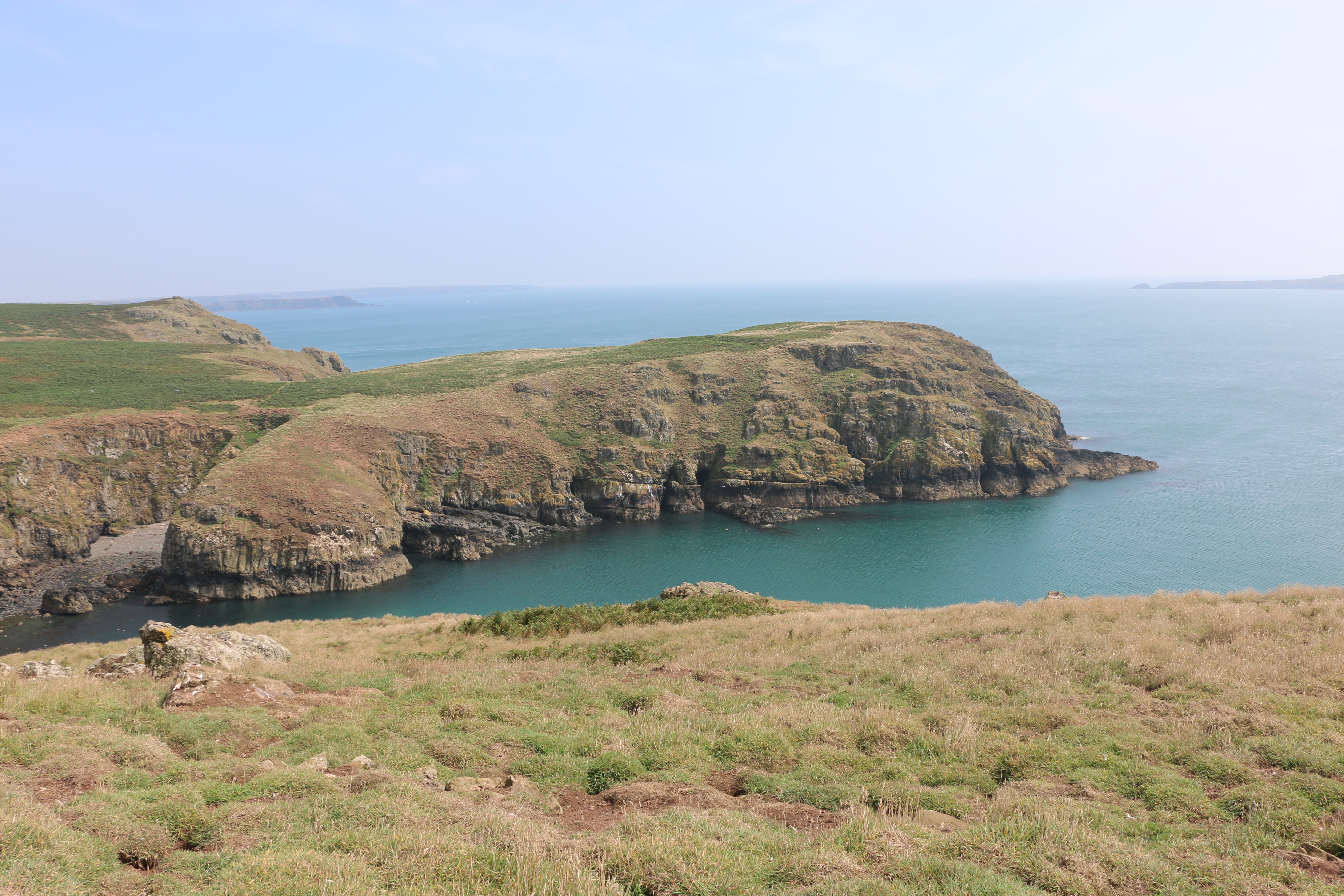
In the next part of our visit to Skomer we move on from the farmhouse to the magnificent coastlineand impressive views.
Ailsa Craig, sometimes referred to as the Granite Jewel of the Firth of Clyde, is an island that is colloquially known as “Paddy’s Milestone”. It was a haven for Catholics during the Scottish Reformation in the 16th century, and is also reknowned for being approximately the halfway point of the sea journey from Belfast to Glasgow, which was a traditional route for Irish labourers emigrating to Scotland to seek work.
The island is actually a volcanic plug from an extinct volcano, and is owned by David Thomas Kennedy, the 9th Marquess of Ailsa – except for the two hectares which were sold to the Northern Lighthouse Board in 1883.
The lighthouse was built around 1886, by Thomas Stevenson, a pioneering Scottish civil engineer. It originally used oil-burning lamps, but these were later replaced with incandescent lighting, and then, in 1990, the lighthouse was automated. Further refurbishment, in 2001, meant it was converted to run on solar power.
The island contains some of Europe’s most important bird colonies, which includes the continent’s biggest gannet colony, as well as puffins, so is managed as a nature reserve by the Royal Society for the Protection of Birds (RSPB). It’s also designated a Site of Special Scientific Interest (SSSI) and a Special Protection Area, mainly because of thecolony of grey seals, and the occasional whale. There are also visiting large basking sharks during the warm summer months which can be seen feeding at the surface on the planktonic bloom.
The texture of the rocks on Ailsa Craig is a granite called microgranite that is so hard and resistant to impact, it makes it ideal for the manufacture of curling stones. The manufacturer, Kays of Mauchline, Ayrshire in Scotland, has the exclusive rights to the granite, granted by the Marquess of Ailsa, and has been making these stones since 1851, and providing them for the Winter Olympics since Chamonix in 1924.
I thought it interesting that boulders of of the Ailsa Craig microgranite were transported by glaciers as far afield as County Donegal and Pembrokeshire. Of course this led me down another rabbit hole …
The microgranite is part of the geology of the Precambrian rock of the Pembrokeshire Coast National Park. Formed as the lava pushed through the existing rocks and solidified, these rocks can be seen in various locations, such as the coastline of St Bride’s Bay and the southwest tip of the St David’s Peninsula.
Something else I discovered…
There are ruins on the island of a castle.
Ailsa Craig Castle today – photgraph courtesy of Douglas Wilcox www.seakayakphoto.com
These remains are of a castle built in the middle of the sixteenth century by the Hamilton Family to protect the island from King Philip II of Spain. It stands on a shoulder of rock around three hundred feet above the sea, the only approach to it a steep and narrow footpath, although there used to be an external set of stairs to the tower. The castle was in ruins after the Reformantion but was later restored by Thomas HamiltonIn and the work recorded by an armorial panel high up on the south gable, showing the Hamilton arms.Today only the tower remains.
Our first walk: an easy five mile circular walk. We thought…
We followed a footpath alongside a stream and through a field covered in glorious wildflowers, including one that we later discovered was called the Deptford pink which is nationally rare. I took a photo of the flower: it had a long and deep pink petals with pale spots and ragged edges. Unfortunately, later (not having the expertise of the photgrapher), I saw that I’d had my mobile phone turned the wrong way round and had an image of a red, sweaty face … mine (well it was a hot day).
So here is a photo of the Deptford pink courtesy of The Species Recovery Trust.Apparently the plant has been used in traditional medicine for various purposes, such as treating digestive ailments and as a diuretic.
This area is called Coed y Felin and includeds an ancient oak/ash woodland planted with sycamore, beech and sweet chestnut.
Pathways criss-cross this ancient woodland site, leaving clues to its long-held links with the local population. Its timber has been used to support local mining villages for centuries. But Llanrwst has also long been known as a market town with a history of a whole range of industries over the centuries, one of which is a thriving woollen industry. Apparently it’s historically recorded that in the Middle Ages the price for wool at Llanrwst market set the price for wool throughout England and Wales in that period.The photographs below are the ruins of a woollen mill, Felin Uchaf.
The directions told us to zig zag up a steep lane.
And then continue for about one and a half mile along a lane.Or rather, up a very steep lane!
And this is where the five mile circular walk became … a little longer. The signs disappeared. And there were four turn-offs to choose from. So, three times, we wandered up this lane, (which I swear was at least half a mile long from bottom to top) and then down and then up again.
Until I stopped for breath and the photographer declared joyfully, ‘There’s a lovely view from up here.’
After that I believe the person who wrote the directionsbecame bored, jotted down a few notes about going through fields, and went home. And we more or less followed our noses. Or, should I say, because anyone who knows me knows I have no sense of direction whatsoever, I followed the photographer (who, true to form, was really only looking for “great shots”)
We meandered through fields along vague paths, which I was sure were sheep trails … see the evidencebelow?
And note … a stile! After last year’s walks in the Yorkshire Dales here and here, the photographer promised no stiles this time. And yet, on the very first walk – a stile.
It was quite a quiet walk back to the start after that…
PS: The following is an interesting article about Y Pont Fawr – the bridge in Llanrwst that, on our way to the cottage we were staying at, we tried to cross three times before being successful. Because of the high crown of the bridge it’s impossible to see if there’s another vehicle coming the opposite way … until it’s almost too late.
As this piece says further down: “The bridge is too narrow for vehicles to pass on it, and its hump limits forward visibility. This explains the local nickname Pont y Rhegi – “bridge of swearing”.” I’m not saying who added to this nickname, but the photographer refused my request to stop to take a photograph of the bridge.
Pont Fawr, Llanrwst
A ford crossed the river Conwy in this vicinity long before it was bridged. The original bridge was declared unsafe in 1626 and preparations began for its replacement, funded by the people of Caernarfonshire (west of the river) and Denbighshire (east of the river). In 1634 four Lancashire stonemasons were contracted to build the new bridge. The year 1636 and the royal coat of arms are shown on a plaque on the upstream side of the bridge, which is known as Pont Fawr (“large bridge”).
The workmen who built the bridge inserted the keystones for the central arch upside down. This was not discovered until the opening day, when the arch collapsed! The central arch rises to c.18 metres above the water.
The renowned architect Inigo Jones was professionally associated with the wealthy Wynn family of Llanrwst, and legend has it that he designed Pont Fawr. The pictures of the bridge and Inigo Jones (courtesy of The National Library Wales) were used to illustrate Thomas Pennant’s books about his travels in Wales in the 1770s.
Pennant wrote that two of the arches were extremely beautiful, marking “the hand of the architect”, but the third was inferior, having been rebuilt in 1703. Inigo had changed Ynyr, his real Christian name, to Inigo or Ignatius when he went to Italy, according to Pennant.
The bridge features full-height cutwaters (stonework shaped like a ship’s bow). The river is the outlet for rainwater and meltwater from across a large area of Snowdonia including Dyffryn Mymbyr (around Capel Curig), one of the wettest places in Britain. Since the western arch collapsed in 1702 and was rebuilt, the bridge has stood the test of countless floods and the advent of motorised lorries and buses.
The bridge is too narrow for vehicles to pass on it, and its hump limits forward visibility. This explains the local nickname Pont y Rhegi – “bridge of swearing”.
William Peers may have uttered an expletive on a dark night in 1907 when the traction engine he was driving crashed through the wall at the Llanrwst end of the bridge. After crossing the river, he had misjudged the position of the main road. The stoker and two navvies (engaged in building Dolgarrog aluminium works) jumped clear. Mr Peers fell about three metres onto the riverbank. The engine was said to have made a complete rotation in mid air before hitting the riverbed about six metres below the road.
Remember me saying in the last post about our visit toCatrigg Force – a small but impressive waterfall just east of the village of Stainforth? And that the first time we found it we’d actually planned to call to see it as the first part of a massively, more strenuous, longer walk – a longer walk, planned by the photographer? One where we could take in the landscape from the Victoria Cave in Ribblesdale? And I said, more to come on that another time? Well, this is it. The above is the last (nearly last) part of the track up to the cave
Another of my photographs when I stopped to take a breath on the path (path?!!) on the way up to the cave.The photographer was already there. Give him his due, he did come back to help me to the top.
And here it it, the limestone Victoria Cave, located east of Langcliffe in Ribblesdale and discovered by chance in 1837, the year of Queen Victoria’s coronation.
Until then the cave was unknown. Tinsmith Michael Horner (1813-1878) struggled through a small hole between rocks,searching for his dog and found the cave. Inside tound bones, coins and various metal objects on the sediment floor. Later, on the 28th June 1838, Joseph Jackson, a keen amateur archaeologist, investigated further. The Victorians were fascinated by ‘bone caves’ where there might be a possibility of finding evidence for the earliest humans and extinct animals. Some animal bones were actually found here. It’s thought that hyenas used the cave as a den and dragged bones that had been scavenged into it, including hippos, narrow-nosed rhino, elephants and spotted hyenas bones. After the last Ice Age the cave was used by hibernating brown bears. In amongst the animal bones of reindeer was an 11,000 year old antler harpoon point, the first evidence for people in the Yorkshire Dales.Some items from the cave are held at the Craven Museum in Skipton.
The roof of the cave has become increasingly unstable over the years and roof falls are possible.We didn’t go in!
This is another one of my photos (yes I do know it’s less inspiring than the photographer’s). But I spotted this from up high, from outside the cave – and thought it was a large teddy bear, or the skeleton of a teddy bear!! Of course, when we got closer… it was just a pile of rocks. Note to self – contact optician
Just before we set off on the downward trail, and with an eye on the clouds bubbling up in the distance, a photograph of the next five miles we needed to go.
And it’s here I will reveal a moment of a basic and elementary photographer’s mistake.
” One last photo before the rain sets in,” he says, scanning the vista. “I didn’t realise it had become so dark so quickly.”
I waited, didn’t say a word while he huffed and puffed, and glared at the sky. For quite a while Then I stated the obvious. ” Your lens cap is still on.”
Good job he has a brilliant sense of humour!!
We followed the trail past the rugged terrain of the Warrendale Knotts before descending the hillside on the way back to Settle.
Where we had a well- earned cup of tea and a scone.
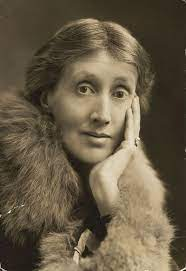
Their mother, Julia Prinsep Stephen had become a widow in 1870 after her first husband, Herbert Duckworth, died of a burst abscess. She already had three children: George, Stella, and Gerald. The latter was born shortly after Herbert’s death in 1870.
Eight years later Julia married Leslie Stephen. English society in the late 1800s was built on a rigid social class system, and as a graduate of Eton and Cambridge, a respected literary critic and biographer, Leslie was seen as one of the literary aristocracy. He was also a widower and father of a girl, Laura, who had a learning disability, and who, incidentally, was the granddaughter of the Victorian novelist William Makepeace Thackeray.
Despite Leslie doting on Laura as a tiny child, by the time she was nine it was obvious that something was wrong; she was slow to talk or read, and veered from total fatigue to violent tantrums. It was a problem for both her father and Julia (although Julia, as friend of the family, had already partly taken on the role as a surrogate parent after Leslie’s wife, Minny, had died when Laura was five). But marriage and producing four children in quick succession: Vanessa in 1879, Thoby in 1880, Virginia in 1882, and Adrian in 1883, increased the difficulties for the two parents. Neither of them were equipped to deal with a child who had special needs.
Besides being agnostics, both Leslie and Julia were humanists, who advocated the rights for women to be the same as for men, to reach their own conclusions in matters of religion. Yet both believed that the home was the true basis for morality, a sanctuary free from corruption, and therefore home was the place for women. So Julia, who despaired that she was unable to discipline Laura, or train her to carry out domestic chores, apparently felt that her stepdaughter was deliberately wilful. And Leslie, who, during a time when society viewed anyone who was not seen as “normal” as undermining that society, was ashamed of her. His domineering patriarchy in in this upper-class, intellectual, and claustrophobic household would be viewed as bullying these days.
He must have been very frustrated by Laura, and it was a conflicted family: having little parental authority over one daughter, whilst succeeding in having total control over the other two.
Unlike their brother, Thoby, neither Vanessa nor Virginia were allowed to go to school. It was still not considered suitable to send girls to school, so they were educated at home by tutors.
Initially, as small children, they spent their days inventing whimsical stories about their neighbours, then progressed to writing illustrated stories and poems, and making up riddles and jokes for a family magazine they called the Hyde Park Gate News. In years to come, biographers of the two sisters were to declare this as early proof of the reciprocal nature between them that, well before any formal training, they nurtured each other’s art, acting as the other’s friend, adversary, and creative muse. And they must have decided between themselves which of them followed which creative path: Virginia the writer, Vanessa the artist. Yet each one’s individual talents led to the same ending, an endeavour to tell stories through their craft, Virginia with words, Vanessa through her paintings.
But, in the background there was always the perceived family problem of Laura. And, in 1886 at the age of sixteen, when Vanessa was seven, and Virginia was four, Laura was sent away to live with a governess. And was absent from the public family.
Four years later, despite being deprived of any early official schooling, and notwithstanding the Victorian restrictions on girls and women, Julia and Leslie decided to encourage their other daughters to pursue their talents. Over time, Vanessa studied both at the Royal Academy Schools and the Slade School of Fine Art, Virginia took classics and history in the Ladies’ Department of King’s College London.
Laura, on the other hand had been diagnosed by psychiatrists as suffering from ‘imbecility’. However I do need to point out that, despite extensive research, I could find no established medical rules of defining mental illnesses at this time. Yet in law, under such acts as the Lunacy Act of 1845 and the Idiots Act of 1886, there were precise specific and distinct legal classifications for certain conditions. These groupings fluctuated though. Laura was initially admitted to Earlswood Asylum in 1893, aged twenty-three, as an “imbecile” but in the 1901 census she was labelled a “lunatic”. which could suggest worsening symptoms
Virginia and Vanessa had battles of their own to contend with; both, as children, were sexually abused by their half-brothers, George and Gerald Duckworth. As an adult Virginia Woolf wrote extensively about this incestuous abuse in her diaries and letters, although there is little I can find about the abuse with either sister. Understandably, many say this was the origin of the fragility of Virginia’s psychological state. But It needs saying that it has been suggested in various papers that there were genetic connections of mental instability on the paternal side: Leslie Stephen was prone to violent mood swings, his father suffered from depression, a nephew had a bipolar disorder and was admitted into an asylum for mania. Virginia herself suffered from depression, and Vanessa is reported to have had at least one nervous breakdown.I should also add here that therefore it could follow that this family history of the Stephen family means it is likely that whatever condition Laura suffered from in her life, her genetic composition means she was more susceptible to other mental disorders.
In 1895, their mother. Julia Stephen died of heart failure, following a bout of influenza. Shortly afterwards, Virginia had her first mental breakdown.And, when their older half-sister Stella Duckworth, who in the absence of their mother had stepped in to run the household, also died two years later, and after their father died in 1904 after a long battle with stomach cancer, Virginia made her first suicide attempt.
Vanessa took charge. After dealing with all the domestic affairs, she moved the family (Vanessa, Thoby, Virginia, and Adrian) from Hyde Park Gate to the Bloomsbury district of London in 1904 to begin a new life.
Here Vanessa, Thoby, Adrian and Clive Bell started The Bloomsbury Group with friends who were writers, intellectuals, philosophers, and artists who rejected the oppressive Victorian principles of their parents’ generation, and they adopted creative freedom, sexual permissiveness, and atheism. They became known for their unconventional lifestyles and love affairs, shocking many outside their social group.
As the older sister Vanessa dealt with many of Virginia’s emotional and mental breakdowns. But she also held true to her own code of conduct; her lifestyle, her unconventional, sometimes eccentric relationships, were reflected in her art: the nude portraits of her friends and family, the use of design in her work. (both considered to be the prerogative of male artists) Yet her loving care for her sister was balanced by the long term and continuous rivalry in their separate spheres of creativity. Reading through the lines during my research I wondered whether, sometimes, this conflict was wearisome for the older sister; whether Vanessa’s marriage, in 1907, to Clive Bell was subconsciously an effort to distance herself from Virginia.
The marriage, a year after their brother Thoby’s death from typhoid, made Virginia descend again into some sort of nervous breakdown. The marriage meant that Virginia and their brother Adrian had to move out of the Bloomsbury house, thus providing a distancing between the two sisters. A distance Virginia resented, because, before long, she began to pursue Vanessa’s husband, Clive. Their love affair lasted, intermittently, over six years. And there is plenty of anecdotal evidence that reveals enough proof, I think, to believe that the underlying reason for the affair was so that Virginia was once again at the centre of her sister’s life.
In 1914 Vanessa began a life-long relationship with Duncan Grant, who was bi-sexual. Taking Vanessa’s two sons, Julian and Quentin, from her marriage to Clive, and accompanied by Duncan’s lover, the writer David Garnett, they moved to Charleston Farmhouse, Sussex. In 1918 Vanessa and Duncan had a daughter, Angelica.
Because I have concentrated on these two women as sisters, and because much has been written about their achievement by far more scholarly people than me, I have left out details of the body of work that both women produced. I was more interested in what made them ‘be’, what formed them as human beings.
I found an extensive amount of articles, journals, newspaper reviews, discussions, diary quotes, lectures etc. on Virginia that revealed much of her personality and mental health. But far less details on Vanessa’s character. Because she didn’t keep a diary as Virginia did there is little written about her personally, except for the time of her son, Julian’s death during the Spanish War, when she became extremely and understandably depressed. But, mainly, there are only facts about her place in the family, about her marriage and relationships, her part in the Bloomsbury set, and the cannon of her work. And I found almost nothing on Laura. Having left few records of her own, she’s as invisible in history as she was in her family. And yet, her small story needs to stand alongside her famous sisters, because, I think, her presence (wherever she was during her life) must have had some effect on Vanessa and Virginia. There had to be some experiences, some memories they shared, that would always have impacted on the three of them.
Troubled by mental illness throughout her life, Virginia was institutionalized several times and attempted suicide twice before drowning herself by filling her overcoat pockets with stones and walking into the River Ouse on March 28, 1941. Her ashes are buried in the National Trust garden of Monks House, Rodmell.
Vanessa died at Charleston Farmhouse, at the age of eighty-one, after a bout of bronchitis, on 7th April 1961. She was buried on 12th April, without any form of service, in Firle Parish Churchyard.
N.B. Leslie and Julia visited Laura until Julia’s death in 1895. Stella visited her until her death in 1897. Her aunt Annie Thackeray Ritchie visited her until her death in 1919. Annie’s daughter Hester Ritchie brought her home for visits on occasion. Then the visits stopped. When Laura died in 1945 the asylum did not know of any living relatives, though both Vanessa and Adrian outlived her and even inherited the remainder of the legacy Leslie had left for her care
Sometimes, family members can become estranged from one another, either by choice or by circumstances. “In one of her informal reminiscences from around 1922, Virginia describes ‘Thackeray’s grand-daughter, (Laura) a vacant-eyed girl whose idiocy was becoming daily more obvious, who could hardly read, who would throw scissors into the fire, who was tongue-tied and stammered and yet had to appear at table with the rest of us.’ Virginia makes the difference between them clear: Laura was not, in fact, one of “us,”’ https://tinyurl.com/36sj5mc5
And, in a way, this is how Lisa (formerly Mandy) feels about her sister, Angie, in my book, Sisters, when she says, “I never wanted to be in Micklethwaite ever again. Yet here I am. And meeting the one person I never wanted to see again. “
Sisters waspublished by Honno on the 26th January 2023:
It’s a funny thing about Judith Barrow’s books. I start reading, thinking they will follow an expected genre, get about halfway through, and realize that they are about something else entirely. In Sisters, for example, I thought I was going to meet another Cinderella, one who lives through and overcomes family trauma, meets her prince, and lives happily ever after. Only… not so much.
When we meet thirteen-year-old Mandy, she’s the classic middle-child of a working-class family on a 1970s housing estate. She’s proudly pushing the pram containing their family’s much-anticipated and beloved baby brother when she runs into her big sister, Angie, a typically boy-crazy young teen. Angie is attempting to show off for a boy when a terrible accident occurs and the precious baby is killed.
A devastated Mandy rushes back to her home, but to her shock is blamed for the tragedy. She waits confidently for her big sister to explain, but Angie doesn’t step forward. Instead, their family falls apart in a meltdown of grief, blame, and shame. Publicly branded a baby-killer, Mandy is bullied at school, shunned by her parents, and lied about by her sister, the one person who could have saved her.
Of course, we can see how the adults who should have provided love and support in spite of what was obviously an accident, instead fail their child. How the sister she’d always looked up to allowed her own fear to keep her from protecting Mandy or even telling the truth. And how all of the social structures of home and school and church fail to protect and support.
The bewildered girl is sent to Wales to live with her aunt and uncle. Mandy changes her name, rejects her birth family, and reinvents herself as Lisa. But that’s only the beginning of the story. As the two girls grow up, we can see that their split-second reactions in a moment of trauma are actually reflections of the people they will grow to be.
Both leave their broken family, and very soon come to life-changing forks in their separate journeys. Angie starts down a dark path where the only piece of herself she sees as valuable, her appearance, is regularly sold.
QUOTE: “There was a moment when Angie had a chance to change her life: that first time she stepped through the door of that house, that first night, that first week, that first time, that first man… But she didn’t.”
At almost the same moment, Lisa steps up to prevent a little boy being kidnapped. She recognizes that protective spirit as her life-calling, and begins training to become a child advocate.
QUOTE: “That day with the little boy, I knew I’d never have a choice if I saw a child in distress. And I knew what I wanted to do with my life.“
The meltdown of Mandy/Lisa’s nuclear family, the way everyone fails each other and her in a moment of ultimate stress— that was the story I expected to read. But it wasn’t the story Sisters had to tell. Instead, as the years pass, we see each sister tentatively begin to rebuild their lives, to unfold their personalities and characters from the smashed wrecks of that devastating moment.
Raised by her loving Aunt Barb and Uncle Chris in far-off Wales, Lisa finds her own strengths and life purpose. As she grows, she rebuilds some of the tattered relationship with her mother, and becomes a strong woman unafraid to love. The frightened little girl who keeps silent to protect the big sister who has betrayed her, channels that strength to protect other children.
But Angie’s path is one where that first instinctive cowardly betrayal sets the pattern for her inability to stand up for herself. It leads almost inevitably to a shameful existence and an abusive marriage.
When their mother dies, the two sisters finally meet up again. And this is where my expected story turned around completely. Instead of vindication for Lisa, we see a family whose core has disappeared, leaving each of them fundamentally lost. Each one has to forgive themselves for the all-too-human failings of being weak, angry, judgemental, scared. Along with each member of the family, the reader has to decide if it’s even possible to reclaim their humanity by reforming the family bonds shattered by tragedy, weakness, and time.
For me, Sisters is more than a story about a family destroyed by tragedy. It’s an exploration of how much we can give up in the face of devastating betrayal and loss, and how much we must give to reclaim our identity in the face of our imperfections.
I was particularly drawn to the settings. I enjoyed the contrasting descriptions of the family home, and the very different worlds the two sisters flee to, from the comfortable chaos of Wales that welcomes Lisa, to the sterile, compulsively bleached home that imprisons Angie. And yes, there was a bad guy, but somehow he lacked substance for me, an outline of nastiness rather than a fully-rounded villain. Instead, the true antagonists are the human failings in each member of the family, and even more their inability to forgive themselves and each other.
Sisters is a slow simmer, an intimate look at a gradually unfolding train wreck. It invites the reader to examine the effects of tragedy in the moment, but also as those effects ripple outward across the years, and especially the amount of strength and determination needed to swim against those ripples until feet finally find firm ground again. It’s not an easy read, but readers willing to explore the collapse of a family will be rewarded with characters who ultimately redeem their lives, reclaim their humanity, and most of all, affirm their båonds of love and family.
I unreservedly recommend this beautifully written, devastating, but ultimately hopeful story.




















 Judith Barrow