Where We Walked #Llyn Crafnant and LlynGeirionydd #Wales #walks #climbs #photographs #stiles #humour #holidays #Sisters #books #readers @honno

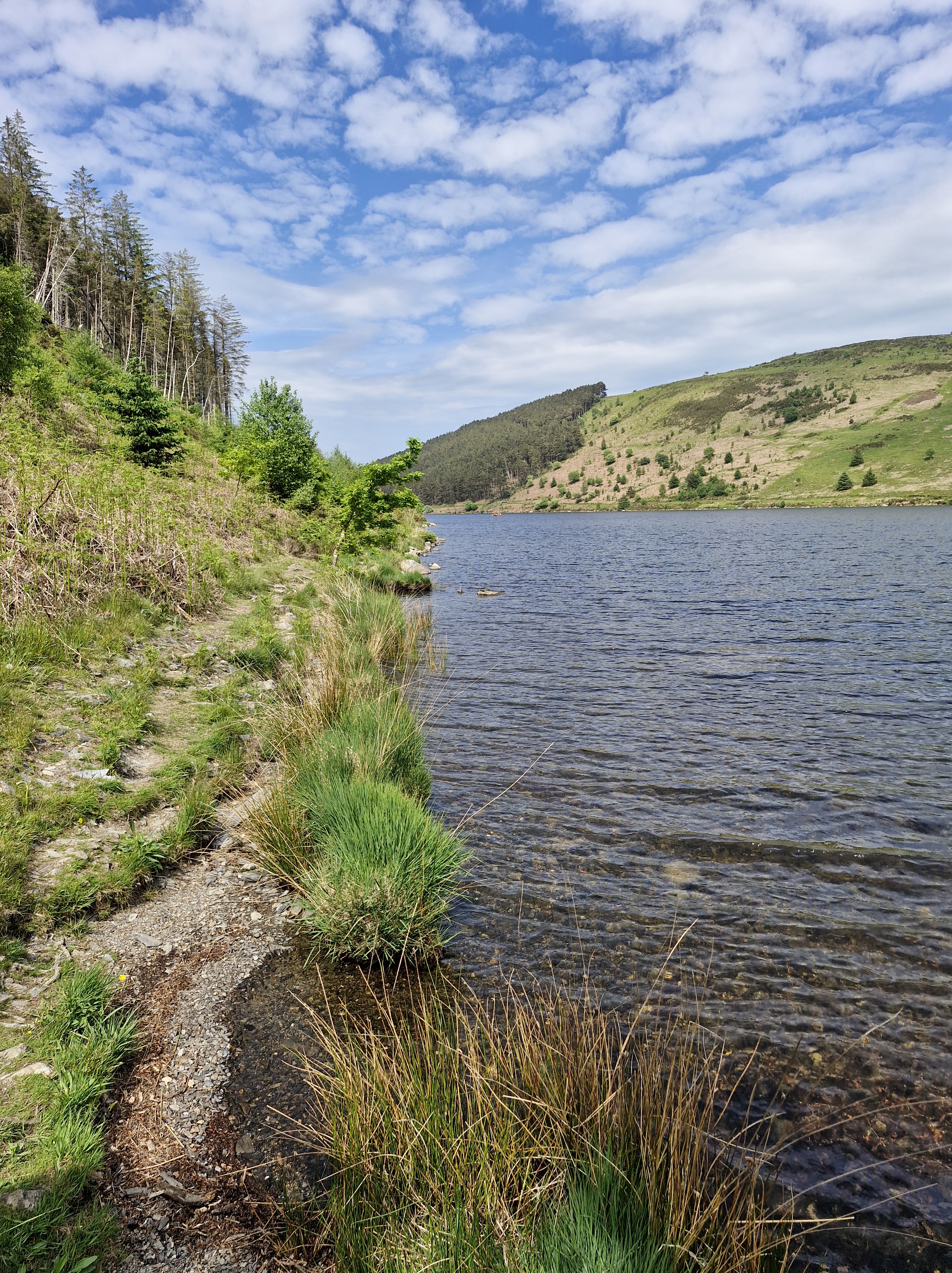
Llyn Crafnant and LlynGeirionydd are separated by the forested slopes of Mynydd Deulyn (Mountain of the Two Lakes) and lie within wonderfully scenic valleys where the Gwydyr forest meets the lower slopes of the Carneddau mountains in Conwy.”The lakes are about a mile apart,” said the photographer casually. “The walk’s about five miles.” What actually happened was that we took the circular route which covers a distance of eight miles and involved some steep climbing.

But, at this point I have to say that wasn’t his fault. We ended up – or should I say – started off walking in the opposite way to the route in the book, having parked in the car park near LlynGeirionydd, instead of the one near Llyn Crafnant.

This was due to the fact that, at one point, the SatNav took us in the wrong direction. It’s always the SatNavs fault, you know; we once got stuck on a very narrow dirt farm track faced with a sign that joyfully said in large red writing, ” Use your eyes, the SatNav lies”. I think I might have said that before, it’s something I bear in mind when sitting by a certain irate driver having to turn back on a journey.

Anyway, I thought, it’ll be alright; we’ll just read the directions backwards.

I waited on the edge of the grass while the photographer took his first photo of Llyn Geirionydd.

Gwydir Forest is named after the Gwydir River, which takes its name from the ancient Gwydir Estate, established by the John Wynn family of Gwydir Castle, who owned this area (Gwydir is translated as River with Red Banks) The land here was once dominated by lead and zinc mines. Some of the mines have been partially restored and made safe for visitors, but we didn’t visit; our sights were set on getting to Llyn Crafnant Though we did pass an old restored engine-house, and also the waste tips, now left to be naturally covered over.

The First World War had highlighted a shortage in wood production and the forest was stripped bare at the time because many of the early forestry workers, former employees in the forest’s mines, had no experience of forestry. This caused the 1919 Forestry Act to be passed and Gwydir Forest was acquired from Lord Ancaster by the Forestry Commission in 1921.

Most of the original plantations have now been felled and replanted as part of the forestry cycle. We passed quite a few places where this was happening.

The majority of the forest is conifer such as Japanese larch, Norway spruce and Scots pine but apparently, over the last two decades there has been more Welsh Oak, ash and beech planted to give a more varied and softer outline to the forest

“When we get to the top of this track, there’s a little bit of a short climb and the track narrows a bit,” said the Photographer over his shoulder as I puffed and panted behind him. ” Don’t worry, it’ll be so worth it for the view.’

The track did narrow a bit indeed. As the directions said, ‘…into a steep narrow footpath, less than forty centimetres wide (that’s about sixteen inches in old money) in some places, on an unmade and uneven surface, where you can expect mud, rocks and tree roots.‘. The embarrassing thing is, just as I was wobbling leaping gazelle-like from rock to another a young couple (stressing young here!) ran past… with a dog … very quickly. And they even had the breath to wish us a cheerful “good morning.”

Every now and then we caught glimpses of the view. Went past a stile. Down a wider path. Through a gate. Saw the obligatory cow. And then…

The Photographer got his first proper shot of Llyn Crafnant on the northern edge of the Gwydir Forest.

And then lots more. It really is a glorious place

One last look and we walked away from Llyn Crafnant …

Following the arrows we crossed over the road into a small wooded area. And there the arrows stopped. We looked around: there was a stile in the far corner, but it was broken, covered in brambles and branches and looked unused. On the other side of the clearing there was a broad track. After some discussion we chose the track. (later realising we should have tackled the stile).

After an hour of walking up the never-ending road we stopped for breath, and for the Photographer to revell in the scenery and take many photos of the craggy slopes of Mynydd Deulyn.

And for me to have a rest. It wasn’t until we got back to the car that I realised I had somehow managed to take the attractive shot below whilst I was rummaging in my rucksack for the fourth, and last, bottle of water. Naming no names, but someone dared me to include this in the post – and I’m never one to pass on a dare. Which is probably the reason I find myself on these hikes walks.

Another hour of uphill, round a bend, and the road began to descend, until we were …

Back to the start…

I’m often asked what do I think about when I’m walking and with not enough breath to talk. I must say not having enough breath to talk isn’t something that often happens to me. But usually I’m taking in what’s all around us. We walk in so many diifferent kinds of places, so I just soak up the sights and the sounds whether in the country or in more urban areas.

But there are times when I’m thinking how to describe what I’m seeing, wondering if it will fit into a scene in the book I’m currently working on – or intend to work on. Sometimes it will, sometimes it won’t. It’s usually the latter, but that’s okay. And if I can keep it in mind for when we next stop for the Photographer to capture the scenary, I’ll make notes.

And there have been occasions when I can use those notes. One day we were nearing the end of our walk at Llyn y Fan Fach and Llyn y Fan Fawr near Llanddeusant in Carmarthenshire, Wales. It had been long, so the sun was low in the sky and it felt quite erie as we took a last look out over the water.

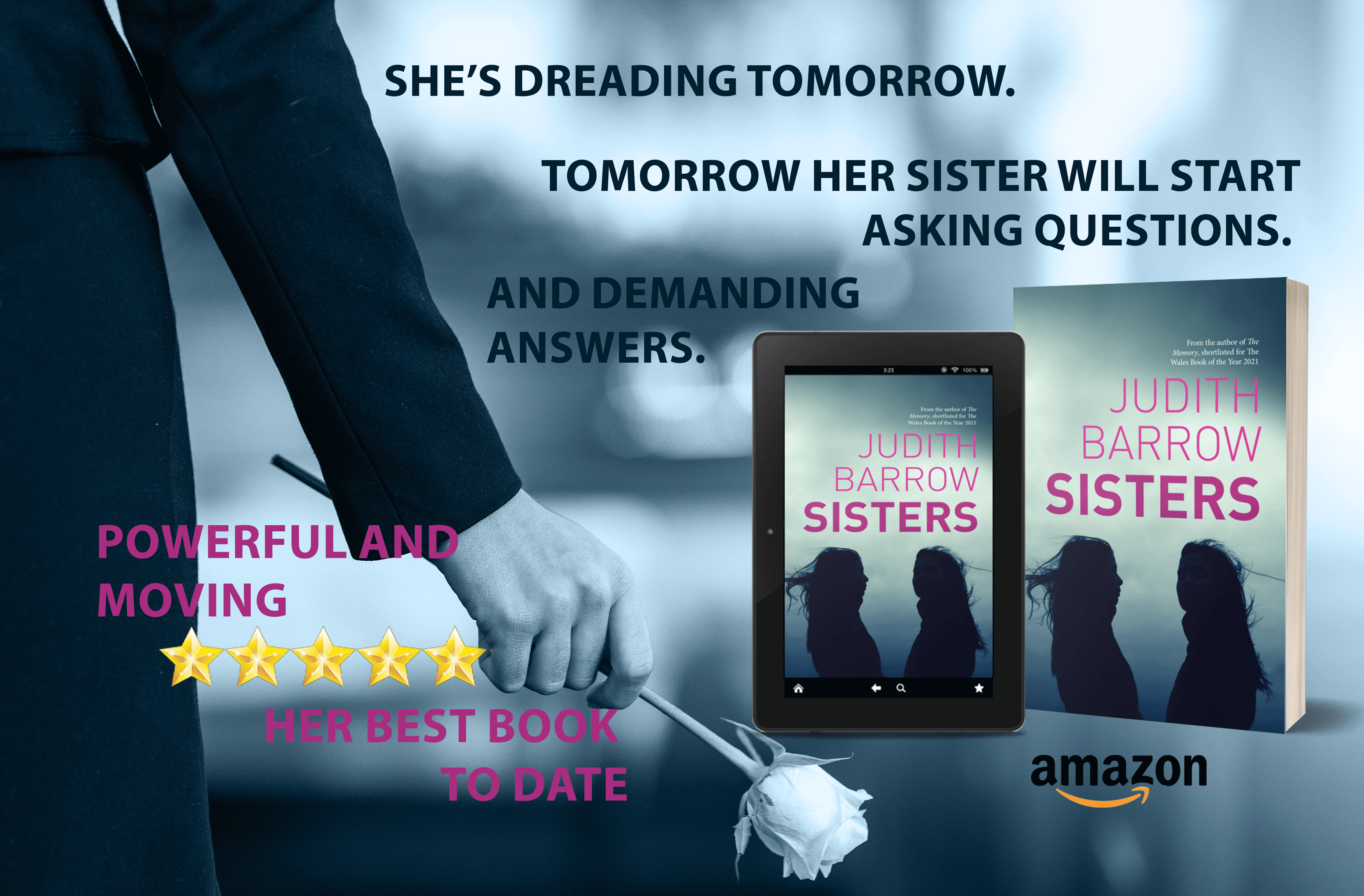
And I remembered that moment, that feeling of almost sinister atmosphere when I wrote one of the scenes in Sisters.

“‘Whoops! Watch your step, Miss Clumsy.’ Said in a jokey manner, it still manages to imply the familiar censure. ‘If it wasn’t for me always looking out for you, I don’t know what you’d do.’ He laughs. ‘Probably kill yourself, one of these days.’ He pulls her close, turns her so they are facing the lake, standing on the edge of the steep banking.
The sun is sinking lower in the sky, the black shadows of the trees lengthen, their reflection stretch and waver over the lake, the water rendered blood-red.

Book Description:

An accident and a terrible lie by sixteen-year-old Angie tears her family apart and her younger sister, Lisa, being sent away. They don’t speak for thirteen years, until their mother’s death brings them together. Lisa quickly realises her sister is trapped in a dangerous marriage.

What does Lisa owe to the family that betrayed her? And if she tries to help, will she make things more dangerous for them all?

A powerful story of domestic violence, courage and forgiveness.

Published by Honno Press (26 Jan. 2023)

Trust and Secrets: The two things in families that make or break the familial bond.

Trust is the one thing that families should be able to take for granted. Trust born from love, from the belief that each member knows the other because they have lived together, seen the weakness and strength of each other. Having faith in each other means there is trust in theirselves, in their judgements, in the confidence that they are implicitly correct in that conclusion. But of course trusting can be the automatic option, the unquestionable. It also avoids any confrontation between siblings, parents, relatives. It means that every one can get on with their lives, not having to think too hard about the actions of everyone else in the family. It’s taken for granted that each believes whatever they are told. Don’t question. In turn it’s accepted that each can also reveal whatever they want to disclose about themselves, their thoughts, their actions. And take for granted that they are believed.

There is only one problem with that premise. Everyone is alone in their heads. No one (whatever anyone believes to the opposite) can read minds. What we present to the world, the façade we choose to show is our decision.

 And that is where the secrecy comes in. Although it’s undeniable that every family has its secrets, it’s the substance of them that count. Of course secrets can also be trivial, small, kept in a loving way (a celebratory surprise, a present) or as a kindness, hiding something that is better kept under wraps if the person keeping it believes that.

On the other hand, harrowing, life-changing secrets can damage an entire family for some time. Even forever. Those kinds of secrets break that instinctive trust, that belief that those closest to us, who we love and respect, are truthful. Are not lying.

Families can be complicated. That’s an obvious statement. And where there are families with secrets, there are stories. And these are the stories that are at the root of all my books.

Links:

The Stranger in my House

The Memory

Sisters:

Social Media links

https://judithbarrowblog.com/


https://twitter.com/judithbarrow77


https://www.facebook.com/judith.barrow.3


https://www.honno.co.uk/authors/judith-barrow

https://www.bookbub.com/profile/judith-barrow

And so, with Changing Patterns the Story of the Haworth Trilogy continues: Sequel to Pattern of Shadows and the book before Living in the Shadows. #Excerpt #weekendRead #Promotion #Novelines #Honno

Although all three of the books in the Haworth trilogy are based on the same family, they are also stand alone. And yet, to be completely honest, I do need to add this from one of the reviewers…

“This is the part where I’m supposed to tell you that each of these wonderful books can be read alone. But no, don’t do that. In fact, if you haven’t read any of them, you’re luckier than I am, because you can start with the prequel and read in chronological order. I chose to review these books as a set, and I believe that’s how they should be read.
Every now and then, I come across books so beautifully written that their characters follow me around, demanding I understand their lives, their mistakes, their loves, and in this case, their families. Taken together, the Howarth Family stories are an achievement worth every one of the five stars I’d give them.

Changing Patterns – a bargain!

Book Description:

May 1950, Britain is struggling with the hardships of rationing and the aftermath of the Second World War. Peter Schormann, a German ex-prisoner of war, has left his home country to be with Mary Howarth, matron of a small hospital in Wales. The two met when Mary was a nurse at the POW camp hospital. They intend to marry, but the memory of Frank Shuttleworth, an ex-boyfriend of Mary’s, continues to haunt them and there are many obstacles in the way of their happiness, not the least of which is Mary’s troubled family.
When tragedy strikes, Mary hopes it will unite her siblings, but it is only when a child disappears that the whole family pulls together to save one of their own from a common enemy
.

Excerpt:

16th June 1950

Sometimes Mary couldn’t believe he was there. Sleepless, she would reach out and touch Peter just to reassure herself that after five years apart they were together again. He’d given up a lot to be with her.

‘You are happy?’ He slung his arm around her shoulder and pulled her closer.

The breeze ruffled their hair. The tide was on the turn and Mary watched the waves collide and dissolve. High above, gulls hung motionless their cries lost in the air currents

‘Mm.’ Mary rested against him. The smell of the mown lawn on his skin mingled with the salty tang of spray blown off the sea and the faint smell of pipe tobacco. ‘You?’

‘Of course.’

She turned her head to look at him, brushed a few blades of grass from his cheek. In the four months since he’d found her he’d lost the gaunt pallor, the weariness, and gained a quiet contentment.

‘It is good, the two of us sitting here, alone,’ he said.

‘Tom won’t be long though, he’ll be back from Gwyneth’s soon; he said he was only just digging her vegetable plot over for planting tomorrow.’

‘I do not mean Tom. He is family.’

Mary allowed a beat to pass. ‘I know you didn’t, love. And I know what you really mean. But it’s not our problem. If people don’t like our being together that’s their lookout.’ She kissed him. His mouth was warm.

Smiling she drew back. ‘Tom?’ she murmured, her voice rueful.

They sat peacefully on the doorstep of the cottage, each savouring the other’s closeness.

Gradually the sun disappeared behind the cliffs. The trees became shifting silhouettes and the wind slapped the surface of the sea into rolling metallic arcs and carried the spray towards the cottage. Mary licked her lips, tasted the salt

‘It’s getting chilly.’ She shivered.

Peter stood, reached down and lifted her to her feet, holding her to him. ‘Ich liebe dich, my Mary.’

‘And I love you.’

A few moments passed before she forced herself to stand back and, giving him a quick kiss, take in a long breath. ‘Now,’ she said, ‘I’m late sorting tea out. If you put those things away, I’ll go and give that batter a whisk. I’m making Spam fritters to go with that mash from last night.’

She stood on the top step watching him walk down the gravel path to where he’d left the lawnmower and then glanced towards the cottage next door. Although it was only just dusk the window in Gwyneth Griffith’s parlour suddenly lit up and the oblong pattern spilled across the garden. Tom emerged out of the shadows swinging a spade in his hand and turned onto the lane. Mary waved to him and he waggled the spade in acknowledgement. ‘Tom’s coming now,’ she called out to Peter. ‘I’ll stick the kettle on. He’ll want a brew before he eats.

The van came from nowhere, a flash of white. Mary saw it veer to the right towards Tom. Hurtling close to the side of the lane it drove along the grass verge, smashing against the overhanging branches of the blackthorn. Caught in the beam of the headlights her brother had no time and nowhere to go. Frozen, Mary watched as he was flung into the air, heard the squeal of the engine and the heavy thud of his body on the bonnet of the van. The spade clattered along the tarmac. Peter threw open the gate and was running before she could move.

‘Tom,’ she heard him yell. Somewhere, someone was screaming. She was screaming.

Links to buy:

Amazon.co.uk: https://tinyurl.com/4wj2jedc

Amazon.com: https://tinyurl.com/nj87jz6k

My Review of Long Shadows: Tales of Llys y Garn by Thorne Moore #TuesdayBookBlog #Histfiction

long shadows


I gave Long Shadows: Tales of Llys y Garn 5*

Book Description:

Llys y Garn is a rambling Victorian-Gothic mansion with vestiges of older glories.

It lies in the isolated parish of Rhyd y Groes in North Pembrokeshire. It is the house of the parish, even in its decline, deeply conscious of its importance, its pedigree and its permanence. It stubbornly remains though the lives of former inhabitants have long since passed away. Only the rooks are left to bear witness to the often desperate march of history.

Throne Moore’s Long Shadows: Tales of Llys y Garn comprises a trio of historical novellas that let us into secrets known only to these melancholy birds.

The Good Servant is the story of Nelly Skeel, loveless housekeeper at Llys y Garn at the end of the 19th century, whose only focus of affection is her master’s despised nephew. But for Cyril Lawson she will do anything, whatever the cost.

The Witch tells of Elizabeth Powell, born as Charles II is restored to the English throne, in a world of changing political allegiances, where religious bigotry and superstition linger on. Her love is not for her family, her duty, her God or her future husband, but for the house where she was born. For that she would sell her soul.

The Dragon Slayer tells of Angharad ferch Owain in the early decades of the 14th century. Angharad is an expendable asset in her father’s machinations to recover old rights and narrow claims, but she dreams of bigger things and a world without the roaring of men. A world that might spare her from the seemingly inevitable fate of all women.

In these three tales the rooks of Llys y Garn have watched centuries of human tribulation – but just how much has really changed? If you enjoyed the kaleidoscopic sweep of David Mitchell’s Cloud Atlas you will appreciate Long Shadows.

My Review:

I have long been an admirer of Thorne Moore’s work and have not been disappointed with these three novellas in  Long Shadows: Tales of Llys y Garn

The first, The Good Servant is told from the point of view of the housekeeper, Nelly Skeel; the protagonist, living at the end of the nineteenth century.  Well rounded and well portrayed in her actions, there is a vulnerability about this character; as the reader I found myself both can empathising and sympathising  with her and yet being exasperated. Yet should I? She is of her time and  of a certain status in her world.

And, so, on to The Witch. This story, set in the seventeenth century,  takes the reader through the early years of Elizabeth Powell to her adult life. Told mainly from the protagonist’s point of view with the occasional insight to one or two of the  other characters from a third person narrator, the emphasis is on the restrictions of the religion at that time. and the class struggles; land versus money. I liked Elizabeth, which is something I cannot say about Anthony, her brother. Always there is hope that all will be well but there is an all encompassing darkness to her story…

The Dragon Slayer is the story of Angharad ferch Owain, living during the fourteenth  century. Also told from the protagonist’s point of view we read of her fear of her father, of her future. This protagonist I liked the most. The ending is satisfying. I don’t know why I was surprised, but I was. As with the first two novellas, this tale is dark with themes of the women being mere chattels to be bargained with, used for the progression in society of their families.

I enjoyed the way the women were portrayed as having a strength and internal rebellion. But yet there was always the conflicts of status and money, of land and possessions, of greed and thwarted love. Of patriarchy.

In all three novellas, both the internal and spoken dialogue the author has the tone and subtle dialect that I imagine Rhyd y Groes in North Pembrokeshire to have been in those eras.

And, in all, the descriptions of the buildings, of Llys y Garn and of the ever-changing Welsh countryside are evocative and easily imagined.

Just a comment about the style of the book:  

The intriguing Prelude, giving the history of the “rambling Victorian-Gothic mansion” that is Llys y Garn,  is fascinating.  And I loved the short explanations of the after-years of novella. And  then we have the Interludes; told in a conversational tone these are filled both with historical details and those pertinent to the story,. Finally, the Epilogue, giving the continuing, ever-evolving history of Llys y Garn through the following centuries. 

It is apparent that the author has researched thoroughly for each of these stories; the themes of Welsh legends, myths, superstitions  and tales are woven throughout the history of the decades.  

Watch out for the ravens

This is a collection of novellas I can thoroughly recommend to any reader, especially those who enjoys historical literature.

Links to buy:

Amazon.co.uk: https://amzn.to/2rDFQj7

Amazon.com: https://amzn.to/2Iap5Hr

About the author:

Thorne Moore

Thorne was born in Luton and graduated from Aberystwyth University (history) and from the Open University (Law). She set up a restaurant with her sister but now spends her time writing and making miniature furniture for collectors. She lives in Pembrokeshire, which forms a background for much of her writing, as does Luton. She writes psychological mysteries, or “domestic noir,” and her first novel, A Time For Silence, was published by Honno in 2012. Motherlove and The Unravelling followed, also published by Honno. She has also brought out a book of short stories, Moments of Consequence. Her last novel, Shadows, was published by Endeavour in 2017. She’s a member of the Crime Writers Association.

Praise for Thorne Moore and her novels:

“Thorne Moore is a huge talent. Her writing is intensely unsettling and memorable” – SALLY SPEDDING, AUTHOR

“Totally had me hooked from page one… Highly recommended if you love a good psychological thriller” – BROOK COTTAGE BOOKS

“I devoured this book. Beautifully written, frighteningly real” – CHILL WITH A BOOK

“A compelling blend of mystery and family drama with a gothic twist… The author’s ability to create an atmosphere is exceptional” – JUDITH BARROW, AUTHOR

“Beautifully told, this really did have me captivated” – CLEOPATRA LOVES BOOKS

“Moore has created a figure who reaches out across the decades and grabs our sympathy… Her character transforms the novel” – BOOKERTALK