Where We Walked – Elan Valley and the Carvings #memories #walks #photographs #Wales

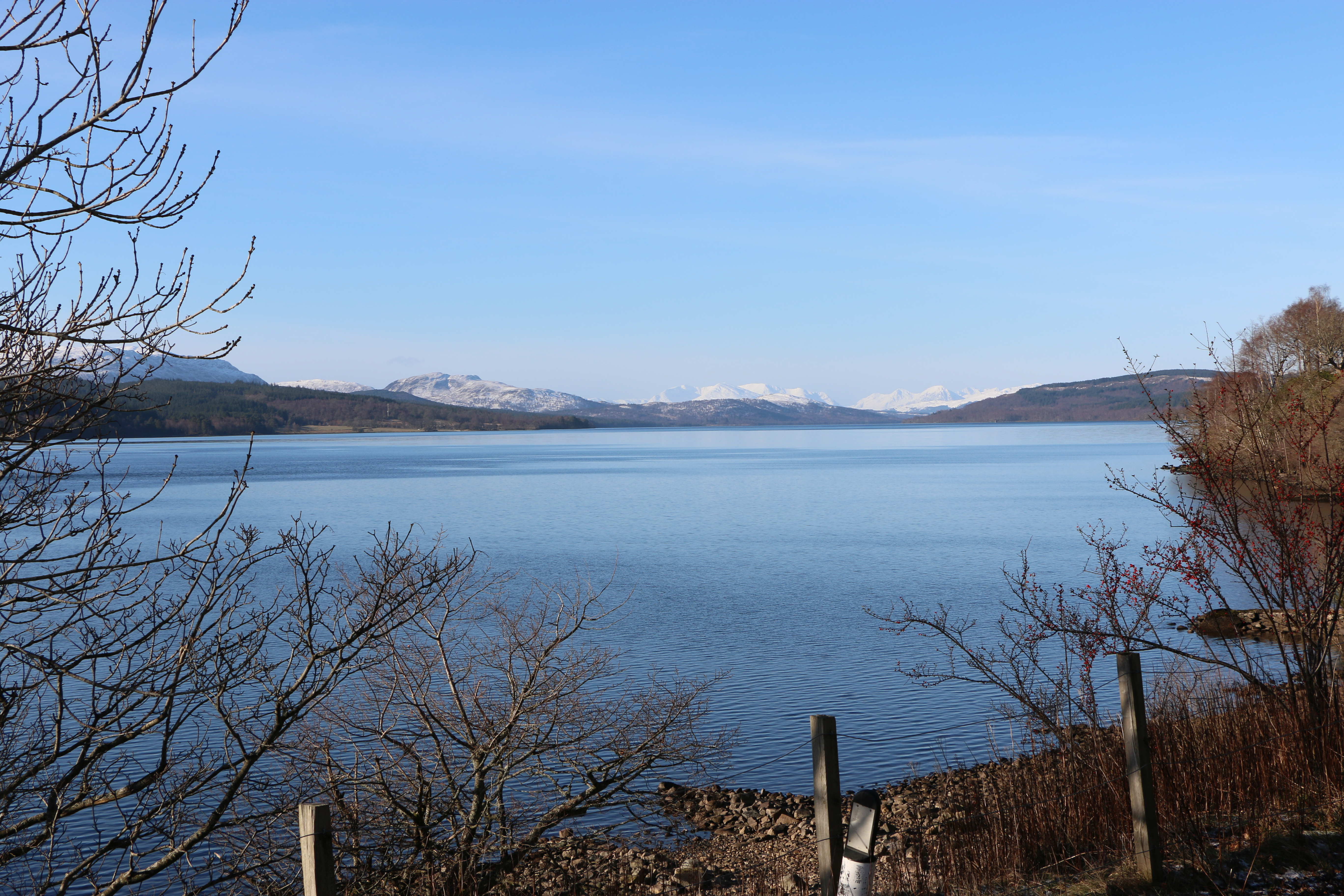
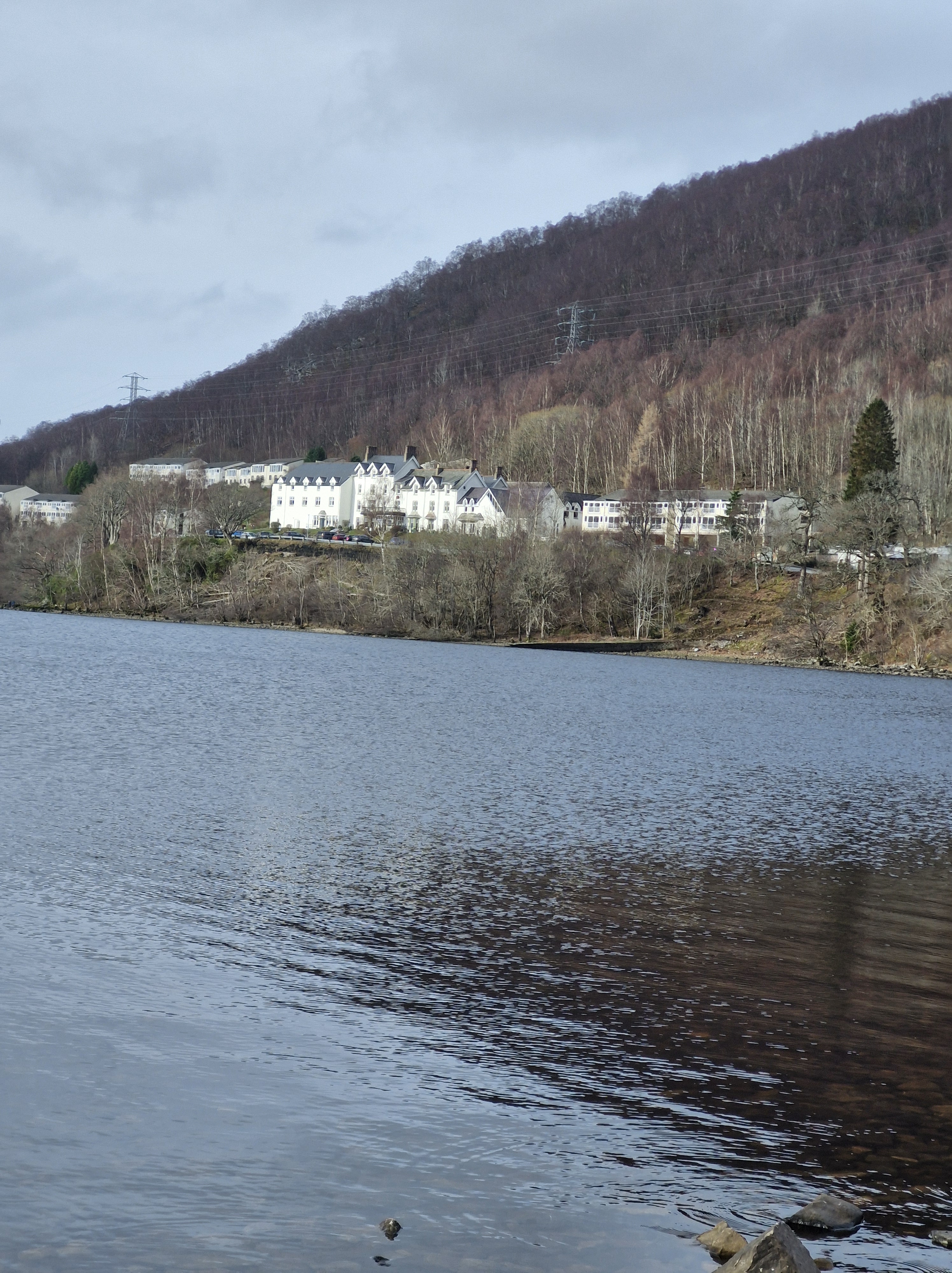
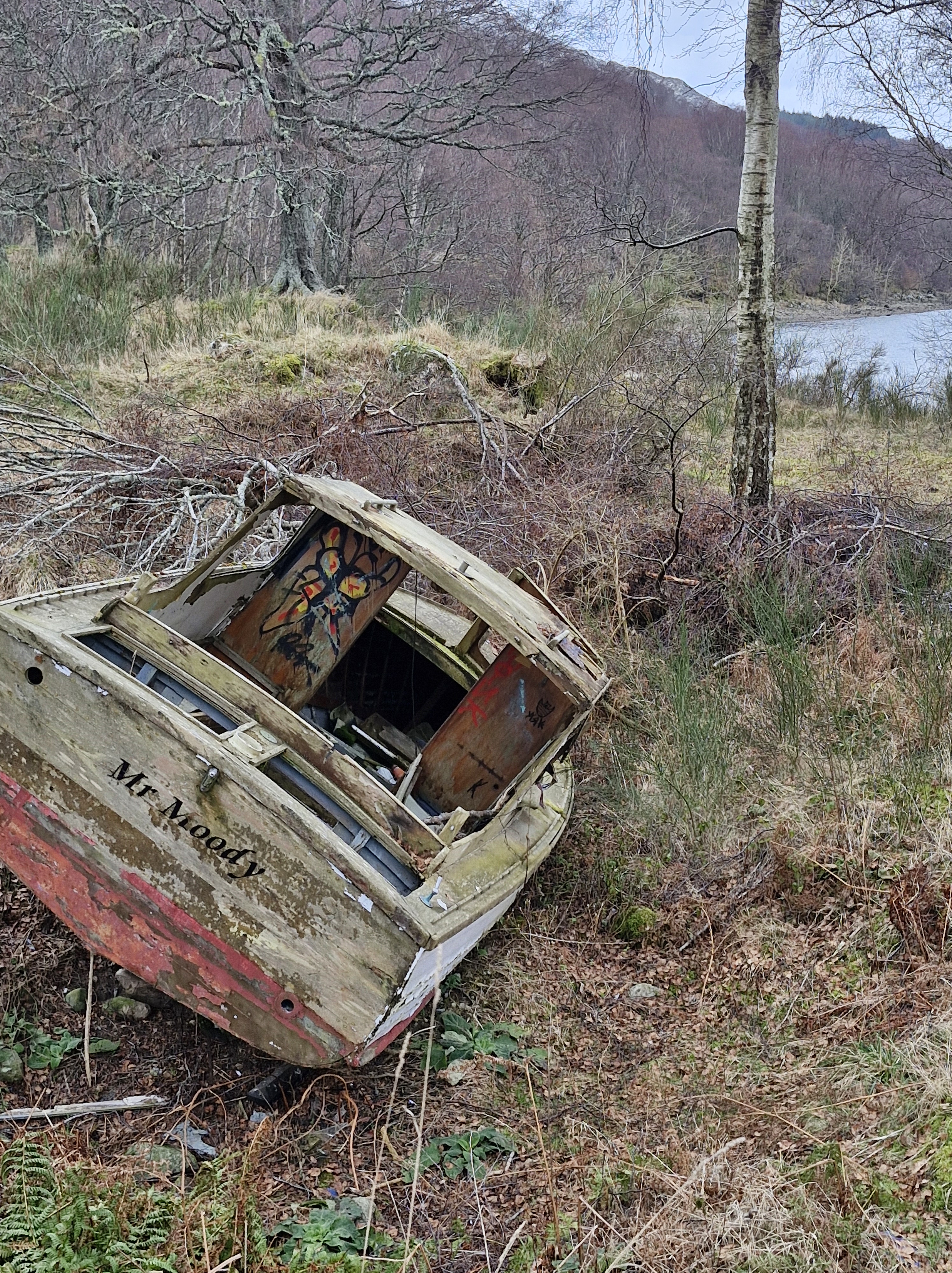
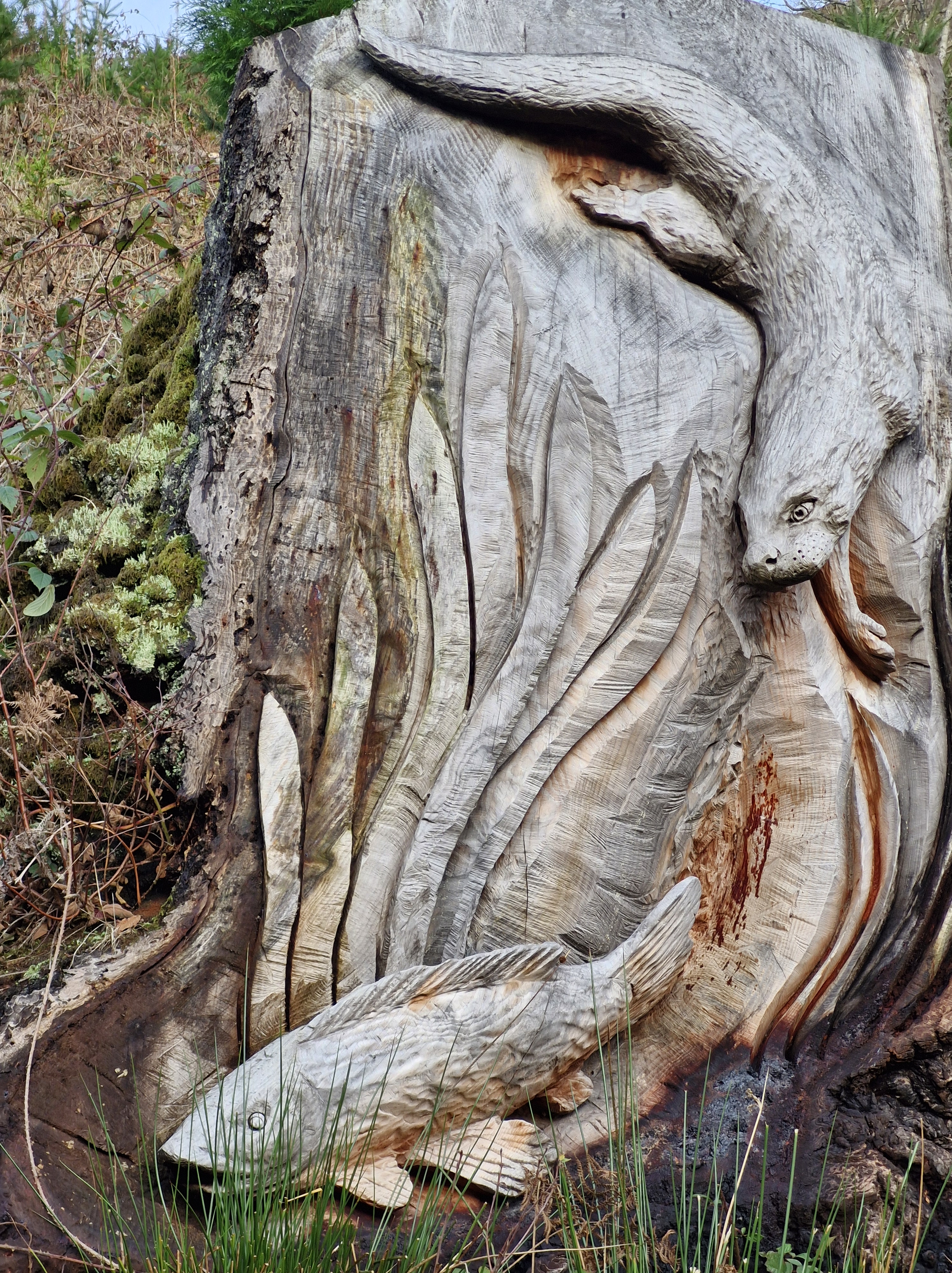
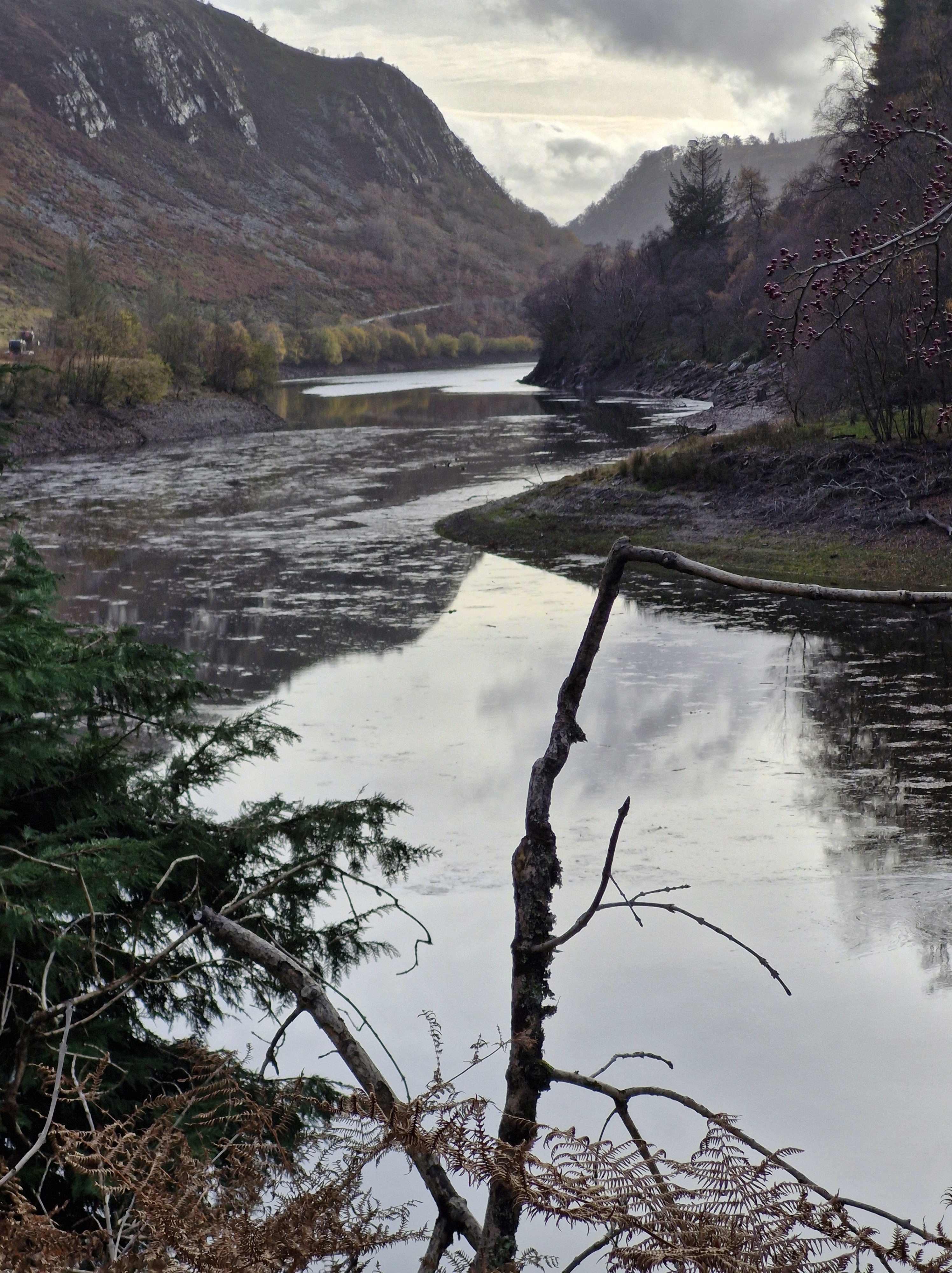
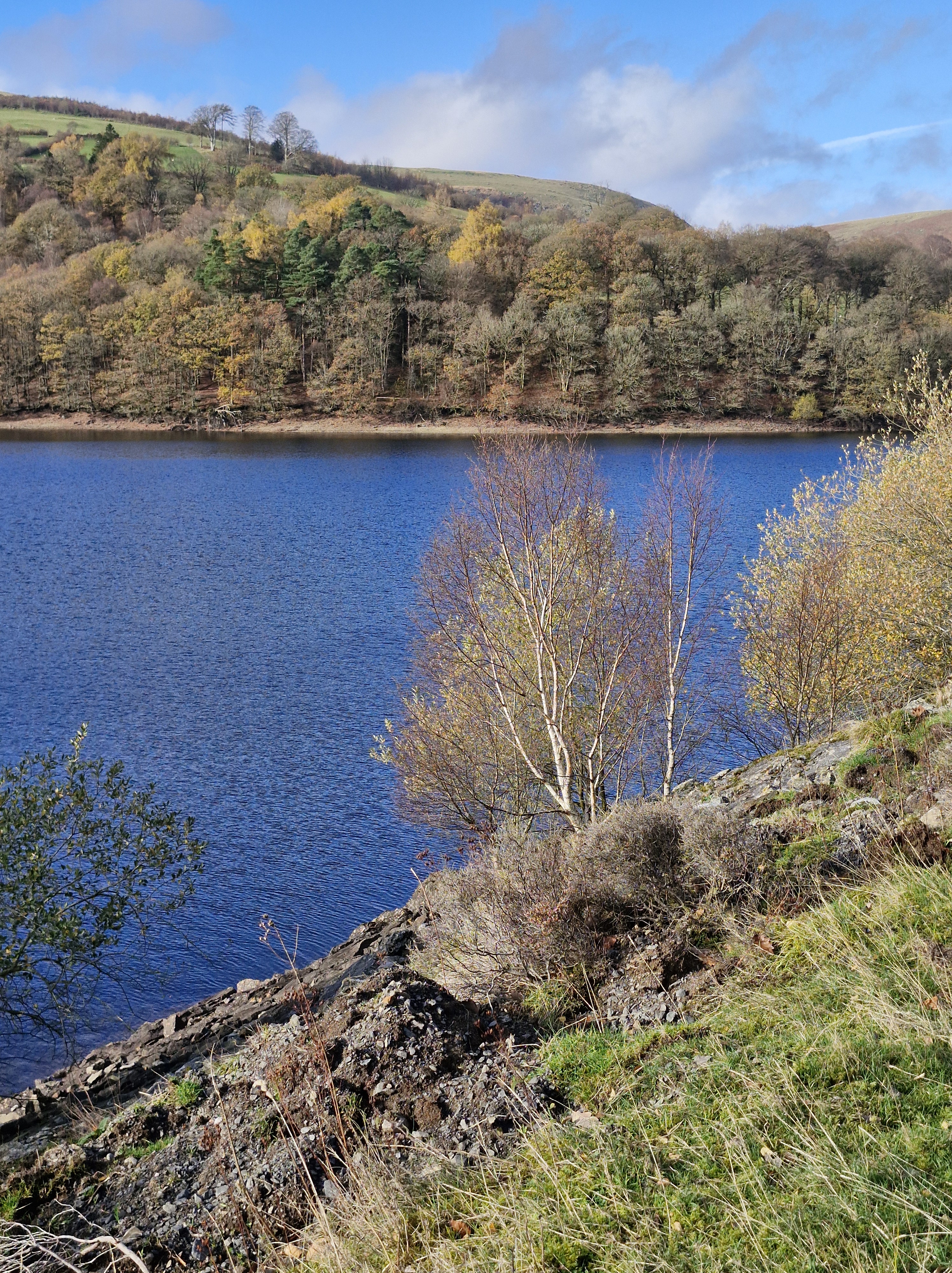
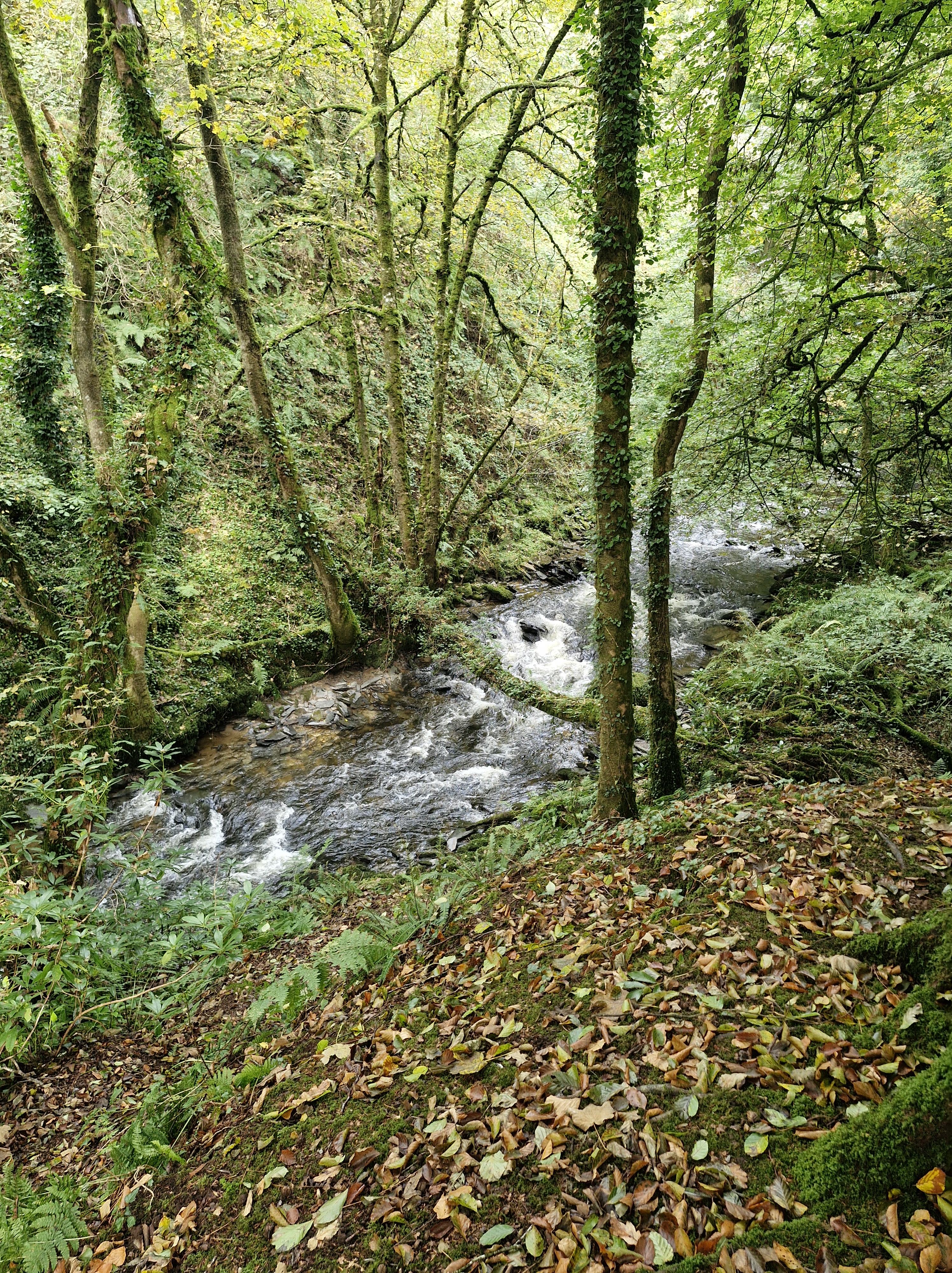
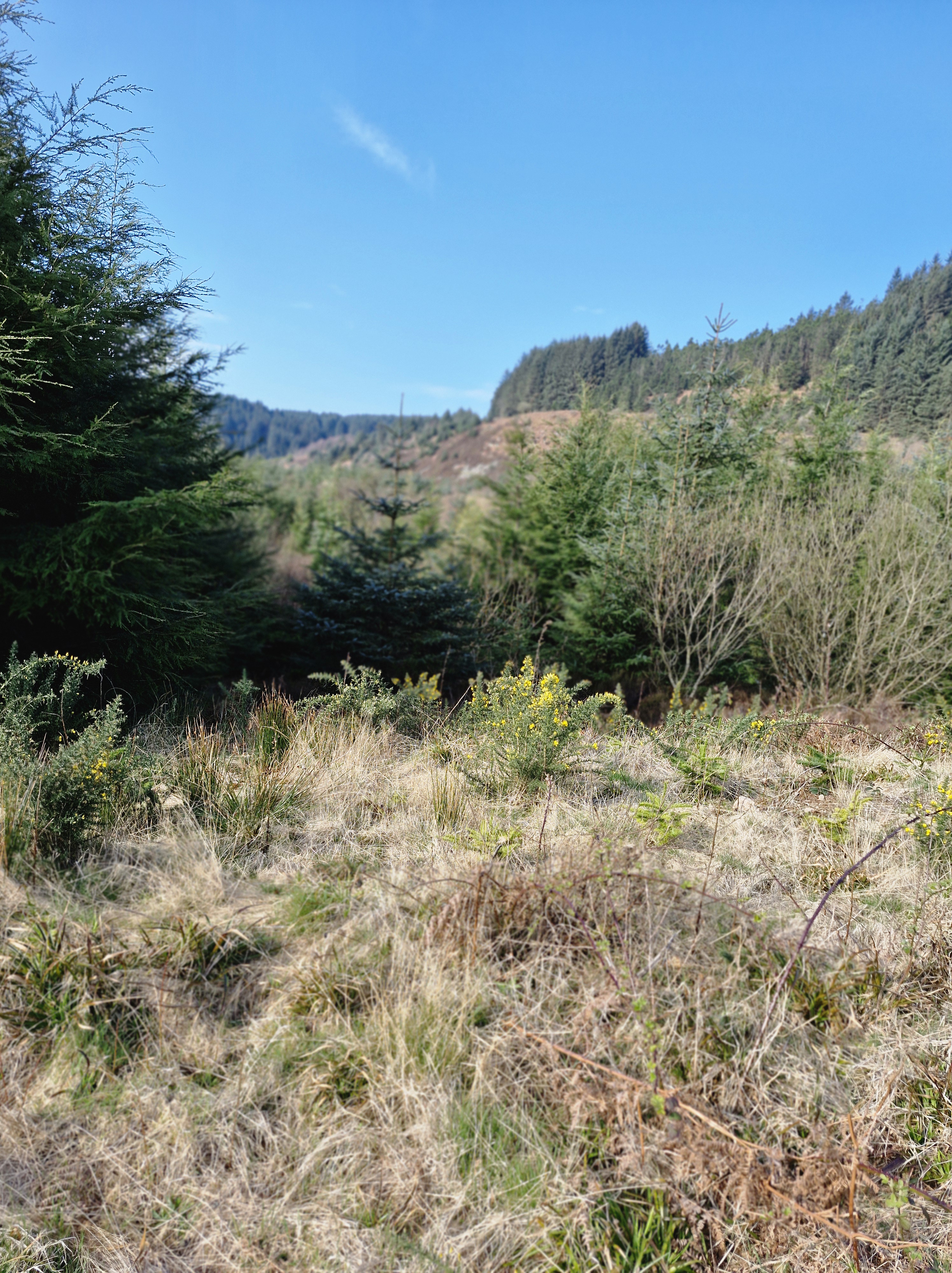
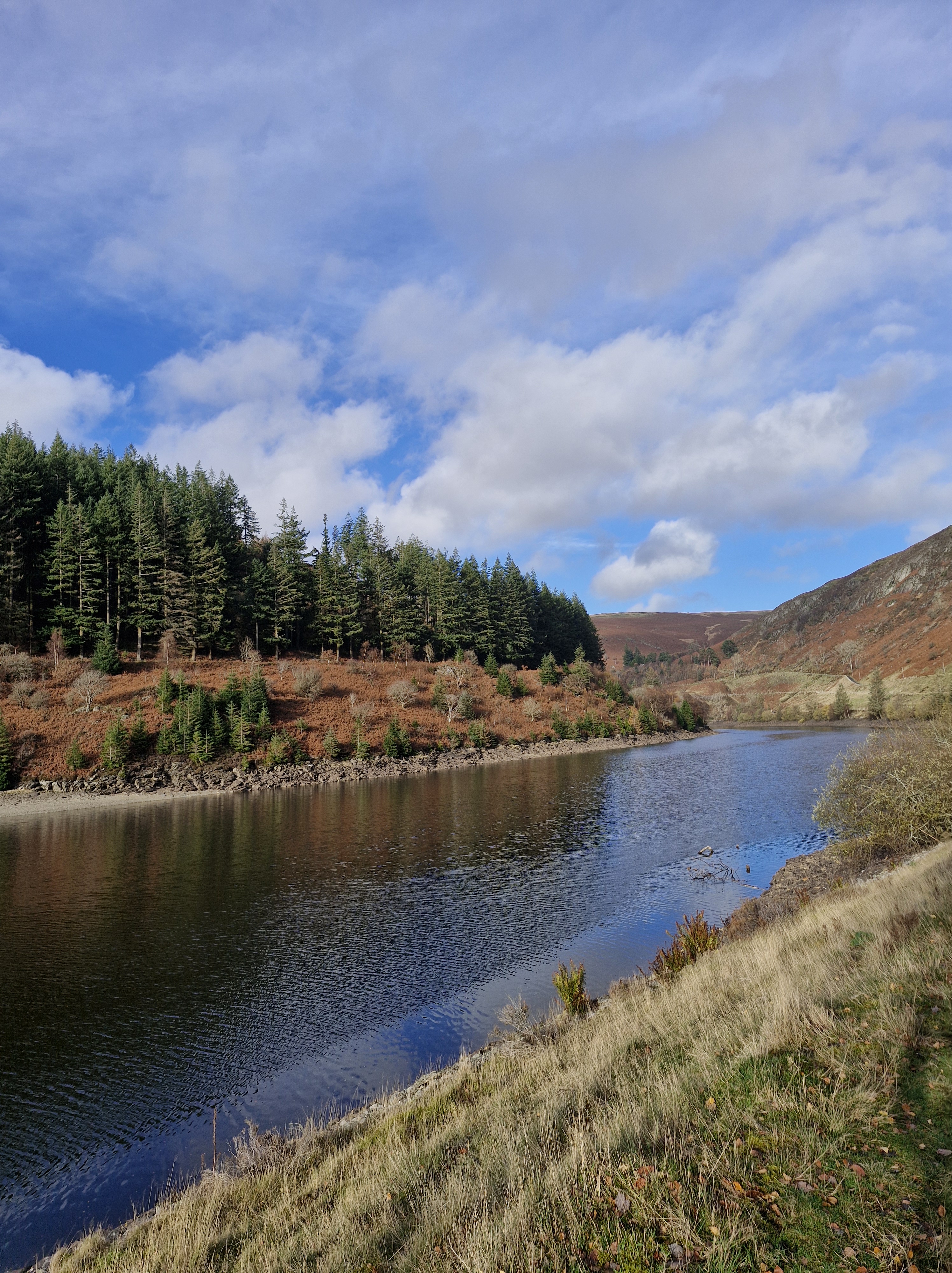
On our recent walk around Garreg Ddu Dam in the lower Elan Valley we noticed that, since we were last here, even more carvings had been created along the trail.

This area of land was originally a Victorian Douglas Fir plantation, clear-felled to reintroduce native species and increase biodiversity. The project to carve the trees lining the road was commissioned Dŵr Cymru Welsh Water and created by chainsaw sculptors Simon O’Rourke, Paul Edwards, and Matthew Crabb, who worked from ideas presented by schoolchildren from the community.

More information can be found here

It was getting late in the afternoon, the day had been gloriously sunny and warm, but now dusk was settling in and the gathering clouds in the sky were showing signs of the rain forecast for the following day.

Foel Tower: a point of interest at the start and end of our walk around Garreg-ddu: Just upstream from the submerged dam at Garreg-ddu is the Foel Tower, the starting point for the 70 mile journey of the water supply to Birmingham.


The lower section of Foel Tower has a number of openings inside at different levels where a system of valves and cylinders can be raised and lowered to draw off water from the reservoir at the right depth for the current water level.

Photographs courtesy of http://history.powys.org.uk/history/rhayader/foel.html

The above photograph was taken in 1947 showing the Foel Tower during very low water levels in the Garreg-ddu. Most of the openings in this image are normally underwater.

Foel Tower takes in water from the Claerwen Valley through a pipeline which takes water underground from the dam system. Water is also collected by Pen-y-garreg and Craig Gochhe, the two dams higher up in the Elan Valley.

Links to my books:

Amazon.co.uk: https://tinyurl.com/55r6s5vp

Amazon.com:https://tinyurl.com/53ndmrhe

https://www.honno.co.uk/fiction

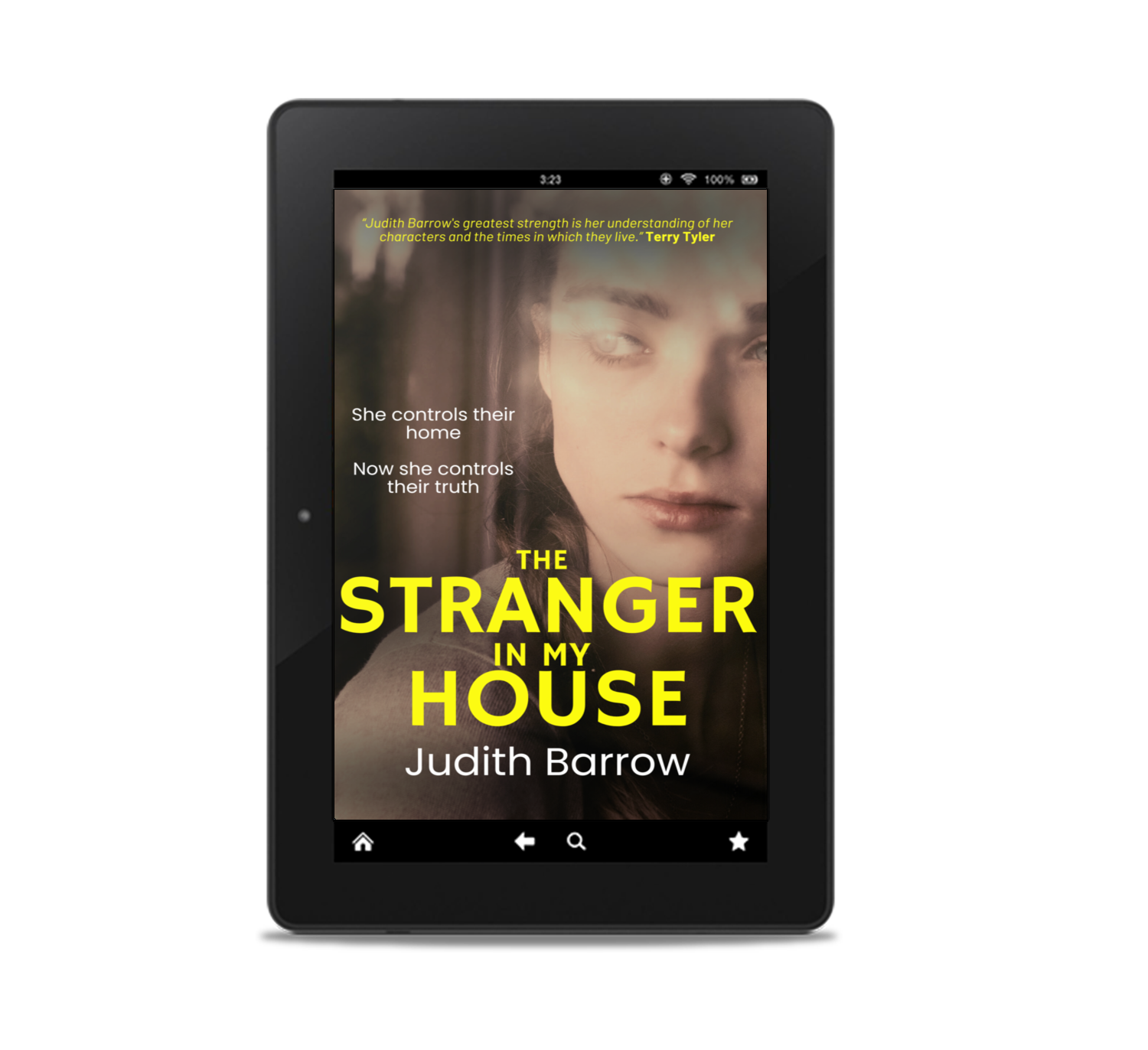
My latest book, published in November 2024 is The Stranger

Review for The Stranger:
5.0 out of 5 stars
 Storytelling in a class of its own… stunning.

One of the author’s many strengths is in capturing the clear and authentic voice of a confused child – Mandy’s voice, in The Stranger, still haunts me, torn between her own grief, her sense of right and wrong, and her love for her family. And once more, in her latest book she wonderfully portrays the suffering of eight-year-old twins Chloe and Charlie – already grieving the loss of their mother, their lives torn apart by their father’s marriage to her former nurse, an evil manipulator of the highest order…

Where We Walked – Elan Valley #walks #photographs #memories #books

After weeks of what seems to have been constant rain, we embarked on a couple of days away, determined to walk, whatever the weather. We headed for Mid Wales.

We were lucky: the clouds parted, the rain stopped, the sun came out. We took a trip to Elan Valley and walked around Garreg Ddu to Pen y Garreg.

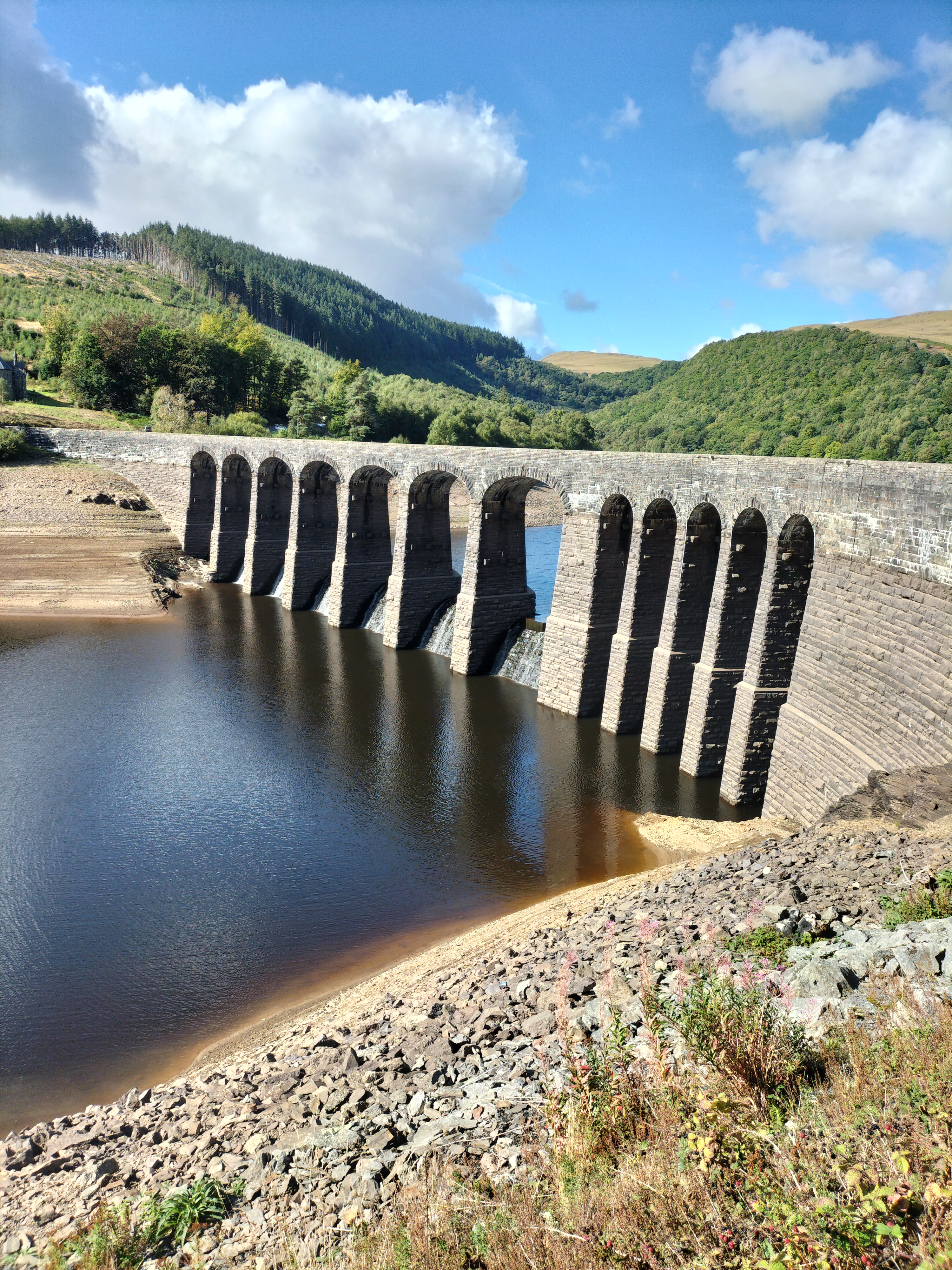
We’ve been a few times in the past, the last being in 2023 when there was a drought declared. Below is the road bridge/ wall between Garreg Ddu and Caban Coch. On the left 2023, on the right this time, in November.

Though there were less daylight hours this time to walk we still were able to see some of the differences in the water levels in the reservoirs between our visits in 2023 to this November.

In 2023 the water was so low we could see the outlines of the houses, the roads and the church that were compulsory purchased in 1892 in order to dam the Elan and Claerwen rivers within the Elan Valley and supply water to Birmingham. This was because of the rapid growth of that industrial city, and the numerous outbreaks of disease that prompted Birmingham City Council to petition the British government to pass the Birmingham Corporation Water Act in 1892, allowing the corporation to acquire the land.

Building work began in 1883. There are six impressive dams altogether. Four follow the Elan River – Craig Goch, Pen y Garreg, Garreg Ddu, and Caban Coch and two are on the river Claerwen – the Claerwen dam and the unfinished Dol y Mynach dam.

The History of Elan Valley:

In 1893 one hundred people in Elan Valley had to move to allow the work to begin, but only landowners received compensation payments. Many buildings were demolished: three manor houses, eighteen farms, a school and a church – the latter being replaced by the corporation and renamed Nantgwyllt Church. Over the next three years a railway line was constructed to transport the workers and thousands of tonnes of building material each day.

Thousands of men and their families lived in wooden huts in the the purpose-built Elan Village, where, eventually a library, a public hall, a shop, and a canteen were built. There was also a hospital, used for injuries and as an isolation hospital. There was even street lighting which was powered by hydroelectric generators. New workers were initially expected to spend the first overnight in a lodging house to be deloused and examined for infectious diseases. Only then were they allowed across the river to the village. Single men lived in groups of eight in a terrace house shared with a man and his wife. A guard was employed to check for illegal importation of liquor and unauthorised visitors. There was a bath house which the men could use up to three times a week but the women only once. And the pub was for the men only. A school was provided for those under elevens, after this the children were expected to work.

The dams were built in two phases. The first phase, which cost six million pounds and employed fifty thousand was opened on the twenty-first of July 1904 by King Edward VII and Queen Alexandra. The building of the second phase dams was delayed due to the two World Wars and work only started in 1946. Because of engineering advancements just one large dam was built instead of the three smaller ones originally planned for. This was the Claerwen. This dam was completed in 1952 and opened by Queen Elizabeth II on the twenty-third of October.

Writing is one of my biggest pleasures in life … besides walking. #books #anniversaries #writing #walking #photography #Pembrokeshire #Wales #Saints #mythsandlegends #memories

The Stranger in my House – published November 2024

One of my greatest pleasures – besides writing – is walking. In fact walking is what I mostly post about on social media; mainly because I realised a long time ago that across many of the socials, it’s writers talking/commenting/sharing with other writers. And it’s my own fault; I have never got around to writing a newsletter to potential readers. Nevertheless I’ve made some lovely friends over the years online as well as in real life.

And, as a creative writing tutor, I’ve also made friends with many people who wanted to learn to write …. something … whether it was a novel, a short story, poetry, travel writing, or writing for children.

Alongside many of the authors I know, I share a fascination of people, and I admit I people watch. Which is probably why all my novels are character led, whatever genre I’m writing in. This no more so than in The Stranger in my House, published on the 14th of November last year (2024). The story has a main theme, coercive control; the ability of one woman to change the lives of a man and also those of his children. And not for the better.

Building characters layer by layer in a story has to have a balance: of their backgrounds, their history, the way they respond to life and to the people around them. Much as in real life. I believe there comes a time when we are all mostly what we have lived, what has happened to us, how we responded, how we were treated, how we treated others. Yes, there is always the argumant of inherited, biological traits, but I do believe that, in later life it’s what our lives have been like. However, I’m always open to that statement being challenged, and I have been involved in many discussions, on many occasions.

In all my stories, as with most writers, my characters take on a personality and life of their own. I found this especially so in The Stranger in my House. So much so that I wondered what happened to Charlie and Chloe, the two protagonists in the story, after the reader closes the book on their lives. At the beginning they are just over six years old. By the end they are adults.

I like to think that Chloe and her husband, Mark, and Charlie and his partner, Simon, become as smitten with being outside, with looking at nature, the change of the seasons, and with walking, as my husband and I are.

And there is nothing better on cold, wet, and windy winter evenings than looking back at photographs of our walks.

So here is another treasured memory:

St Justinian’s to Porth Clais:

Walking in the footsteps of St Justinian, or sometimes scrabbling to get to the top of the next path.

Literally on hands and knees. But it was so worth it

This image has an empty alt attribute; its file name is img_0261.jpg

Wonderful views overlooking Ramsey Island

This image has an empty alt attribute; its file name is img_0264.jpg
This image has an empty alt attribute; its file name is img_0265.jpg
Just to prove I was there – I hate having my photo taken, but waa caught unawares by the Photographer.
This image has an empty alt attribute; its file name is img_0262.jpg
This image has an empty alt attribute; its file name is img_0284.jpg

And look who we saw. (from a great distance,of course. As I’ve written in a recent post, we saw the seals and their pups last month, just before the mothers decided their offspring was able to fend for theirselves after only a month or so.

This image has an empty alt attribute; its file name is img_0277.jpg
Seal pups and their mums

So… who was St Justinian?

Justinian was born in Brittany in the 6th century. At some point in his life, he made his way to Wales, where he settled on Ramsey Island.

Justinian soon became close friends with St David, the patron saint of Wales, and visited him often in the monastery where the cathedral now stands.

He was less impressed however by the lax behaviour of some of the monks and decided to isolate himself on Ramsey island. According to legend, he took an axe and chopped up the land bridge that linked the island and the mainland. As he worked, the axe became blunter and the lumps of rock remaining became larger and larger. They are still visible today in Ramsey Sound, where the waters foam over them at high tide. Followers joined him on the island but his actions didn’t go down well with everyone though. They soon turned them against him and they beheaded him!

To the astonishment of his killers,he picked up his head and walked across the sea to the mainland, and where he set his head down, another spring of water issued forth.

A spring of water gushed up from the ground where his head first fell and this became the famous healing well known as St. Non’s Well, situated next to the ruins of St. Non’s Chapel.

Justinian was buried where the chapel now stands. Within its walls are some stone footings, which may mark his original gravesite. His body was removed to the cathedral at St Davids, probably at some time before the end of the 15th century.

During the early medieval period, two chapels were built on Ramsey. One was dedicated to St Tyfanog; the other to St Justinian. There is no trace of either building today, though their sites are known.

Where We Walked #Pembrokeshire #Walks #Photographs #Leisure

One of our Interesting and Fun Group Walks with the U3a:

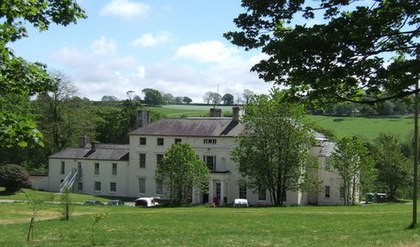
Yesterday we joined with Pembrokeshire U3a on their Monday Walk around the woods and alongside the River Sealy on the Sealyham estate near Wolfscastle.

There is a long history of owners of the land dating from the time when King Edward III, in the fourteenth century, granted some land to Thomas Tucker (a captain in the King’s army), who subsequently built a house there.

A house that was later rebuilt in the mid-18th century. Eventually, in 1905, the last of the descendant family members, Catherine Octavia Edwardsn with her husband Victor James Higgon, the last of the Tucker family to live at  Sealyham house moved another mansion in Pembrokeshire, Treffgarne Hall.

Around 1910, portions of the land were sold to the Pembrokeshire County Council and, in 1920, Sealyham House and part of the land were sold to the King Edward VII Welsh National Memorial Association and converted into a tuberculosis hospital until 1954. In 1955, it was re-purposed for elderly patients but was permanently closed as a medical facility in 1964.
In 1970, the Sealyham house was sold to a Nancy Ellen Perkins. She converted it into an apartment building as rentals. In 1980, it was sold again to an investment firm that used it for an outdoor activities centre.
It was resold in 1986 to the Sealtham Activity Centre for young people, as an educational facility,

Sealyham is also well known for the Sealyham Terrier. The Tucker-Edwardes family of the nineteenth century were one of the leading landowners of Pembrokeshire. Breeding dogs was a favourite and expected pastime people of noble families or military background. Captain John Edwardes’ family had the time and the means. Although no records were kept it’s believed that The Welsh Corgi, The Wire Fox Terrier, and the now extinct English White Terrier all played a part in the make up of the Sealyham. After Edwardes’ death in 1891, other breeders began to work with Sealyhams, including a man called Fred Lewis who promoted the breed. But, according to the Kennel Club the Sealyham Terrier is one of the dog breeds of British and Irish origin that are … “considered to be vulnerable due to their declining registration numbers. These breeds are at risk of disappearing from our parks and streets, simply because people don’t know they exist or because they aren’t considered fashionable. in 2024 there are only a hundred dogs of Tucker-Edwardes’ breed, making it an endangered breed.”

A Hundred Tiny Threads #Prequel #familysaga #histfiction #WW1 #reviews #family #relationships #Poetry

It’s eight years this month since the prequel, A Hundred Tiny Threads, to the Haworth Trilogy was published – so a little celebratory post – with an extra personal memory at the end – for one of my oldest books.

It’s 1911 and Winifred Duffy is a determined young woman eager for new experiences, for a life beyond the grocer’s shop counter ruled over by her domineering mother.

The scars of Bill Howarth’s troubled childhood linger. The only light in his life comes from a chance encounter with Winifred, the girl he determines to make his wife.

Meeting her friend Honora’s silver-tongued brother turns Winifred’s heart upside down. But Honora and Conal disappear, after a suffrage rally turns into a riot, and abandoned Winifred has nowhere to turn but home.

The Great War intervenes, sending Bill abroad to be hardened in a furnace of carnage and loss. When he returns his dream is still of Winifred and the life they might have had… Back in Lancashire, worn down by work and the barbed comments of narrow-minded townsfolk, Winifred faces difficult choices in love and life

A couple of reviews:

“When I emerged at the end of this book – during the reading, my immersion was total – it was with a sense of having experienced it all first hand, and of having deeply felt every moment. This was story-telling at its very best… and a book that will long linger in my memory.”

“I loved it… A page-turner that keeps you hooked. The story line has lots of twists and turns and you feel yourself moved on so many different levels. As the book unfolds it gives you moments of tenderness and love, hatred and spite all blended together with conflict, prejudice, guilt, grief and a desperate longing for change. Judith describes the period so well, with some very graphic, cruel and harrowing episodes, enabling you to empathise with each character in turn. I particularly like the fact that the story held together to the last page.”

Three year earlier, on the exact date – the 17th August – the book was published, I’d written the following…

My Grandad

grandad for sally's blog

My grandfather died seventy years ago this week. Obviously i never knew him and have only one small black and white photograph of him on my study wall. He’s standing in the backyard of the terraced house they lived in in Oldham. Lancashire. This is a poem I wrote about him a long time ago. My mother said he was gassed in WW1 and never recovered. 

My Grandad

I look at the photograph.

He smiles,and silently

he tells me

his story…

In my backyard I stand,

Hands wrapped around a mug of tea.

Shirt sleeves, rolled back,

Reveal tattoos – slack muscles.

I grin.

All teeth.

Who cares that they’re more black

Than white.

Underneath

That’s my life;

That’s the grin I learned

When burned

By poison

Spreading

Like wild garlic.

That’s the grin I wear

When I look

But don’t see

The dark oil glistening,

Blistering, inside me.

When I hear, but don’t listen

To my lungs closing.

I posture,

Braces fastened for the photo,

Chest puffed out.

Nothing touches me –

Now.

Later I cough my guts up –

Chuck up.

I trod on corpses: dead horses,

Blown up in a field

Where grass had yielded

To strong yellow nashers.

And in the pastures

I shat myself.

But smelled no worse

Than my mate, Henry, next to me

Whose head grinned down from the parapet –

 Ten yards away.

He has perfect, white teeth.

Much good they’ve done him,

Except for that last night at home

When the girl smiled back.

Crossing off the Bucket List: Part One @SkomerIsland #walks #photographs #birds #plantlife #Memories

At long last! After living in Pembrokeshire for the last forty-six years and despite walking many miles of the Pembrokeshire coast, and meandrering around a lot of the Welsh countryside discovering wonderful places, lakes, waterfalls … scenary, we hadn’t been on Skomer island. This week we finally managed to go. And it was a glorious day’s adventure.

Boarding the Dale Princess

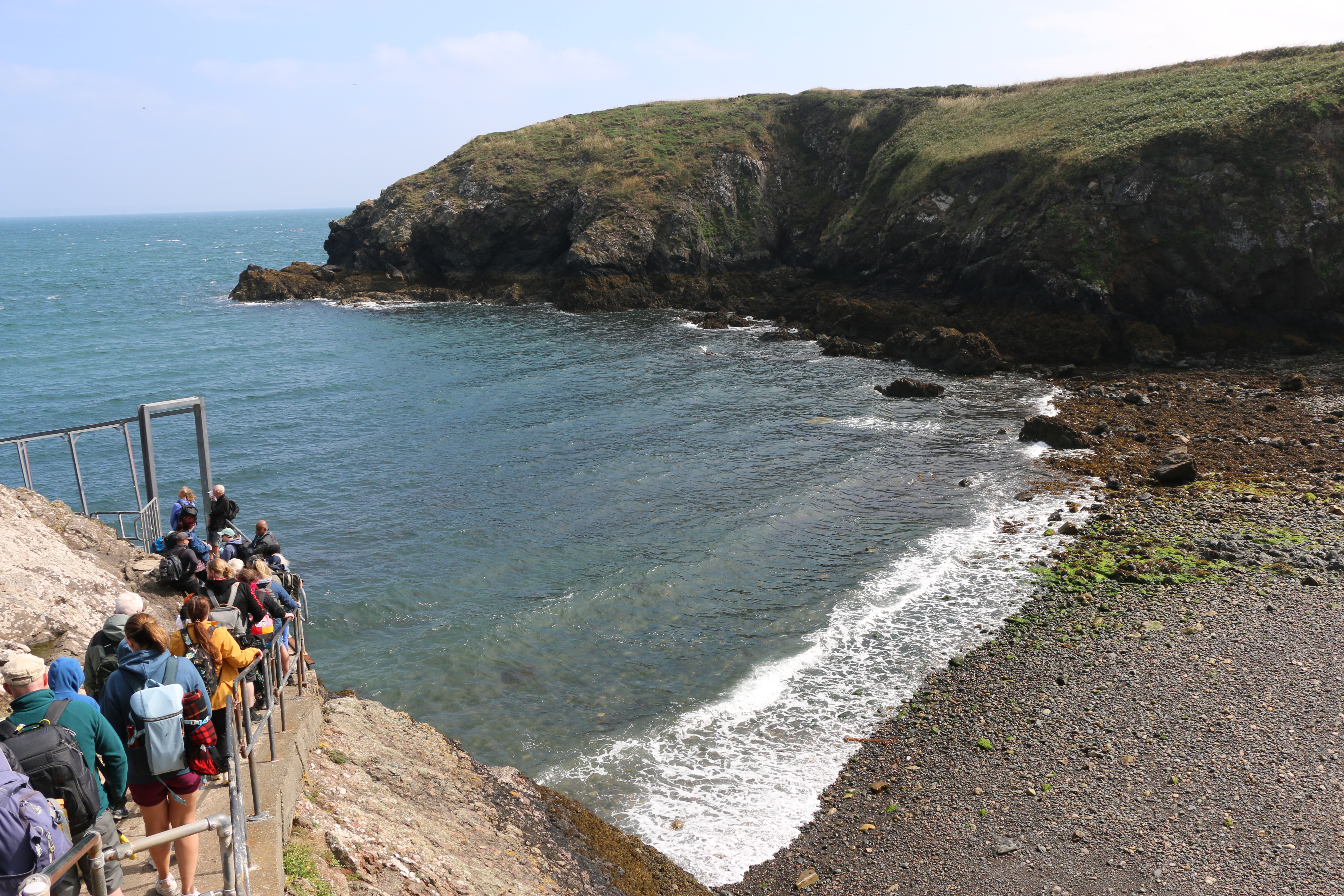
Arriving on Skomer

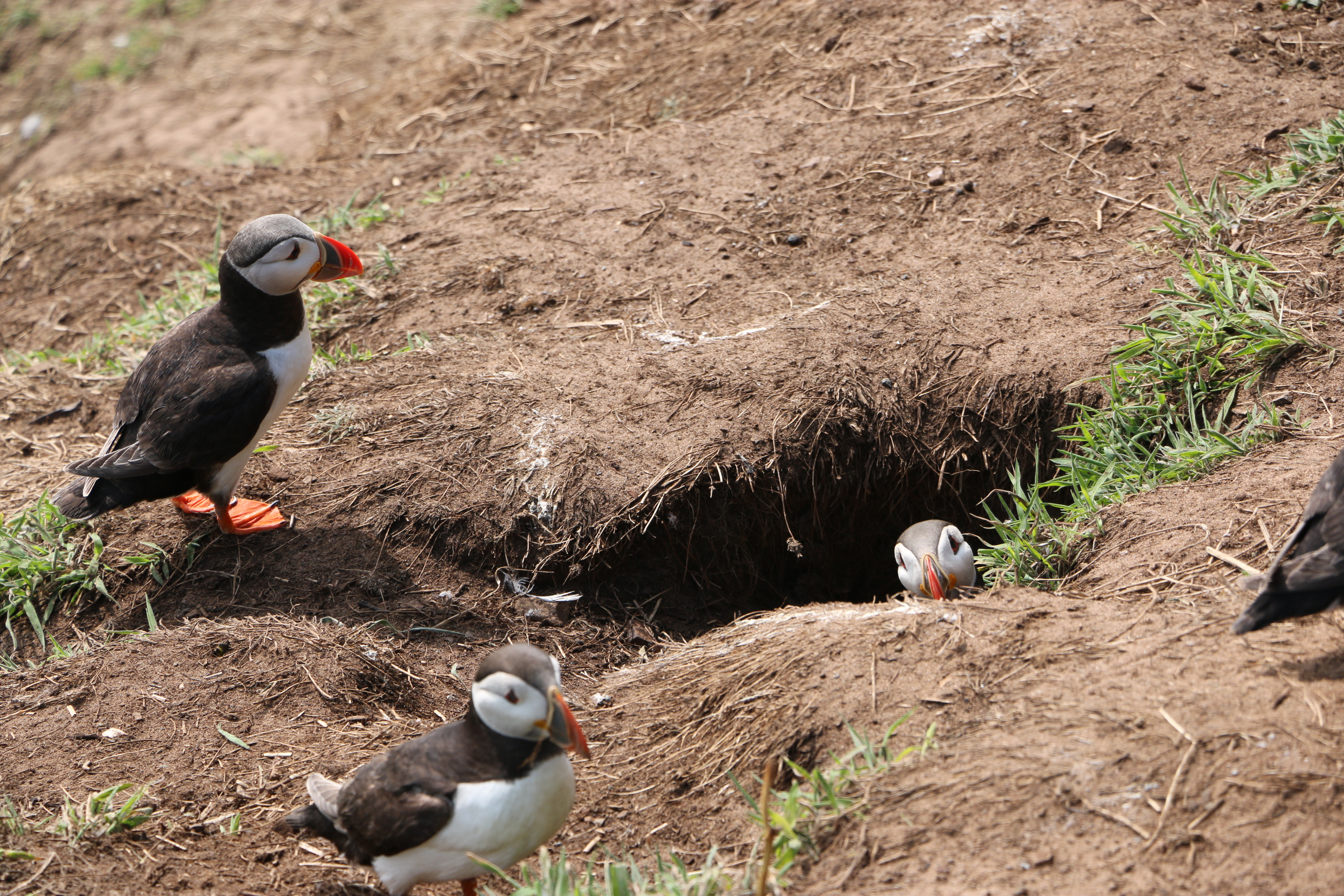
To be greeted by numerous curious puffins who seemed as interested in us as we were in them….

Skomer is internationally important for seabirds and, of course, there are necessary rules to protect the birds so we were told where and how we could walk the paths. One of the National Trust volunteers told us about the numerous species of birds on the island which included the Puffins – now in their last week before they leave the island – we were so lucky to see them.

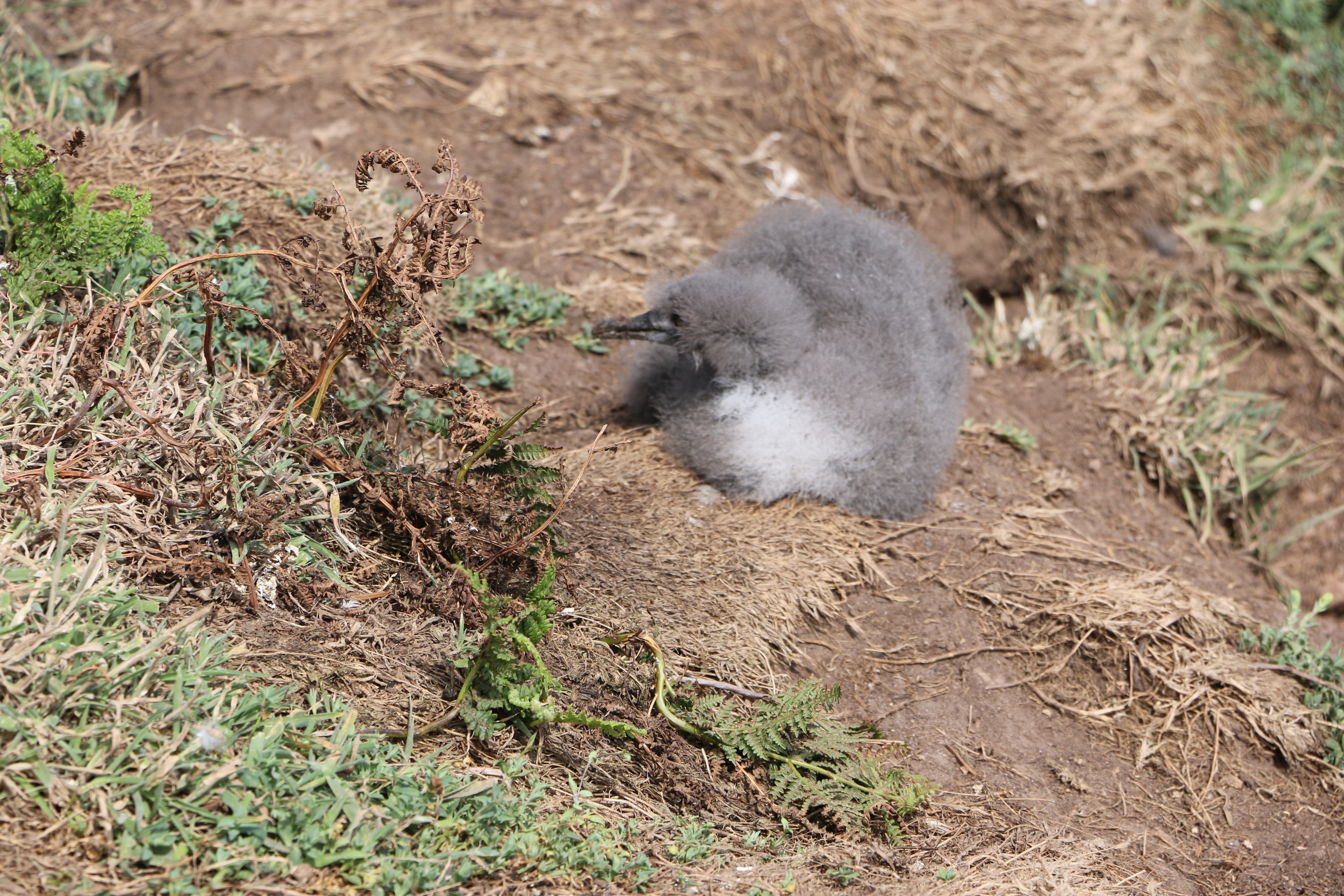
The colony of Manx Shearwaters is the largest colony in the world. Unfortunately we found quite a few remains of these on the narrow paths, apparently caught by the Great Black-backed Gulls. Later in the day we came across a crowd of people watching a Manx Shearwater chick which had wandered out of its ground nest. Seeing the amount of Gulls flying overhead, we hoped it managed to shuffle back to safety.

We weren’t lucky enough to see the Storm Petrels that are usually here on the island (they probably were but our binoculars were of slightly less quality than those hired out for five pounds by the National Trust). But we did see Guillemots, Razorbill, Kittiwakes, and so many of the ubiquitous Carrion Crows and Ravens

And at the Bird Hide, we watched Fulmars, Herring, Lesser and Great Black-backed Gulls as well as a pair of Canada Geese around the North Pond. (Well, I think they were Canada Geese, the Photographer said they were … ducks!) Huh!

Two watchful Kittiwakes

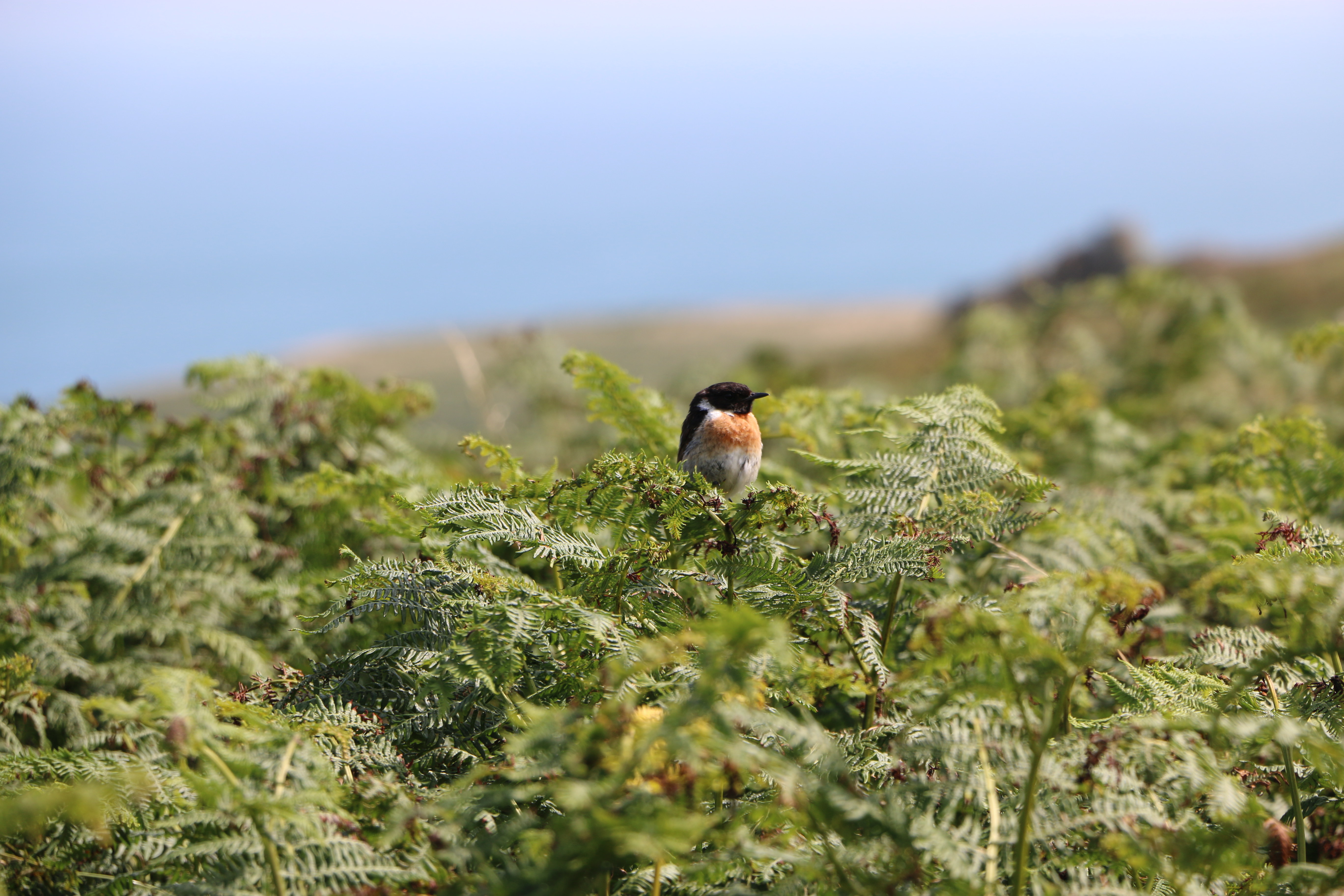
And, later in the day we were followed by a pair of these little birds – we think they were trying to lure us away from their nest.

We thought they were Stonechats – or Linnets – but maybe someone more knowledgeble will be able to correct us?

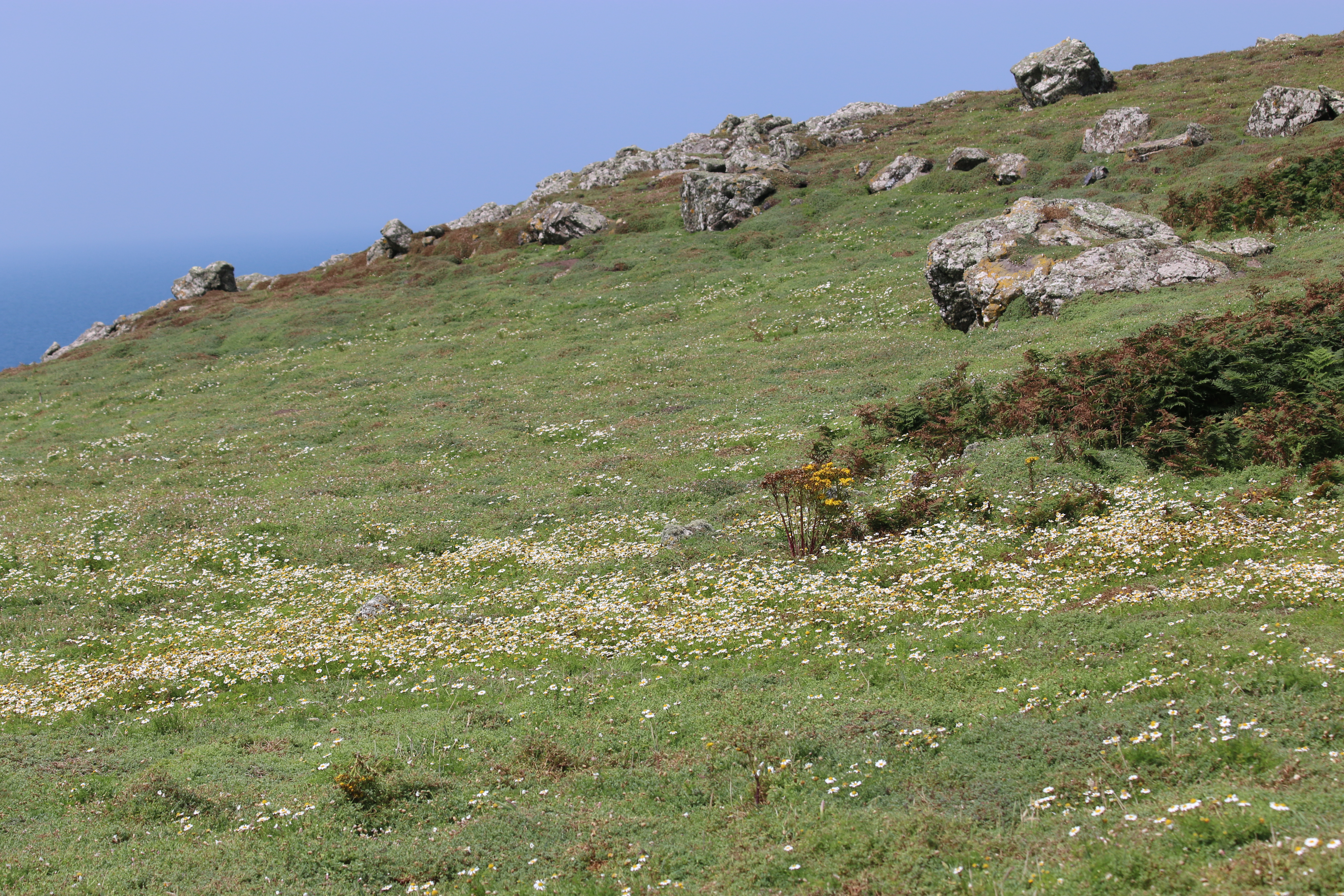
Some of the paths are so narrow they were designated one way paths – we were warned not to stand on the grass alongside in case there there were still Puffin burrows with chicks in them. Others are wider and surrounded by ferns, daisies, wild flowers … a treat to see.

We arrived at the old farmhouse where we stopped for our picnic.

History of the farmhouse:

There are unsubstantiated records of a house built in the centre of the island, thought to be around seventeen hundred on which are the ruins of the old farmhouse, itself dated from about 1840. This was once an impressive and substantial house, built in the traditional Pembrokeshire style with small slates fixed in mortar, protecting the front of the house. Early pictures show a metal veranda running the length of the house, and at the back of the building, an old smoking oven where fish and meats would have been preserved.
The slightly thicker soils in this part of the island and access to water in North Valley enabled a range of crops to be grown. There are records of the farm supporting three families at one time with cows and sheep grazing on the land as well as horses to help with the heavy work. Farming was largely abandoned after the outbreak of the First World War and all agriculture on the island finally ended in 1950.

And onwards to today:

In 1959 the Island was bought by the Nature Conservancy (the Government department that became the Countryside Council for Wales) helped by the West Wales Field Society (the charity that became the Wildlife Trust of South and West Wales). It was declared one of the country’s first National Nature Reserves and is now owned by National Trust and managed by the Wildlife Trust of South and West Wales.

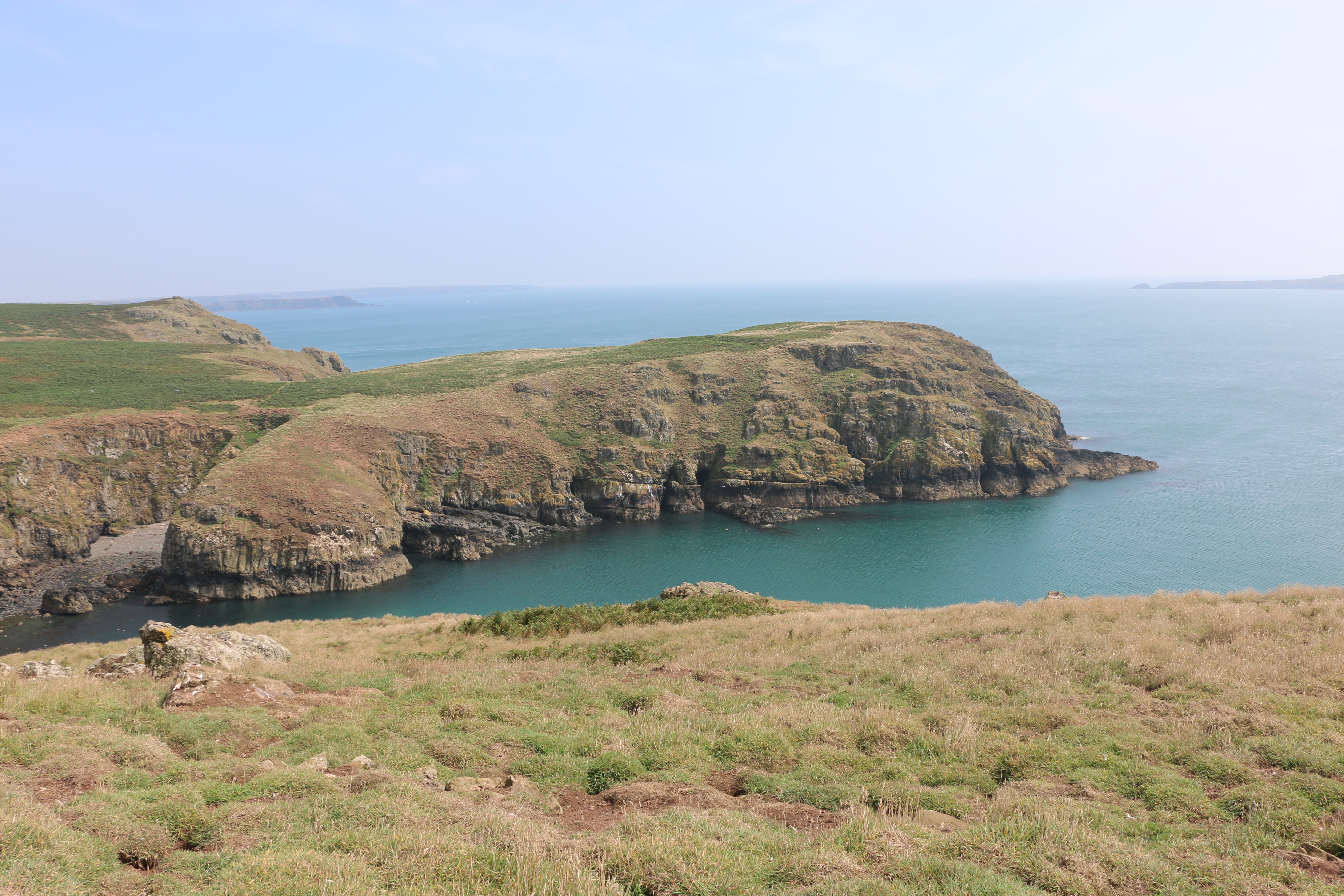
In the next part of our visit to Skomer we move on from the farmhouse to the magnificent coastline and impressive views.

The Winter of Discontent: The Background to Part Two of The Stranger in my House. #CreativeControl #Families

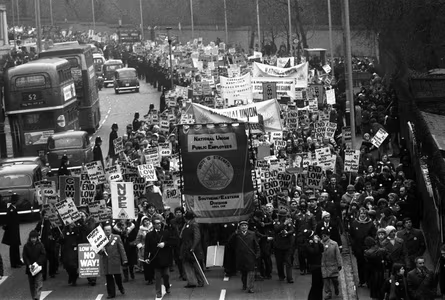
Part Two of The Stranger in my House is set against what is now called the Winter of Discontent – A term that comes from Shakespeare’s play Richard III, but it was used in an interview by the then Prime Minister James Callaghan and was taken up by the media. It lasted between November 1978 to February 1979 in the United Kingdom and, following opposition from the Trades Union Congress (TUC), took on the form of widespread strikes by both the private and public sector. Trade unions demandied pay rises greater than the limits Prime Minister, James Callaghan, and his Labour Party government imposed in an effort to control inflation.

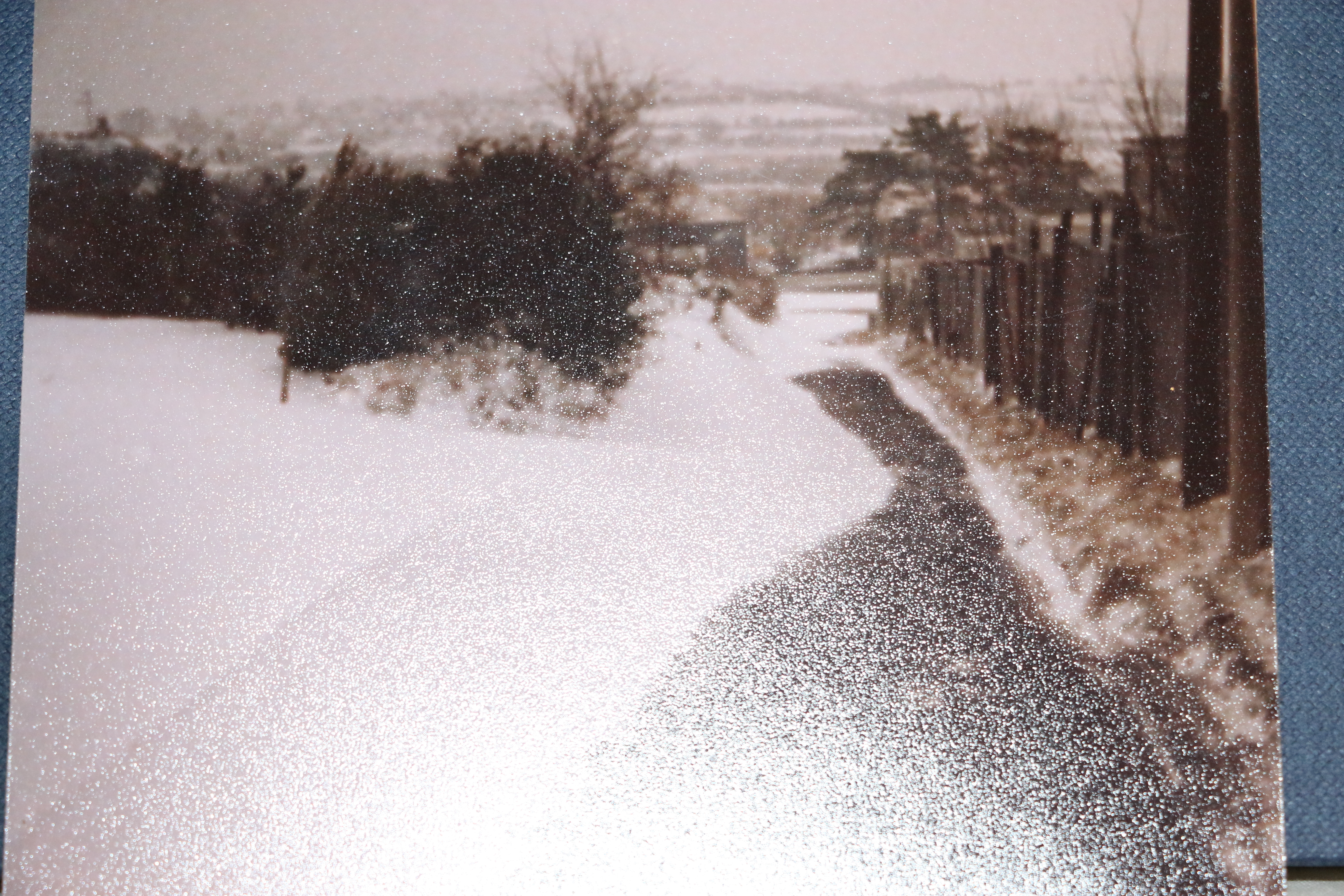
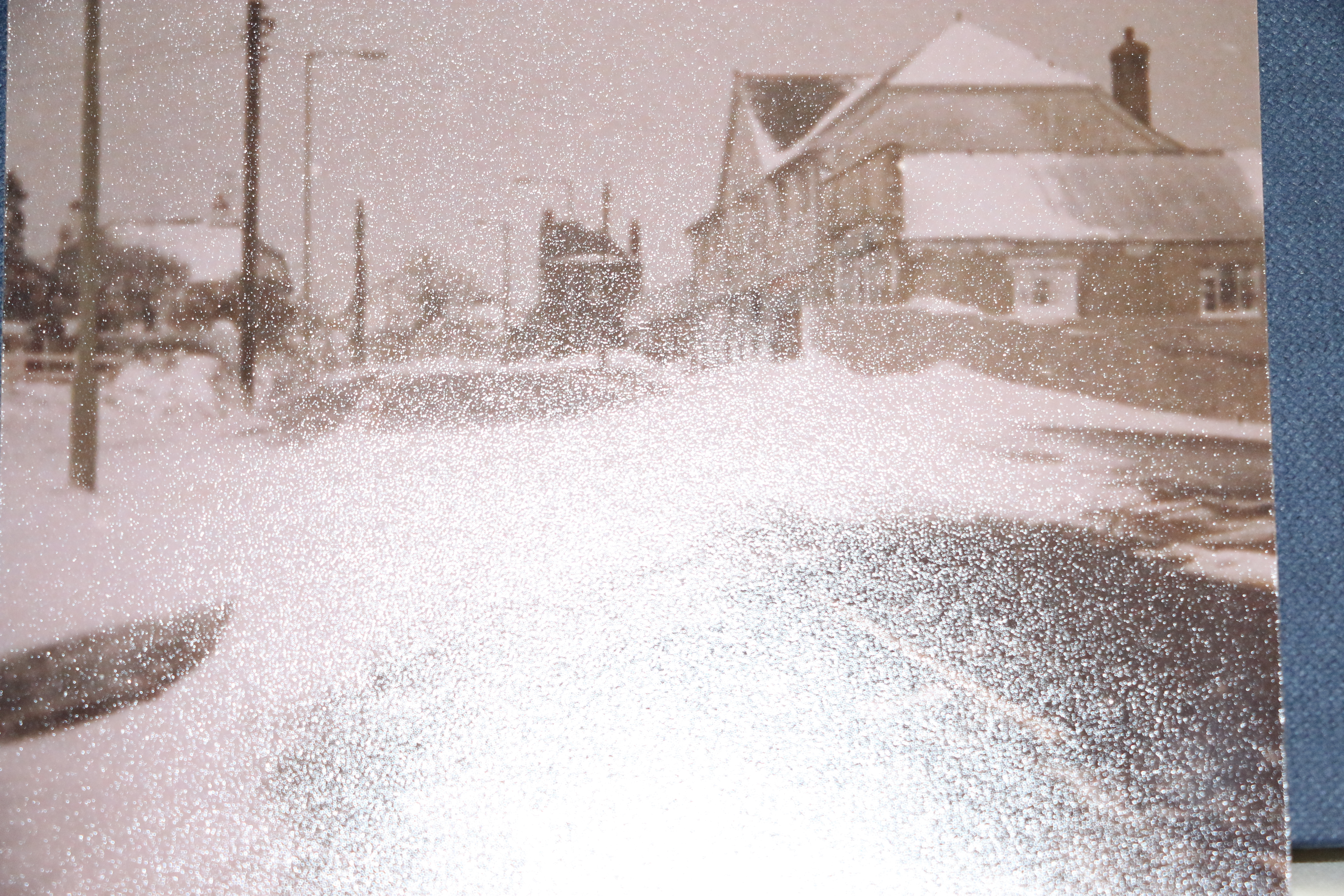
It was also the coldest winter in sixteen years. Heavy snowfall and freezing temperatures disrupted transport, businesses, and energy supplies.

In January 1979 (between the 1st and the 14th), some 20,000 railwaymen held four one-day strikes. There were strikes by haulage drivers, petrol tank drivers, and eventually municipal workers – 1,250,000 of them organised a one-day national strike on 22 January 1979.

The most notorious incident was the grave diggers’ strike on Merseyside, which hit the headlines with the press vilifying trade unions for their lack of sympathy with the bereaved, and, it was argued, with the needs of the nation.

But it was a strike by refuse collectors that came to symbolise the complete breakdown of UK public services. Local councils rapidly ran out of storage space as the binmen continued to strike, so rubbish was left in streets and open public spaces instead.

Photograph courtesy of The Guardian
Photo by Evening Standard/Hulton Archive/Getty Images)

A gripping ‘cuckoo in the nest’ domestic thriller

After the death of their mum, twins Chloe and Charlie are shocked when their dad introduces Lynne as their ‘new mummy’. Lynne, a district nurse, is trusted in the community, but the twins can see her kind smile doesn’t meet her eyes. In the months that follow they suffer the torment Lynne brings to their house as she stops at nothing in her need to be in control.

Betrayed, separated and alone, the twins struggle to build new lives as adults, but will they find happiness or repeat past mistakes? Will they discover Lynne’s secret plans for their father? Will they find each other in time?

The Stranger in My House is a gripping ‘cuckoo in the nest’ domestic thriller, exploring how coercive control can tear a family apart. Set in Yorkshire and Cardiff, from the 60s to the winter of discontent, The Stranger in My House dramatises both the cruelty and the love families hide behind closed doors.

“Judith Barrow’s greatest strength is her understanding of her characters and the times in which they live.” Terry Tyler

Grateful for this reader’s review. One of the first for The Stranger in my House, when it was published in November 2024.

Received the book today and finished it in the one sitting!

Judith Barrow’s done it again! The Stranger in My House is a book that showcases her renowned credentials. The characters are superbly drawn, the tension grows steadily and with each turn of the page your heart is gripped by the dilemmas facing the young protagonists, twins Charlie and Chloe, and their well-intentioned father. As with The Memory (shortlisted for Wales Book of the Year) it’s the way Barrow takes the ordinary and everyday, that we recognise and identify with, and skilfully uses her eye for human behaviour to turn it into something that becomes a nightmare we can readily believe in.
The story begins in 1967 and over the following decade the sense of time and place is expertly done without being intrusive. At the core of the tale is coercion and the reader can see how cleverly the others are being manipulated by the woman who undermines them and shatters their family bonds. My dislike for Lynne and her son Saul built with the book’s momentum. There was that fear that they would get away with unimaginable cruelty and malice. To counter that, were those whose innate love and kindness provided a heartwarming buffer.
From the start, I was gripped and that grip tightened inexorably. It’s becoming a cliché to say that you couldn’t put a book down – but I couldn’t. I had to know what was going to happen next. It mattered. That is the hallmark of a great author.

So You Want to Organise a Book Fair? #Books #Writers

PART TWO

So, to the practicalities …

You’ll definitely need a constitution for the official book fair bank account and if you’ll be looking for grants, sponsorship etc.

Get started early; you’ll need plenty of planning time. Work out the best time of year for your area by looking around, seeing what else is on at certain times. Is there any event happening on the date you’d like that might help or hinder footfall to your book fair? Is there a festival you could link up with? Or a similar event to yours which would take away your potential public? If the latter, don’t be inflexible, change your date.

Book your venue. You want somewhere that people will pass and enter easily. (Check for disability access and facilities). And check that there is somewhere outside of the building that you can hang a banner advertising the book fair on the day – or, at the least, somewhere that you can stand A boards outside without causing any obstruction

Thorne Moore and I on the morning of our last book fair and hoping this banner will attract enough attention for our last book fair at the. It did – well, alongside the rest of the publicity we’d put out there over the previous few months, it did.

If you intend to ask your authors to give talks, hold creative writing workshops, hold panels on various aspects of writing or genres, or invite publishers to put on an appearance for talks or editor sessions (always a good move and the authors will thank you!), make sure there are enough rooms. Most importantly, make sure the actual room/hall you’ll be holding the book fair in is large enough. You’ll need a fairly spacious area because you’ll be inviting lots of authors to participate… won’t you!?

Also check for the number of tables and chairs the venue has. And make sure you can get your hands on more tables if necessary. You don’t want to have more authors than tables

Find out if the venue has public liability insurance. If not you have two choices, stump up for it yourself (in which case you could be paying out a fortune) or ask the individual authors to take out their own – much the better option and a lot of writers have their own insurance anyway.

Lists, lists and more lists! Try to include as much detail as possible and when things need to be started or completed by. You won’t always hit the targets but you’ll know when they go whizzing by (a bit like that deadline you’ve set for yourself with your WIP). Know which of you is responsible for each task. But don’t forget to ask for or offer help from one another… you are a team working to one goal.

And that’s it! This is what worked for us. And, for anyone brave enough to organise a book fair – good luck.

Oh, and don’t forget – you’re entitled to a little of the publicity for yourself.

Judith Barrow Thorne Moore

On Being an Interviewer and Wanting to Organise a Book Fair?

Many years ago I was asked by a local online television company, Showboat TV to interview for a programme called BookSmart. In slight trepidation I agreed; I had no experience in interviewing anyone. But as an author and a creative writing tutor they obviously thought I would be able to talk to other writers about their books and the way they wrote.

I remember I had just the first two books of the Haworth trilogy published then …

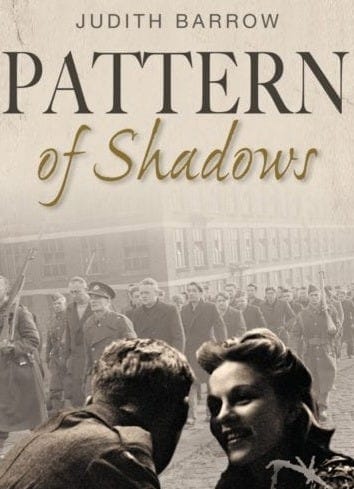
Pattern of Shadows

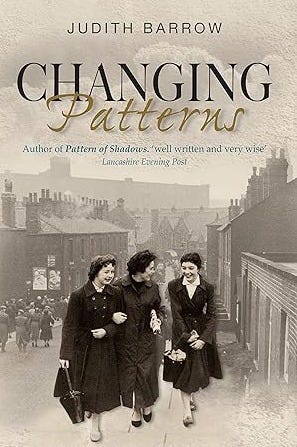
And the sequel: Changing Patterns

But ShowBoat TV had faith in me, and it’s been interesting – and fun. I’ve met many people, authors who live in Wales and authors from all over the world. At first it was filmed and shown through the internet; these days, when I interview, we work through Zoom. Which is what I did when interviewing Debbie Campbell last year, and lately Suzi Quatro. Need I say these were the highlights of my volunteering – and Showboat TV are promising more of this ilk for their viewers.

Viewers, whose numbers, may I say, have risen steadily over the years,because the company provides such a variety of programs. Besides BookSmart, there are interviews with musicians and performances of dramas produced by small companies. All accessible from the homepage, which contains all of the seven free series, with one episode following one each day.

But not only does the company cover all this, but they also travel around filming events, and, in the past, they filmed and were sponsors for the September annual book fairs that I helped to organise, initially with friends and fellow authors, Thorne Moore and Alex Martin – then in later years, when Alex moved away, just with Thorne.

It was hard work – and it began in the January of each year.

When embarking on this, the first thing you do is start with the obvious; find someone like-minded to help you with the organising of the whole affair. More importantly, someone who you know well enough to recognise you’ll be able to work together without egos getting in the way. (And, yes, I’m speaking from experience; enough said!) And someone with a sense of humour. Believe me, if you’re determined to hold a book fair, you’ll need one.

So, to the practicalities – but maybe that’s better left for next time…

My Review of Nine Lives by Terry Tyler #ShortStories #Review #Reading

Book Description:

Winner of ‘Best Short Story Collection’ in the 2014 eFestival of Words, “Nine Lives” comprises nine short dramas in the vein of Terry Tyler’s well-loved novels, some funny, some sad, with her usual unpredictable twists. The first chapter of full-length novel and tale of sibling rivalry, WHAT IT TAKES, is to be found at the end.

The stories:

Angel – The perfect wife of the perfect husband is tempted by the fruit of another.
Shut Up And Dance – Paul says he will love Laura whatever size she is. But will he?
Mia – The threat of ‘the other woman’…
Kiss Your Past Goodbye – Zoe finds out what happened to her first love, who broke her heart.
We All Fall Down – Two old friends meet for a drink – just a swift one, of course!
Bright Light Fright – A tale of vengeance, a burglary, and a nasty shock.
Mama Kin – Emma and Melanie have very different approaches to childcare – oh dear!
Don’t Get Mad – Get Even – Kevin and Marcus have been best friends

My Review:

At the moment I’m finding it difficult to concentrate on reading ( well on anything actually). But, having been a fan of Terry Tyler’s writing for a long time I was pleased to come across this collection of short stories. Not a clue why I haven’t found it before!

The one thing (well, not only the one thing – I could expound on this for ages) that I love about this author’s work is her ability to get inside each character’s head, whoever they are, whether a protagonist or the antagonist … or even a minor character. She brings them alive instantly and draws the reader into the story.

Each of these stories are short, but they pack a punch and made me think. There is always something beyond the words, the characters, the plot. I think it’s life – and the general affliction of humanity; whether it’s pride, or greed, or revenge- or whatever else that lies beneath the facade of what is called ‘real life’.

They may be short, they may be easy reads on the surface – but they dig dip and I loved them.

And the book was the winner of ‘Best Short Story Collection’ in the 2014 Festival of Words, which says everything.

So … highly recommended … to any reader.

Where We Walked – Glenashdale Waterfall and the Giant’s Graves, Arran, Scotland #Walks #Photographs #Viewpoints #Waterfalls #Legends #History

We’ve just returned from a wonderful couple of weeks on Arran. The photographer sourced the walks for us. Today he promises a short outing because it’s rather warm; “maybe a couple of hours allowing for stops… for Dusk, our borrowed border collie, of course”. (Oh, not for photographs then?).

We are going to one of the most famous waterfalls on Arran, Glenashdale Falls, and then on to see the Giants’ Graves.

We follow the directions from a rather old book of walks, which immediately adds a couple of miles on by sending us along a wide rather rough road, instead of going to the end of Whiting Bay and turning onto the forestry track.

Though I have to admit we passed some peaceful scenic views.

We were unable to follow the path through the forest to the Iron Fort due to the damage and fallen trees, caused by the latest storm on the island. So we continued along the wide track for another mile.

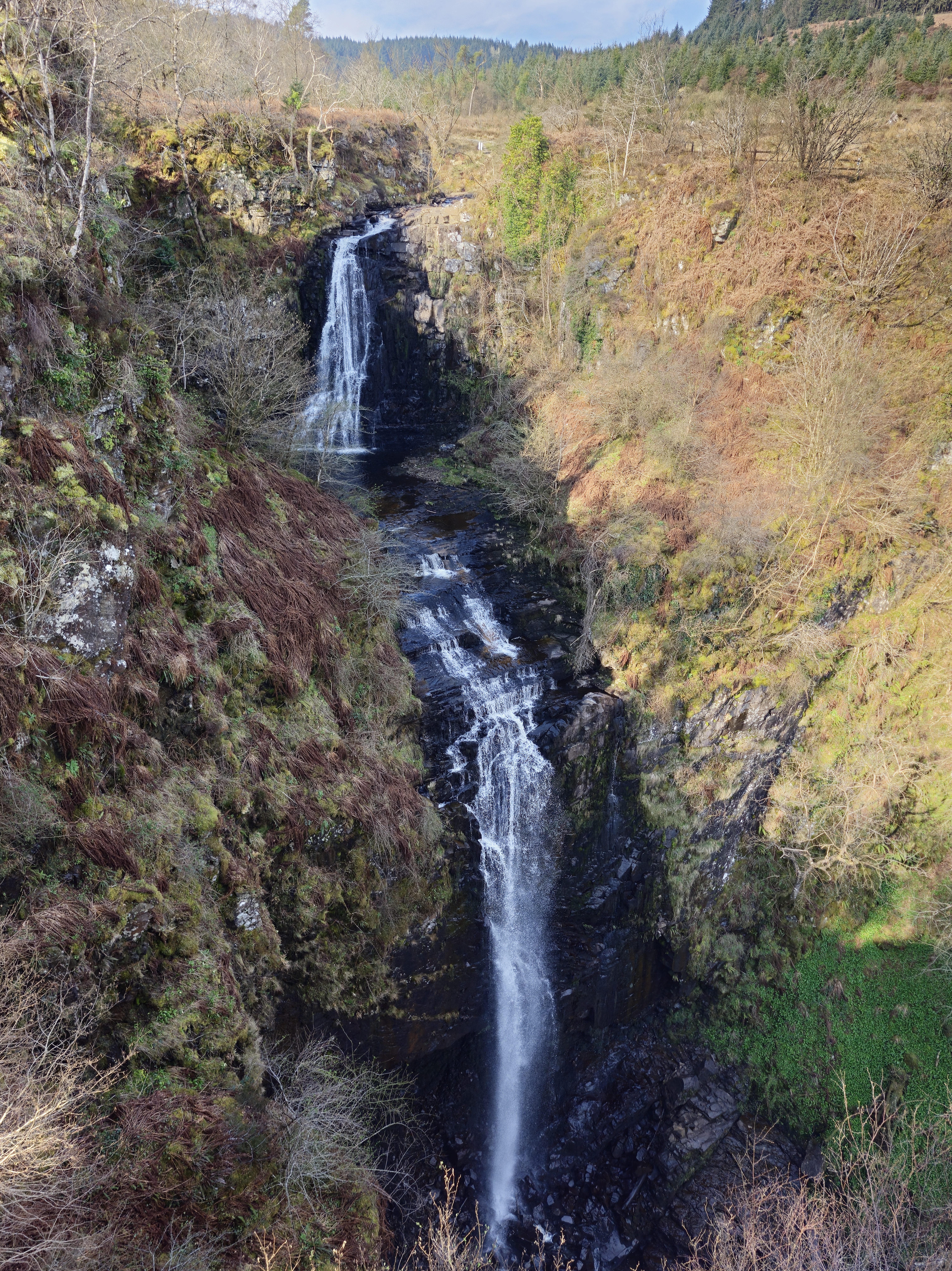
We reached Glenashdale Falls, also known as Eas a’ Chrannaig, one of a series of falls on the Glenashdale Burn, which flows from moorland near the summit of Tighvein eastwards towards Whiting Bay.

The viewing platform – not for anyone scared of heights

Not sure why I was encouraged to go along the viewing platform first. Thinking about it, my walking companions may have thought I was heavier than the two of them put together…

The sound of the rushing water competes with the breeze rustling through the trees around us. It’s a magnificent, awe inspiring place.

We retraced our steps from the waterfall and turned left, following a sign to the Giant’s Graves along the wide track … for another mile.

The Photographer trudges through tall grass to the edge of the cliff to take pictures. At one point he disappears completely. Dusk and I wait – patiently – he’s done this disappearing act many times in the past, just to get a good shot of somewhere.

When he returns we walk on, until a sign for a narrow path informs us we’re almost at the site of the Giants’ Graves.

The Giants’ Graves are the remains of two Neolithic chambered tombs on the Isle of Arran in Scotland on a ridge one hundred and twenty metres above the sea and overlooking Whiting Bay to the south. Mostly ruined, with turf covering part of the remains, they still have an air of mystery standing proud in a clearing in the forest.
The North cairn, excavated in 1902, has a chamber that is six metres long, and is around one metre wide. Among the artifacts recovered were pottery shards, flint knives, and leaf-shaped arrowheads.
The South Giant’s Grave has a chamber about four metres long, and over one metre wide. The initial excavations in 1902 only revealed soil and stones, but in 1961/2 more exploration produced nine shards of a round-based vessel, and fragments of burnt bone.

Legend has it that the giant referred to is Fionn mac Cumhaill, an early Irish war-leader, and his followers, known as the Fianna. Between the 10th and 14th centuries, his legend became widely known in Scotland. According to legend, Fionn and the Fianna had superhuman strength and size, being as much as 500 times larger than a man.

It’s getting late; we need to get back to Whiting Bay.

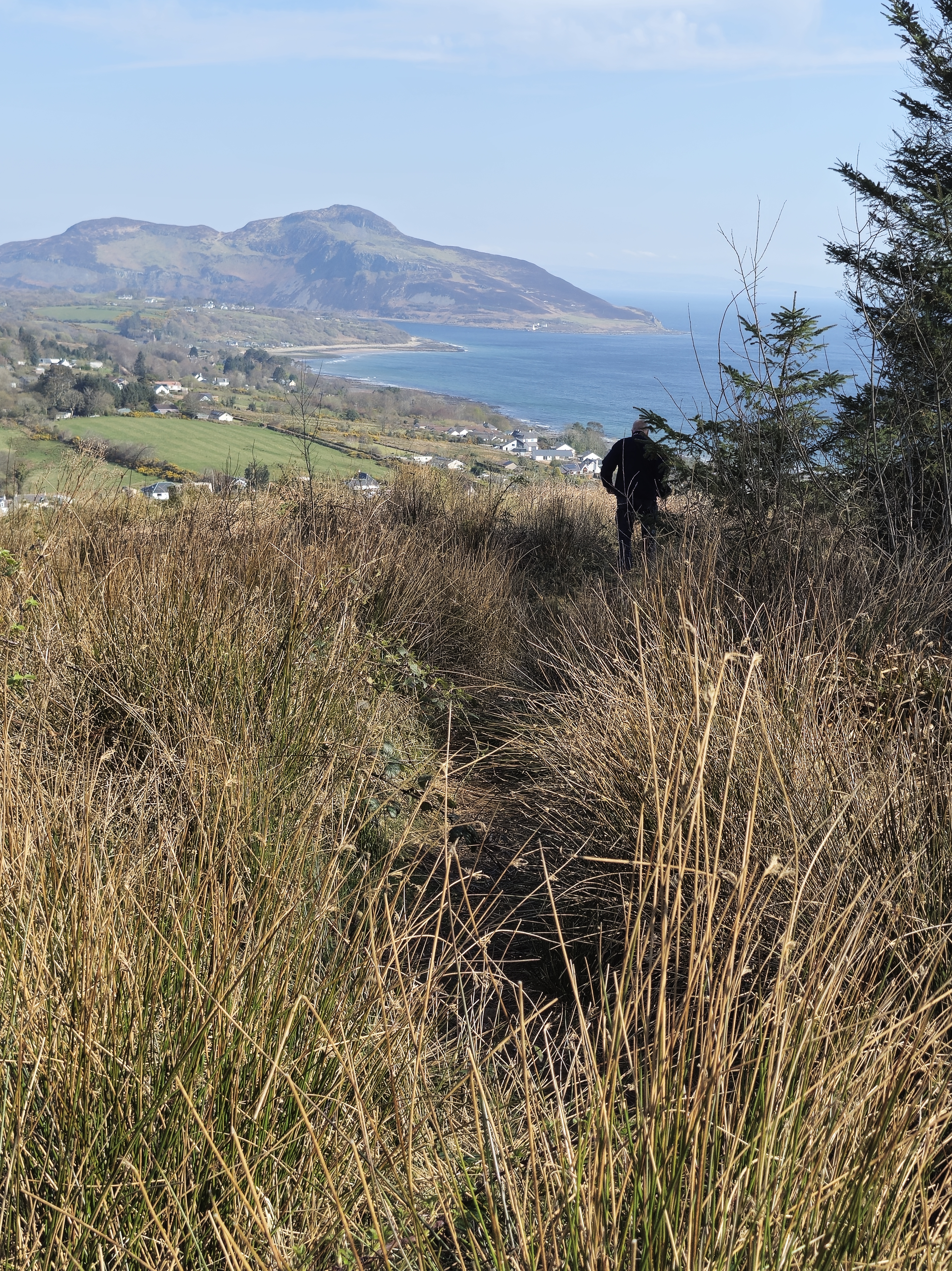
Beyond the graves the narrow path winds its way steeply down. And one of the rare times the Photographer catches me unawares for a photograph … from behind!

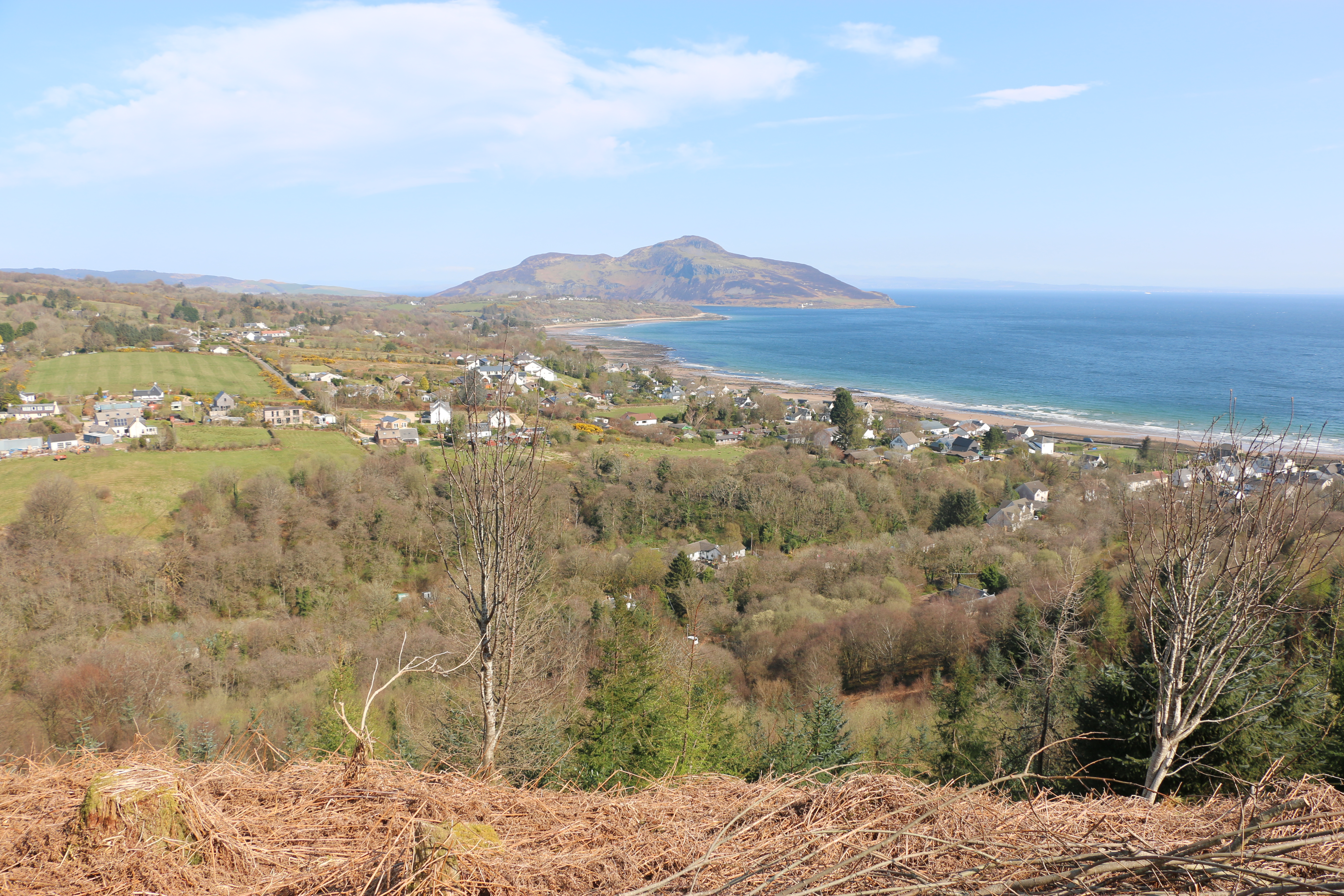
One last photo – Whiting Bay, with Holy Island in the distance.

The walk took us just a little more than the two hours that the more up-to-date directions we later discovered, so the following day we had a rest (using Dusk as our excuse again!) before our next adventure – a coastal trek as far as Kingscross Point, stopping to photograph the ruins of a viking fort and the views of Holy Island, before continuing back to Whiting Bay.

The Holy Island or Holy Isle is an island in the Firth of Clyde, off the west coast of central Scotland, inside Lamlash Bay on the larger Isle of Arran. The island is around three kilometres long and around one kilometre wide. Its highest point is the hill Mullach Mòr. There will be more about the Holy Island in our next post of walking on Arran.

And now a little self indulgent promotion…

A gripping ‘cuckoo in the nest’ domestic thriller

After the death of their mum, twins Chloe and Charlie are shocked when their dad introduces Lynne as their ‘new mummy’. Lynne, a district nurse, is trusted in the community, but the twins can see her kind smile doesn’t meet her eyes. In the months that follow they suffer the torment Lynne brings to their house as she stops at nothing in her need to be in control.

Betrayed, separated and alone, the twins struggle to build new lives as adults, but will they find happiness or repeat past mistakes? Will they discover Lynne’s secret plans for their father? Will they find each other in time?

The Stranger in My House is a gripping ‘cuckoo in the nest’ domestic thriller, exploring how coercive control can tear a family apart. Set in Yorkshire and Cardiff, from the 60s to the winter of discontent, The Stranger in My House dramatises both the cruelty and the love families hide behind closed doors.

“Judith Barrow’s greatest strength is her understanding of her characters and the times in which they live.” Terry Tyler

https://tinyurl.com/36m89w6t

Grateful for this reader’s review. One of the first for The Stranger in my House, when it was published in November 2024.

The Stranger in my House is an urgently compelling story of abusive power, detailing the damage that happens when those with the power to protect vulnerable children choose to turn their eyes away. Judith Barrow takes us into the dark & haunted world of coercive control, masterfully turning her own power as a storyteller on to this troubling theme, exploring it with insight & sensitivity.

In Lynne, the author has created a monster. Her victims, twin children Chloe & Charlie & their hapless father, are each portrayed with Judith Barrow’s usual precision & humanity; the writing as always, is impeccable.

It is a troubling book, but ultimately, on some level, redemptive. And although I found the ending satisfying & honest, I was nevertheless left with a sense of sadness, not only for Chloe & Charlie, but because decades on from the events in this book we still exist in a world where the emotional needs of children are too often subsumed by those of selfish, self-serving, abusive adults.
The Stranger in my House is a hugely important book & I highly recommend it.

https://tinyurl.com/36m89w6t

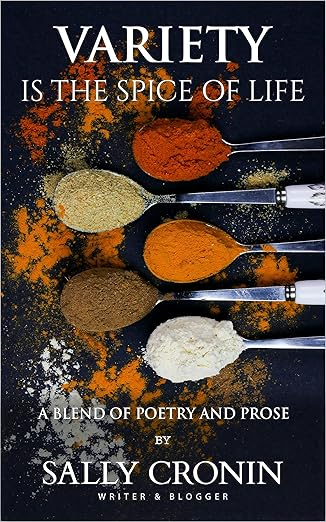
My Review of Variety is the Spice of Life: A blend of poetry and prose by Sally Cronin

Book Description:

Variety is the Spice of Life is a collection of poetry and short stories about relationships with others, including pets and animals inhabiting the world around us. The connection with others brings love and friendship, excitement and sometimes surprises, danger, mystery and sometimes the unexpected.

The poetry explores human nature, the fears, desires, expectations and achievements. Nature offers a wonderful opportunity to observe animals both domesticated and wild. Even in a back garden you can observe a wide variety of creatures and the daily challenges to survive a harsh environment.

The short stories introduces you to a healer whose gift comes with danger, a neighbour determined to protect a friend, a woman on the run, an old couple whose love has endured, an elderly retired teacher who faces a life changing accident, a secret that has been carried for over 70 years and a village who must unite as they face devastating news.

My Review:

I read Sally Cronin’s Variety is the Spice of Life quite a while ago, and recently when ‘tidying up’ my kindle I was surprised and somewhat dismayed to see I’d made notes on this lovely collection of poetry and prose that encompasses such a variety of themes – and not reviewed it.


So here I’m rectifying that.


The poetry at the start of the book is almost a study of the world around us. It’s an invitation to look once more at nature, however small and seemingly insignificant, and is portrayed through wonderfully insightful and sensitive words, so evocative that each piece evokes an image. I remember how, the first time I saw the poems, I read each of them out loud, relishing the sounds, the rhymes, the rhythms. And I would invite any reader to do the same – they come alive in that way, as does all good poetry. Sally has a way of capturing emotions and sensitively showing the uniqueness of the world around us – and the many layers in human nature.


The theme of the individuality, the variety of actions and reactions we are all capable of, is repeated over and over again in many subtle, and sometimes overt ways, throughout her prose. I was tempted to quote, to unpick each of the eight short stories, to describe the core, the main premise that runs through them. But, sticking to my decision not to reveal any spoilers in my reviews, I would just urge any potential reader to discover them for themselves. All reveal the writer’s natural gift for storytelling, of capturing the essence of characters and the world they inhabit. Some stories brought chuckles and a wry smile, others the feelings of sadness, of sharing fears and loss. And tears. Writing a short piece of prose is not an easy task; wrapping up a scene or a journey into a package that reveals a whole plot to the reader in so few words requires a special intuition on the part of the author. Sally Cronin shows she has a talent for such an understanding.


I can do no more, having given Variety is the Spice of Life a second reading, than to stress how much I recommend this offering from Sally. You won’t be disappointed.


A last word on the cover – a brilliant spicy image of the promising within!!

About the author

Sally Cronin is the author of eighteen books including her memoir Size Matters: Especially when you weigh 330lb first published in 2001 which followed her weight loss of 150lbs and the programme she designed to achieve a healthy weight and regain her health. A programme she shared with her clients over her 26 year career as a nutritional therapist and on her blog. This has been followed by another seventeen books both fiction and non-fiction including multi-genre collections of short stories and poetry.

Her latest book Size Always Matters is an extended and updated version of her original book Size Matters and now includes the nutritional element to losing weight and some recipes with ingredients that provide the nutrients necessary for healthy weight loss and continued good health.

As an author she understands how important it is to have support in marketing books and offers a number of FREE promotional opportunities in the Café and Bookstore on her blog and across her social media.

After leading a nomadic existence exploring the world, she now lives with her husband on the coast of Southern Ireland enjoying the seasonal fluctuations in the temperature of the rain.

Find Sally through the following links:

Smorgasbord Blog Magazine: https://tinyurl.com/5xskmavn

LinkedIn: https://tinyurl.com/3tn378xb

Facebook: https://www.facebook.com/sally.cronin

X: https://x.com/sgc58

With Many thanks to @DGKaye for this Review of The Stranger in my House

It’s Been an Odd Day…

 Today – Remembrance Day – has been a day when we paid homage to so many who gave their lives in past wars. A day that must have brought back memories for many. It has for me.

It’s eight years since my mother died. My sister arranged the funeral for eleven o’clock today. Eleven o’clock, on the eleven day of the year – perhaps no one else wanted that time or day – I was never told.

This is a post I wrote shortly afterwards. The relationship between Mum and me, and the one between her and my sister, proved so very different. There’s nothing wrong in that, but at no time was it more obvious than on that day…

I wrote… 

Last week I was at my mother’s funeral. I say at because I felt it was a funeral I was a spectator to, not part of.

During the service I realised something strange. Being the eldest, and living nearer to Mum than me,  my sister had insisted on organising the whole thing. It was a Humanist service which was fine; my mother had no beliefs.

But what was odd, was that what my sister had written about my mother was totally unlike the mum I knew. And I wonder if that is something all siblings share; a different view of the characters of their parents.

The mother my sister saw was a woman who liked poetry. So there were three poems in the service. I’ve never once seen my mother read poetry although she did like to misquote two lines from ‘ What is this life if, full of care…’

The mum I knew read and enjoyed what she herself called ‘trashy books.’ They weren’t, but she did love a romance and the odd ‘Northern-themed’ novels. (I’m always glad she was able to enjoy the first book of my trilogy – dementia had claimed her by the time the next two were published) She still managed a smiling grumble, though, telling me it had  taken me ‘long enough to get a book out there’) And she loved reading anything about the history of Yorkshire and Lancashire. Oh, and recipe books… she had dozens of recipe books and could pour over them for hours. I often challenged her to make something from them. She never did… it was a shared joke.

Mum had a beautiful singing voice in her younger days.  She and my father would sing duets together. Anybody remember Pearl Carr and Teddy Johnson?  My parents knew all their songs. And so did my sister and I… I thought. The songs and singers chosen were not ones I remembered. And Mum loved brass bands! She’d have loved to have gone out to a rousing piece from a brass band, preferably the local band. She loved everything about the area and the house she’d live in for almost sixty years

Which brings me to the main gist of the service. No mention of Mum’s love of nature, of gardening, of walking. Nothing about Mum’s sense of humour; often rude, always hilarious. When telling a tale she had no compunction about swearing if it fitted the story. And her ability to mimic, together with her timing, was impeccable. She was smart, walking as upright in her later years as she had when in the ATS as a young woman, during the Second World War. She worked hard all her life;  as a winder in a cotton mill, later as a carer, sometimes as a cleaner. Throughout the service there was no inkling of the proud Northern woman willing to turn her hand to any job as long as it paid. No mention of her as a loyal wife to a difficult man.

Thinking about it on the way home I realised that my sister had seen none of what I’d known and I knew nothing of what she’d seen in Mum. And then I thought, perhaps as we were such dissimilar daughters to her, Mum became a different mother to each of us? Hence the completely opposite funeral to the one I would have arranged for her.

Is that the answer? A funeral is a public service. Are they all edited, eased into the acceptable, the correct way to be presented for public consumption? Because it reflects on those left behind? I don’t know.

Perhaps, unless we’ve had the foresight to set out the plan for our own funerals, this will  always be the case.

So I’d like it on record that, at my funeral,  I’d like Unforgettable by Nat King Cole (modest as always!), a reading of Jenny Joseph’s When I Am Old (yes, I do know it’s been performed to death but won’t that be appropriate?). I’d like anybody who wants to say anything…yes anything…about me to be able to…as long as it’s true, of course! And then I’d like the curtains closed on me to Swan Lake’Dance of the Little Swans. (Because this was the first record bought for me by my favourite aunt when I was ten. And because, although as a child I dreamt of being a ballet dancer, the actual size and shape of me has since prevented it.)

Thank you for reading this. I do hope I haven’t offended (or, even worse, bored) anyone. I was tempted to put this under the category ‘Fantasy’ but thought better of it!

And, today, I’ve also had thoughts of my grandad. Like do many young men he served in WW1

This is a post from quite a while ago, as well. Today was the day my grandad died. I never really knew him. He was always in bed in the front room of my grandmother’s house and had no patience for a small child. But I do remember that day: my mother crying, the fear of not knowing why, what had happened. Of not knowing what to do.

And I have only one small black and white photograph of him on my study wall. He’s standing in the backyard of the terraced house they lived in in Oldham. Lancashire. This is a poem I wrote about him a long time ago. My mother once told me that he was gassed in WW1 and never recovered.

My Grandad

I look at the photograph.

He smiles,and silently

he tells me

his story…

In my backyard I stand,

Hands wrapped around a mug of tea.

Shirt sleeves, rolled back,

Reveal tattoos – slack muscles.

I grin.

All teeth.

Who cares that they’re more black

Than white.

Underneath

That’s my life.

That’s the grin I learned

When burned

By poison

Spreading

Like wild garlic.

That’s the grin I wear

When I look

But don’t see

The dark oil glistening,

Blistering, inside me.

When I hear, but don’t listen

To my lungs closing.

I posture,

Braces fastened for the photo,

Chest puffed out.

Nothing touches me –

Now.

Later I cough my guts up –

Chuck up.

I trod on corpses: dead horses,

Blown up in a field

Where grass had yielded

To strong yellow nashers.

And in the pastures

I shat myself.

But smelled no worse

Than my mate, Henry, next to me

Whose head grinned down from the parapet –

Ten yards away.

He has perfect, white teeth.

Much good they’ve done him,

Except for that last night at home

When the girl smiled back.

It feels right that I post the images below – if it wasn’t for my mother and grandad, I probably wouldn’t have had the inspiration to write these books.
Grateful for this promotion and review of my next book from Sally Cronin of Smorgasbord